How Podyjí National Park Collects Grass Seeds to Restore the Natural Look of Its Steppes
USD 21,23
Popular
At Podyjí National Park in Czechia, conservationists are restoring rare steppe and meadow habitats through what's known as "conservation seed farming" — collecting and sowing seeds from native plants. According to the park administration, the method is used mainly in areas once overrun by invasive black locust (false acacia), as well as in the fight against other alien species such as tree of heaven, Japanese knotweed and common broom.
Once the locust trees are cut down, the ground left behind is often bare, and for decades it tends to be dominated by wood small-reed, brambles or greater celandine — plants that block the return of species typical to the region. Actively sowing collected seeds helps speed up the recovery of natural plant communities and prevents the locust from sprouting again from the soil's seed bank.
Seeds are gathered from "donor" sites — steppe fallows, dry meadows and old orchards near the villages of Havraníky, Popice and Hradiště. Specialists try to source material as close as possible to the future planting sites, to preserve the local genetic origin and keep growing conditions similar. Collection runs from April to September: early grasses are gathered as soon as April-May, the main grass season falls in June, and wildflowers are collected until the end of September. Yields depend heavily on the weather — while 2025 brought a good seed harvest, this summer many donor sites suffered from the first wave of summer heat.
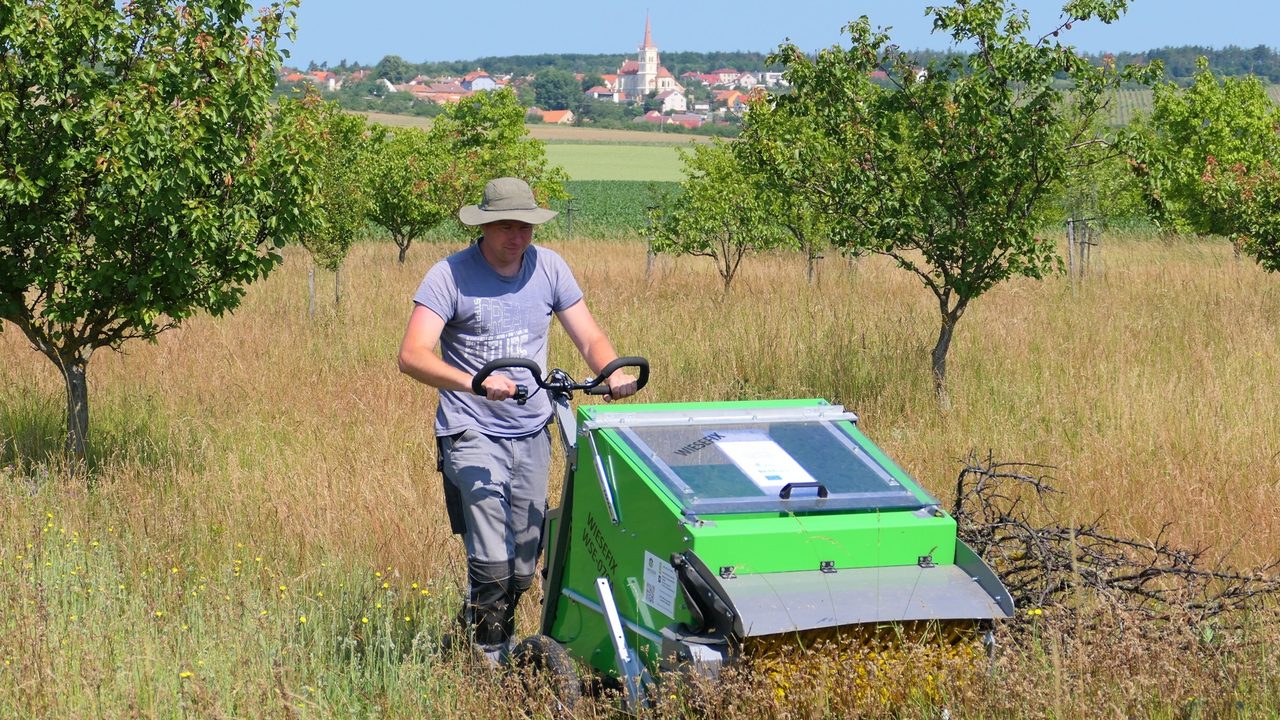
Collection methods range from manual harvesting to mechanized brush harvesters, including portable devices built on brush-cutter frames. Among grasses, fescue and meadow-grass are most commonly collected this way, sometimes oats and feather grass too; by hand, though, almost any species can be gathered, including rare plants like globe thistle, field scabious, cornflowers, pinks and others. The harvested material is first transported in paper bags, then spread out on fine sieves and dried for several weeks in a well-ventilated space shielded from sun and moisture — in the park, an old hayloft has been repurposed for this.
Special care is taken to avoid transferring invertebrates or the seeds of weeds and invasive plants to new sites along with the desired seeds — before moving the material, it is carefully shaken back out into the vegetation, and the brush harvesters are thoroughly cleaned with an industrial vacuum cleaner.
The trickiest stage is preparing the sites for sowing: specialists stress that seeds are only sown on well-prepared, weed-free bare soil — much like preparing a bed for vegetables. As part of the BESTbelt project, some sites had not only the locust trees removed after felling, but also the thick layer of humus typical of locust groves, cleared away with excavators. The best time for sowing is autumn, when moisture levels are higher and the seeds have a chance to undergo natural stratification over winter.
The work doesn't end once sowing is done: throughout the season, specialists monitor how the new grass cover develops, fight off locust and bramble regrowth, and by season's end decide whether the area needs mowing. Some sites use extensive grazing by sheep and horses, though in the early growth phase, intensive trampling is generally avoided.
Park specialists describe it as a labor-intensive, multi-year process: each year, only a few dozen ares can be greened this way, so the method is applied selectively rather than on a large scale. The goal is to create at least "islands" of grasses and flowers typical of the region on former locust-covered ground, from which seeds can gradually spread to the surrounding land. The project to restore meadow biodiversity on former locust plantations in Podyjí National Park is carried out with financial support from the European BESTbelt programme.
Source: ekolist.cz