Hiring Welders via a Subcontractor in Germany: 6 Questions
Popular
The manager of an installation site has four days and six open welder positions. He sends a request to a dozen companies. By the evening of the next day there are forty offers in his inbox. They read almost the same. Experienced specialists, valid certificates, start within a week, full legal support. There is nothing to choose from precisely because there is nothing to choose by.
Why the market looks the way it does
The entry barrier to this business is almost zero. To start offering staff for industrial sites in Germany, it is enough to register a company, order a website and collect the phone numbers of a few foremen. All the expensive part of the work is invisible at the negotiation stage. Checking qualifications, the legal structure of the contract, accommodation, transport, a reserve of people in case of illness. All of this costs money, but none of it can be shown in a commercial offer in a way that lets the client feel the difference.
What is easy to show is everything that makes no difference. Photos of beautiful welds. A line about twenty years of experience that may stand for the experience of one person in a three-person company. A list of industries the company "works in", although in fact it completed a single project there the year before last.
As a result, a conscientious contractor and a reseller of contacts look exactly the same until the day the crew arrives on site. And by then it is too late.
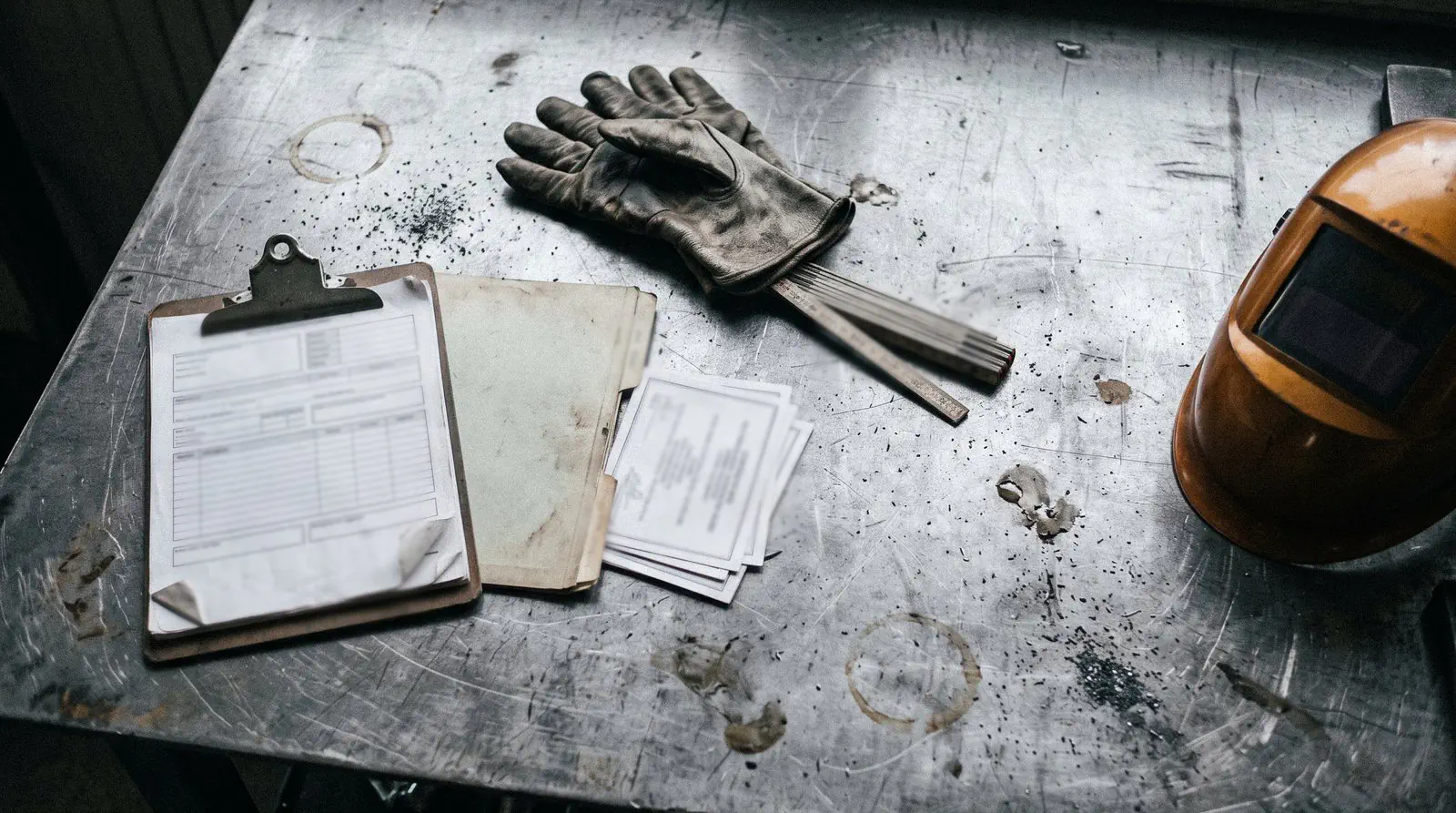
Documents for the specific people are requested before the contract is signed, not on the first day on site.
Three places where things usually break
The certificate exists, but it is not for your job. A welding qualification under ISO 9606 is not universal. It applies to a specific process, material group, welding position, and range of thicknesses and diameters. A welder with a valid qualification for MAG on unalloyed steel in the flat position is formally a certified specialist. On stainless pipe in the overhead position he will not help you, and requalification takes time you do not have.
A supplier who does not raise this himself either does not understand it or is counting on you not to ask. Both options are bad. It is the same with electrical work. Panel assembly, laying cable routes, authorization to work on live installations and holding a VDE certificate are different things, which offers often merge into one word: "electrician".
They showed you some people, others arrived. During negotiations you are shown the profiles of specific workers. A different crew turns up on site, because those people were moved to a more lucrative project or never existed in the first place. There is one way to check this. Ask for documents on the specific people before signing the contract, not after. If the contractor calmly sends copies of the qualifications, the A1 form and proof of insurance in advance, he works with his own staff. If the documents "will be on site on the first day", most likely they are still looking for the people.
A contract for work on paper, labor leasing on site. This is the most expensive mistake, and it is mostly the client who pays for it. Werkvertrag and Arbeitnehmerüberlassung are two different structures with different obligations. Under a contract for work, the contractor is responsible for the result, organizes the process and manages his own people. With labor leasing, the client directs the workers, and the supplier must hold a license under the AÜG.
The problem starts when the contract says one thing and something else happens on site. If your site manager assigns someone else's workers to tasks every morning, keeps their timesheets and decides who does what, then in fact this is labor leasing, whatever the document is called. In an inspection such an arrangement is classified as a Scheinwerkvertrag, a sham contract for work. The consequences fall on both sides, and for the client this means the risk of an employment relationship with someone else's workers being recognized, plus additional social security contributions.
Next to it sits another risk that is remembered less often. Under German law, the client is liable for the subcontractor paying its people the statutory minimum. If the subcontractor fails to do so, the workers' claims can be brought against the client. That is why proof of MiLoG compliance is not a formality for the file but protection of your budget.
A serious contractor raises this topic himself, at the first meeting, and brings a ready structure. His own foreman on site, who receives the task from your project manager and then distributes the work within the crew. Acceptance against a protocol. Working time recorded by the contractor. If the conversation about the contract structure starts only when you start it, that in itself is an answer.

Under a contract for work, the crew gets its tasks from its own foreman. If the client's site manager does it, the arrangement stops being a contract for work.
Six questions to ask before signing
They do not require a law degree. They simply show how deeply the other side understands its own work.
- Which process, material, welding position and thickness range does the qualification of a specific welder cover? A good answer contains numbers and a promise to send the document. A bad one sounds like "all our welders are certified".
- Who gives instructions on site, and what happens if my site manager gives a task directly to your worker? The answer will show whether they understand the difference between a contract for work and labor leasing.
- What happens on day three if someone falls ill? You need a replacement deadline, a source of the replacement and an answer to who pays for the downtime. If you hear "we will figure something out", there is no reserve.
- Which documents will I receive before work starts? The expected minimum is an A1 for every worker, MiLoG confirmation and insurance. For construction work, add the exemption certificate under § 48b EStG, without which the client must withhold part of the invoice amount and pay it to the tax office.
- How is the work invoiced? Payment by hours worked and payment by accepted volume belong to different contract models. If the contract is for work but the invoice follows a timesheet, the arrangement contradicts itself.
- Who will I talk to every day, and in what language? A crew without a person who understands instructions the first time turns every small thing into three days of correspondence.
What tells you more about a contractor than a presentation
Willingness to say no. A supplier who answers "yes, we can do it" to any request has either not understood the task or will take it on and solve the problems at your expense. The sentence "this one we will not cover, it needs a different profile" is worth more than any client list.
Questions from their side. If after you describe the project nobody asks about the material, thicknesses, acceptance standards, shift pattern, equipment on site and safety requirements, the offer will be written at random.
The structure of the price. A rate whose composition you cannot see usually hides the fact that something is missing from it. Accommodation, transport, tools, protective equipment and social contributions will be paid by someone anyway. If not by the contractor inside the rate, then by you, later and separately.
Why the cheap offer is cheap
The difference in rate between a careful contractor and a random one usually does not look dramatic. A few euros an hour. For a crew of eight people over a month that adds up to a noticeable sum, and the temptation is understandable.
But the saving is not in the margin. It is in what was not done. Qualifications were not checked. Accommodation was not arranged, and people live forty minutes from the site. No reserve is kept, and with the first sick day the crew works short-handed. Documents were not prepared in advance, and the first day went on paperwork.
This should be counted not in the rate but in days of downtime and rework. One missed handover deadline usually eats up the entire saving of several months.
In short
A good contractor is distinguished not by what he promises but by how concretely he answers uncomfortable questions and how calmly he says "no". This can be checked in a single conversation if you know what to ask.
Among the companies that build their work on this logic in the German market is LKD Arbeit & Service. Since 2021 the firm has been staffing industrial, installation and construction projects in Germany, works on the basis of contracts for work and services with its own foreman on site, hands the client the A1, MiLoG confirmation and insurance documents before work starts, and publishes its hourly rates openly together with a list of what they include. An open price list is not a guarantee of quality in itself. But it makes possible exactly the conversation about price structure without which comparing offers is pointless.
Prepared with the participation of specialists from LKD Arbeit & Service, lkd-arbeit.de
Comments (0)
Please be polite. Spam and insults will be removed.