Czech geologists find oldest evidence of continental drift, dating back 2.7 billion years
USD 21,04
Popular
Scientists from Charles University in Prague have discovered the world's oldest evidence of horizontal tectonic plate movement in Canada: a curved mountain belt roughly 2.7 billion years old, formed by the collision of lithospheric blocks. The finding was reported by Ekolist.cz, citing research led by Professor Jiří Žák from the Faculty of Science at Charles University.
The Earth's surface is in constant, if imperceptible, motion — the lithosphere is broken into plates that, over hundreds of millions of years, collide, override one another and sink back into the mantle. This process, known as plate tectonics, is responsible for the formation of volcanoes, earthquakes, mountains and oceans. The theory of plate tectonics became established in science in the 1960s, sparking a revolution in geology comparable to the impact of Darwin's theory of evolution on biology.
Yet scientists still disagree on exactly when plate tectonics first began operating — estimates range from more than 4 billion years ago to as recently as around 800 million years ago. The problem is that rocks older than 2–3 billion years, which could preserve traces of these processes, are extremely rare and have been heavily reworked by subsequent tectonic activity.
One of the strongest proofs of horizontal plate movement comes from so-called orocline structures — mountain belts bent into a U-shape as a result of rotation around a vertical axis during plate collisions. Unlike other geological formations, an orocline cannot be explained by the purely vertical crustal movements typical of the planet's early history — its existence is direct evidence that plate tectonics was already at work.
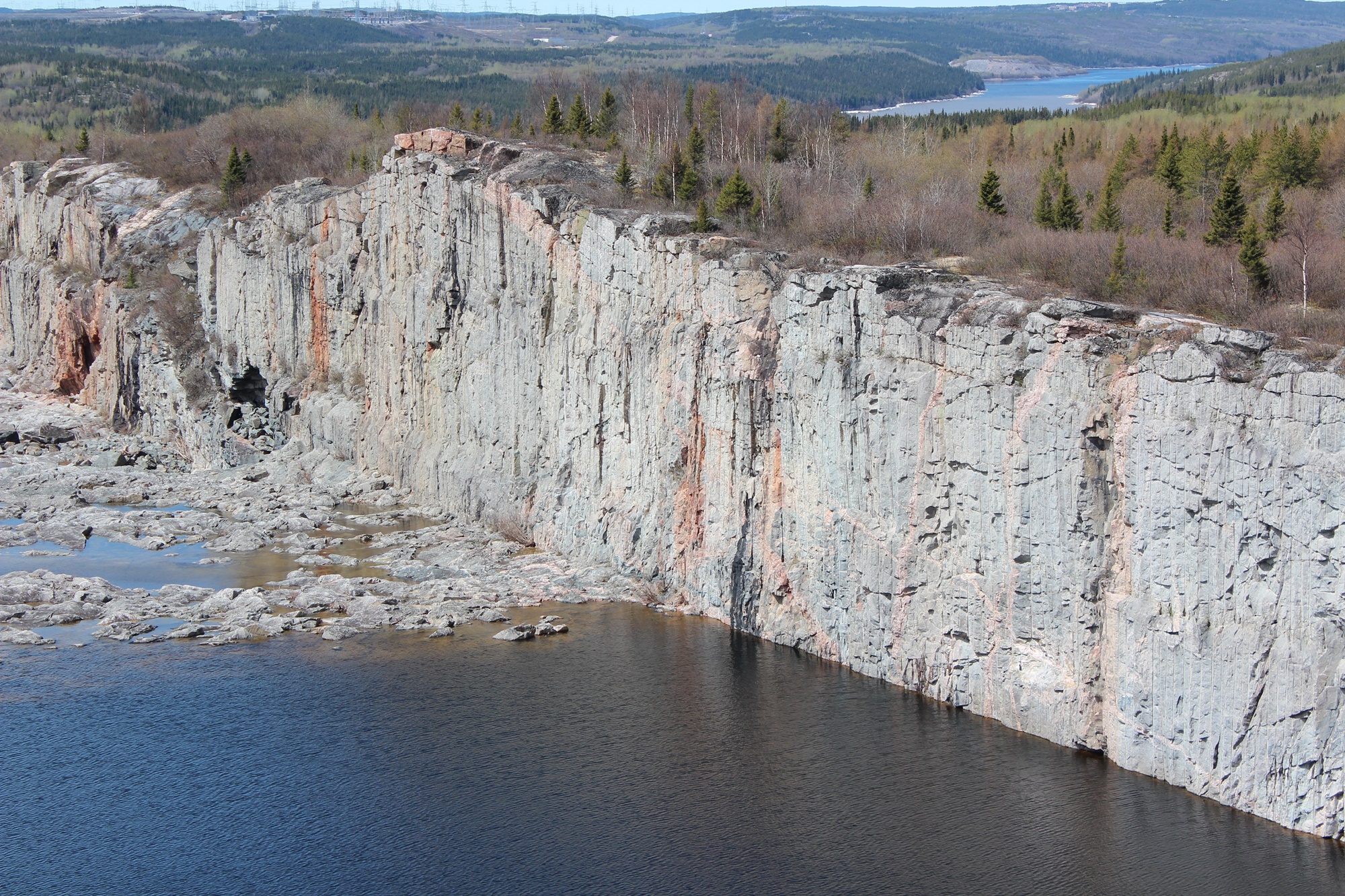
Professor Žák's team studied the so-called Superior Province in Canada's Quebec — the largest surviving fragment of Archean crust on the planet, covering an area roughly half the size of Europe. The oldest rocks here date back as far as 4.2 billion years, though such finds are exceedingly rare; most of the region is made up of rocks between 3 and 2.6 billion years old.
The researchers carried out structural geological mapping and analyzed the magnetic properties of the rocks alongside age data collected by the team between 2021 and 2025. The results showed that the region's mountain belts gradually bent and folded around a vertical axis approximately 2.68–2.66 billion years ago.
The entire process took about 20 million years, during which the rocks shifted by at least 540 kilometers, and the belt's original length shrank by 44%. The estimated rate of plate movement was around 2.9 centimeters per year — comparable to the speed at which modern tectonic plates move today. The orocline formed as oceanic basins subducted and large lithospheric blocks subsequently collided during the assembly of the ancient supercontinent Superia. By comparison, Earth's most recent supercontinent, Pangaea, began breaking apart roughly 200–180 million years ago.
Previously known Precambrian oroclines are extremely rare — the only confirmed example comes from Scandinavia and is about 1.87 billion years old. The newly discovered structure in the Superior Province is nearly 800 million years older, making it the oldest orocline ever found on Earth. This means that plate tectonics involving large-scale horizontal movements over hundreds and even thousands of kilometers was already active on our planet at least 2.7 billion years ago.
The study also involved specialists from the Institute of Geology of the Czech Academy of Sciences and the Czech Geological Survey. Fieldwork was conducted in the subarctic James Bay area of Quebec, while laboratory analyses were carried out at the Rock Magnetism Laboratory of the Faculty of Science at Charles University in Prague. The project received support from the Czech Science Foundation and Charles University's Cooperatio program, with Professor Žák completing part of the research thanks to a Fulbright Commission fellowship during a research stay at the University of Minnesota in the USA.
Read also: Thermal resorts and spas in Czechia: 11 places for relaxation and wellness
Source: ekolist.cz