USD 21,08
Popular
A dangerous ash pest — the emerald ash borer (Agrilus planipennis) — has been caught on EU territory for the first time. On 9 June 2026, the beetle was found in a trap in the Hungarian village of Beregsurány, near the border with Ukraine. Just a few days later, on 25 June, the Czech State Phytosanitary Administration (ÚKZÚZ) reported that 18 adult specimens had been trapped in eastern Slovakia, in the village of Streda nad Bodrogom in the Trebišov district, with another catch confirmed on 7 July.
To date, the beetle has already been detected in 22 cadastral areas in southern eastern Slovakia. Follow-up surveys in Hungary and Slovakia have revealed infested ash trees, prompting both countries to launch emergency response plans and begin eradication efforts in the affected areas.
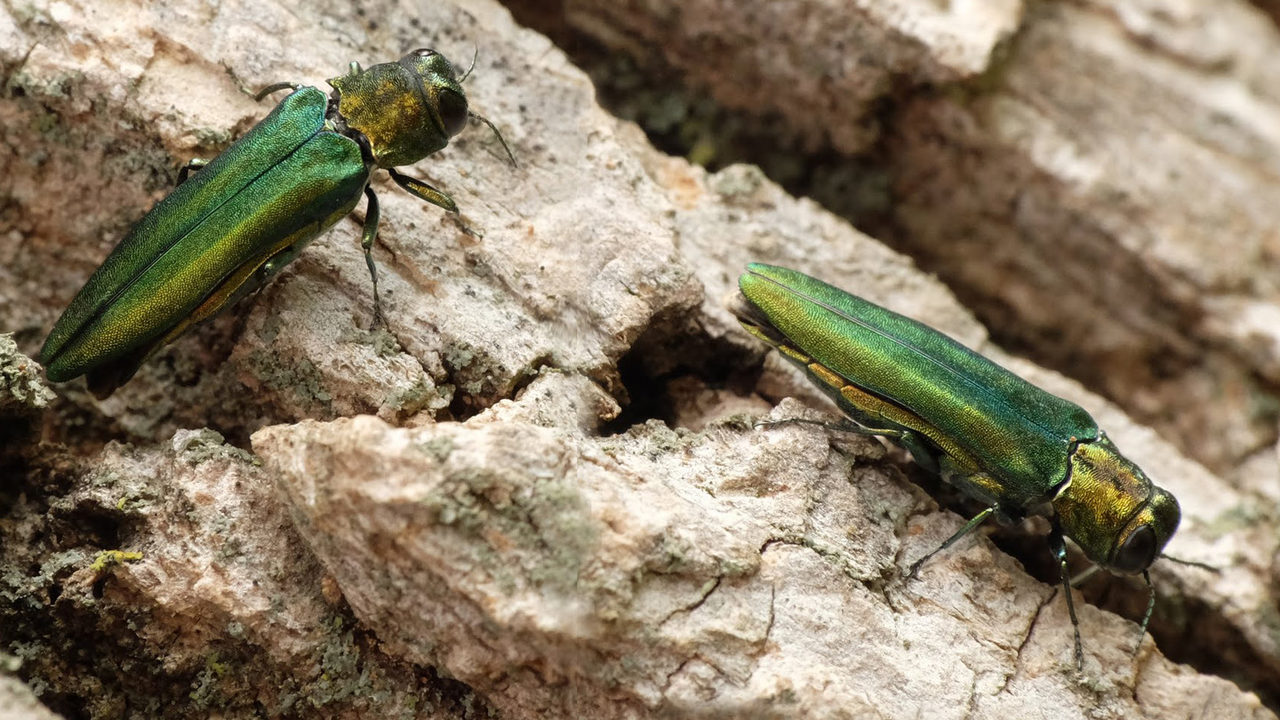
This species of borer attacks all European ash species and can wipe out entire ash stands in a short time — affecting not only weakened trees but perfectly healthy ones of any age. The beetle's metallic blue-green, wedge-shaped body measures 8–14 mm in length. Its larvae develop beneath the bark, carving long, S-shaped galleries through the phloem and the outer layer of sapwood.
The main risk comes from importing planting material of host trees from regions where the pest is present, as well as wood with bark, firewood, wooden packaging, wood chips and untreated wooden dunnage with bark still attached. Warning signs of infestation include yellowing, thinning or dying ash crowns, winding galleries beneath the bark, and the pest's characteristic D-shaped exit holes on the trunk and branches.
The beetle originally comes from East Asia — China, Japan, Korea, Taiwan and Russia's Far East. Around the turn of the millennium it was accidentally introduced to the United States (Michigan) and Canada (Ontario), where within two decades it spread rapidly and became one of the most destructive forest pests across the eastern and part of the central regions of North America.
The European invasion began in 2003, when the beetle was discovered in Moscow. It gradually spread across southern European Russia, from where it reached eastern Ukraine in 2019. Sightings were reported in Kyiv in 2023, and in Belarus in 2025.
Although the nearest known infestation is roughly 250 km from the Czech border, ÚKZÚZ experts warn that experience from North America shows the pest can turn up anywhere — most often carried in by ordinary freight or private vehicles transporting wood. The authority is asking the public to report any suspicious findings, including photos and precise location, to [email protected] or via the dedicated form on the ÚKZÚZ Plant Production Portal, under the "EU Phytosanitary Risks" section.
Public awareness is a key part of prevention: for the fourth time, ÚKZÚZ is joining the pan-European #PlantHealth4Life campaign, run by the European Food Safety Authority (EFSA) together with the European Commission and national plant protection services. Organisers are urging travellers not to bring plants home from abroad, in order to help protect Czech nature.
Source: ekolist.cz