From the "Wandering Womb" to a Multibillion-Dollar Market: How Women's Sadness Became a Diagnosis
USD 21,01
Popular
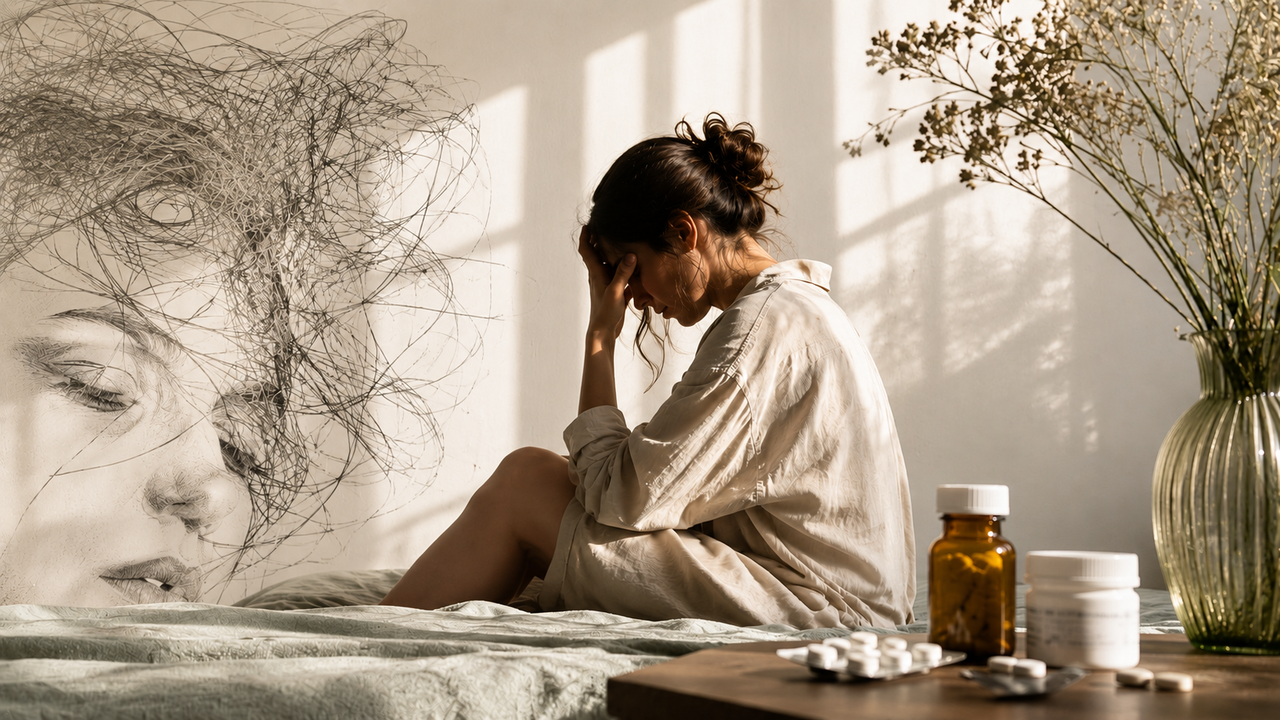
The global antidepressant market reached roughly $18.1 billion in 2024, and analysts predict it will exceed $41 billion by 2037 — with women making up the lion's share of consumers. In the US, the proportion of women taking antidepressants nearly doubled between 1999 and 2018, rising from 10% to 18.6% of the adult population, and in Czechia the number of people on antidepressants is also climbing rapidly, with women turning to them noticeably more often than men.
The medicalisation of women's emotions has roots stretching back to antiquity. As early as 1900 BC in ancient Egypt, women's ailments were attributed to a "wandering womb." The ancient Greeks coined the term "hysteria" from the word hystera ("womb"), and treatments included sexual intercourse or inhaling scents believed to "soothe the womb." The idea that childless or sexually unsatisfied women suffered from hysteria caused by an "unfulfilled womb" persisted until the 17th century, and in the Victorian era ladies carried smelling salts in their handbags in case of an attack of "female weakness." It was only in the 19th century that neurologist Jean-Martin Charcot shifted attention from the womb to the nervous system, and Sigmund Freud later redefined hysteria as a psychological condition caused by repressed emotions. "Hysteria" was officially removed from medical classifications only in 1980.
That same year, 1980, also proved a turning point for depression: before then, it was viewed as a psychosocial problem usually treated with therapy. But once "major depressive disorder" was added to the diagnostic manual, depression came to be understood as a brain malfunction — paving the way for antidepressants to become the primary treatment. In 1988, Eli Lilly launched Prozac, the first FDA-approved SSRI (selective serotonin reuptake inhibitor), which quickly earned a reputation as a "miracle pill" with minimal side effects.
The popularity of this class of drugs was fuelled by the so-called monoamine hypothesis, which held that depression is caused by a lack of serotonin and dopamine in the brain. However, a large-scale systematic review published in 2022 found no evidence that serotonin deficiency causes depression, nor any link between serotonin levels and depressive symptoms. "The idea that depression is caused by a lack of serotonin — we never believed that, it's absolute nonsense," said neuroscientist and psychiatrist Jiří Horáček. According to him, the existence of a treatment mechanism doesn't mean it addresses the underlying cause — it's like claiming that a sore throat is caused by a lack of penicillin in the tonsils. The specialist acknowledges that antidepressants today are prescribed excessively often, although in severe cases — especially where there's a suicide risk — they can genuinely be life-saving.
In the second half of the 20th century, women's emotions became a deliberate target of pharmaceutical marketing. The first mass-market psychotropic drug, Miltown, appeared in 1955. When it turned out to reduce men's work performance, its advertising was redirected exclusively at women, promising relief from pregnancy discomfort, menopausal symptoms and PMS. In 1958, artist Salvador Dalí even created an installation in Miltown's honour called Crisalida, and two years later three-quarters of American doctors were prescribing the drug — by 1965, 500 million prescriptions had been written. Miltown was succeeded by Librium and Valium: the latter inspired the Rolling Stones song "Mother's Little Helper," and in 1972 it became the most prescribed drug in the US, taken by 20% of women and 8% of men.
In the 1980s, SSRIs took the place of tranquilisers. Eli Lilly's Prozac ads appealed to the image of motherhood with slogans like "Sue is playing with her kids again... like she used to," while Effexor XR and Zoloft were marketed with lines such as "I got my mom back" alongside pictures of happy mothers playing with their children. In the 1990s, direct-to-consumer drug advertising was legalised in the US, and antidepressants began appearing on television and in magazines with messages like "Burnt the roast? Husband home with the flu? The perfect day for Prozac" — playing on women's fear of failing to live up to social expectations.
The side effects of these drugs are discussed far less often. Briton Claire Hanley said that after being prescribed a higher dose, she began experiencing involuntary muscle twitching, and within two weeks attempted suicide twice; twenty years after first taking the pills, she still suffers from the effects of the cocktail of medications doctors used to try to treat the side effects of her original antidepressants. It's estimated that around one in a hundred people experience serious SSRI side effects, though Bangor University psychiatry professor David Healy considers this figure too low: in his view, one in four patients experiences increased rather than decreased anxiety on antidepressants, which in some cases leads to suicidal tendencies.
One large study involving more than 222,000 people found an elevated risk of cardiovascular disease and higher mortality with long-term SSRI use, along with reduced serotonin levels and lasting changes in brain chemistry. Another common but often unspoken side effect is sexual dysfunction: women report an inability to reach orgasm and loss of libido, symptoms that sometimes persist even after stopping the medication.
At the same time, experts stress that the goal is not to dismiss women's real mental health struggles. Director Ondřej Moravec, who went through severe depression, admits that antidepressants saved his life, but adds: "It's not the only way out of a difficult state. Medication levels out the brain's condition at a hormonal level, but it doesn't help you avoid falling back into it — for that, you need therapy and a long, difficult journey." Doctors point out that women's sensitivity, anxiety and sadness are not in themselves pathologies, but signals that it may be time to reassess one's lifestyle, relationships and personal needs — and that the real path to balance often requires far more than just a pill.
Source: flowee.cz