Indoor Speed Skating Rink for Sabliková Could Cost 3.6 Billion Crowns: What the KPMG Study Reveals
USD 21,00
Popular
Building the Czech Republic's first indoor speed skating stadium in the town of Žďár nad Sázavou could cost as much as 3.6 billion crowns, including a hotel and parking facilities. That's according to a feasibility study prepared by auditing firm KPMG on behalf of the Vysočina Region.
Analysts estimate that running the complex would cost around 100 million crowns a year, while revenue at full capacity could reach 87 to 109 million crowns annually. "The project's success will depend above all on a well-designed architectural solution, sound management of investment and energy costs, an efficient operating model, and close cooperation between the state, the region, the city and sports organizations," the study notes.
Talk of a speed skating stadium for three-time Olympic champion Martina Sabliková has been circulating in Czechia for years. Former Prime Minister Andrej Babiš once promised to build it. The idea resurfaced this year after speed skater Metodej Jílek won the 10,000m at the Milan Winter Games.
Under the study's recommendations, the Interior Ministry should take responsibility for preparing, financing, building and later operating the facility. The state-run Olymp Sports Centre, which falls under the Interior Ministry and prepares Czechia's top athletes for the Olympics and world championships, is proposed as the investor, operator and sporting partner for the complex.
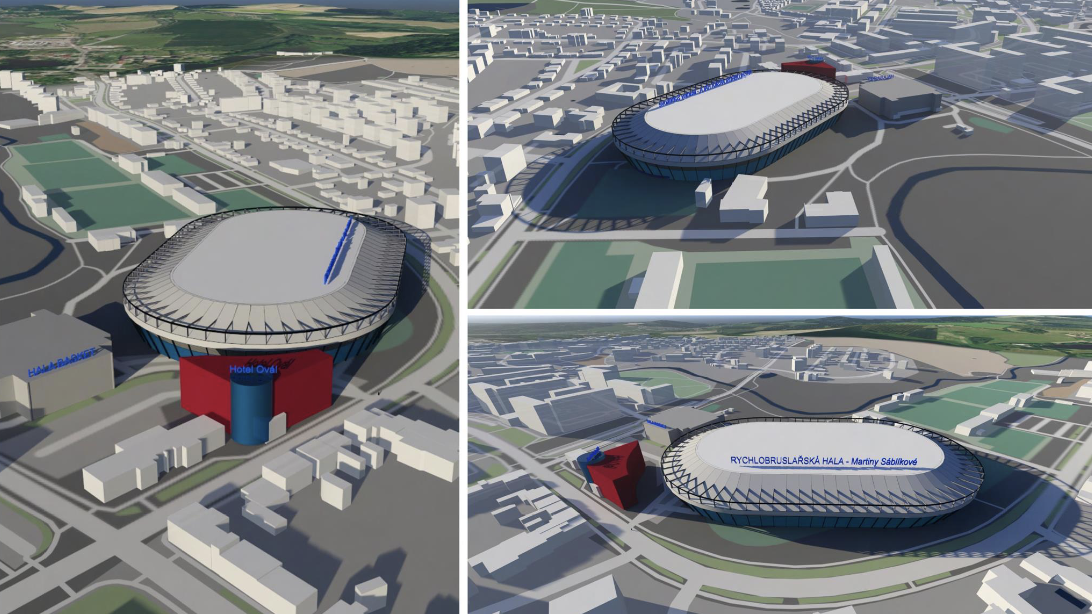
The multipurpose ice complex is planned for Žďár nad Sázavou, on the site of the current outdoor speed skating oval in the Bouchalka district. Its final architectural design will be decided through an international urban planning competition. Besides the skating track, the project envisages at least two ice rinks, spectator stands, facilities for athletes and officials, training areas, a hotel and a parking facility. The sports core alone is expected to cover roughly 27,000 square metres.
The outlet that obtained the study reached out to the Žďár nad Sázavou city hall, the regional authority and the Interior Ministry for comment, but had not received a response at the time of publication.
"The building is envisioned as a multipurpose venue: for around 10 months a year it will operate as an ice arena, while during the rest of the time it will host cultural, exhibition and other events. This versatility is a key condition for the project's economic sustainability," the study states.
In shaping the concept, KPMG drew on comparable multipurpose sports complexes in Europe and Asia. For Žďár nad Sázavou, the proposal calls for a building 12 to 18 metres high, featuring a 400-metre skating track 12–16 metres wide and an indoor ice arena with room for up to five thousand spectators.
The complex would also include a second ice rink, a sports hotel with 75 rooms and 150 beds, and an underground car park for 550 vehicles. Additional facilities would cover physiotherapy, a wellness zone, equipment storage, conference rooms and a restaurant.
According to the analysts' estimates, the sports complex itself would cost 2.1 billion crowns, the parking facility 522 million, the hotel 350 million, and design work 514 million crowns. "The final investment figure will be determined following the subsequent architectural competition, which may either refine or alter the parameters outlined here," the document states.
The push for an indoor speed skating stadium in Czechia dates back to 2006, when Martina Sabliková made her Olympic debut in Turin and finished fourth. A year later, reports surfaced of a possible facility in Nový Osek near Kolín. In March 2010, then-leader of the Social Democrats Jiří Paroubek said that if his party won the May elections, the government and region would help build infrastructure for a stadium in Velký Osek, where Sabliková and her coach Petr Novák had relocated. That 1.5-billion-crown project ultimately fell through.
According to the calculations, annual operating costs for the complex, hotel and parking combined would run between 95 and 101 million crowns. "The biggest cost drivers are energy (31%), staff (22%), and service, repairs and maintenance (15%)," the study notes, underscoring the high energy demands of ice arenas.
Analysts put annual revenue at 88–109 million crowns, generated through sporting activities, accommodation, food and beverage, event hosting, parking and sponsorship/advertising income. "The model shows that with realistic pricing and occupancy, a stable operating result is achievable — though without recouping the investment costs. In other words, the project is not viable without state support," KPMG concludes.
Analysts argue that this shortfall would be offset by indirect benefits — effects on employment, the local economy and tourism, a boost to the city's community life, and its positioning as a "city of speed skating." In June, Žďár nad Sázavou's city council approved a cooperation memorandum with the state and pledged to hand over municipal land for the project free of charge.
Read also: Vegan and vegetarian restaurants in Prague: 11 best spots for plant-based food
Source: seznamzpravy.cz