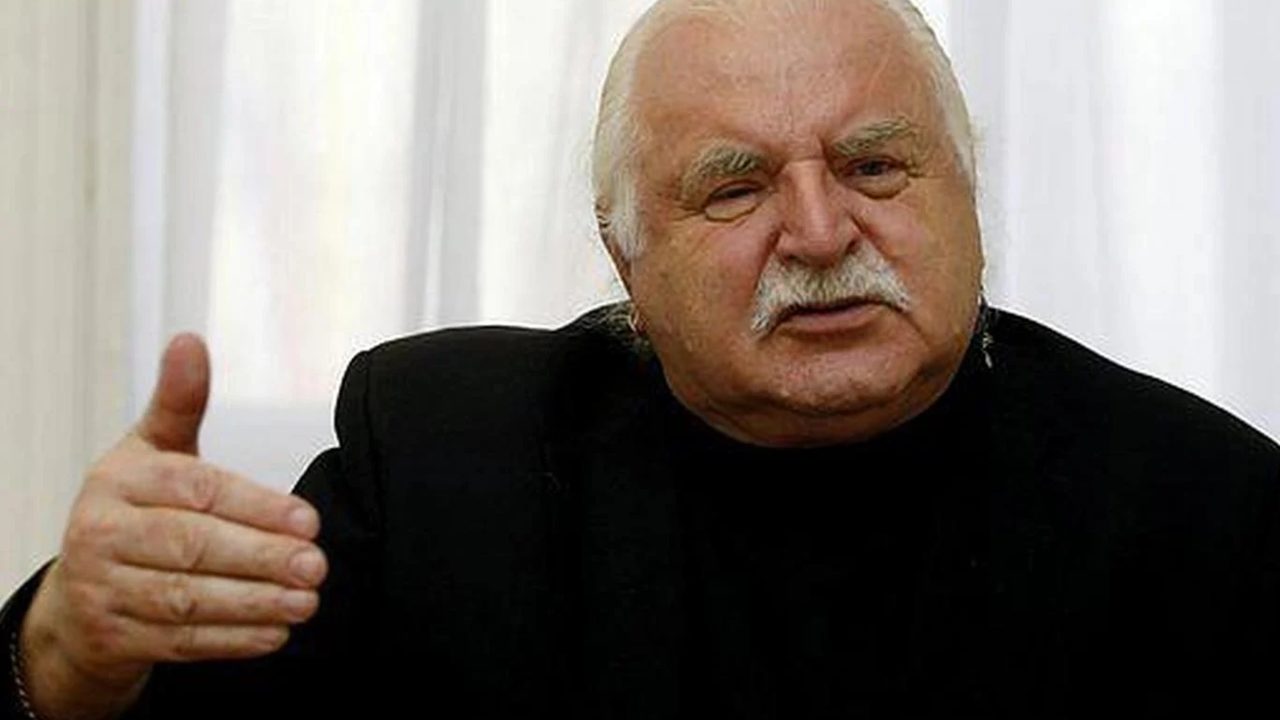
Milan Knížák has died — artist, former head of the National Gallery and founder of the Czech underground
USD 21,23
Popular
Czech artist, musician and former director of the National Gallery Milan Knížák has died at the age of 86. He was one of the key figures on the Czechoslovak and Czech art scene of the second half of the 20th century, with a body of work spanning fine art, music, architecture, design, fashion, poetry and photography.
Knížák was born on April 19, 1940, in Plzeň. He studied at a teacher-training college, at the Academy of Fine Arts (AVU) and in the Faculty of Mathematics and Physics at Charles University, but never completed his studies — he only received his doctorate from AVU in 1997–1998.
At the turn of the 1960s and 1970s, Knížák became known as the founder of Aktual, a group and namesake beat band widely regarded as one of the most significant underground acts of the communist era. In 1968–1969 he lectured at two American universities and took part in events staged by the international art movement Fluxus, which grew out of Dadaist principles and valued the artist's stance and gesture over a traditional exhibition — hence the actions, happenings, performances and installations that ran through his work.
Until 1970 Knížák got by on occasional jobs, later working as an independent artist. During the normalization era he was hounded by the police: branded an "enemy of the state," he was repeatedly detained and imprisoned. In the 1980s he once again lectured abroad, in Hamburg and Salzburg.
After the fall of the communist regime, Knížák was elected rector of the Academy of Fine Arts in 1990 and remained in the post until January 1997 — during that time he opened the academy up to the world and brought fresh momentum to its teaching. He also spent 25 years running the Studio of Intermedia Work, which he founded, whose students included Krištof Kintera, Jakub Špaňhel, Milena Dopitová and Milan Mikulaštík. In 2015, however, Knížák lost the competition for the studio's leadership, a decision that sparked outrage among his students.
Knížák achieved wide public recognition during his tenure at the helm of the National Gallery, from 1999 to 2011. His time there was marked by both achievements and conflicts: he managed to fix the institution's budget deficit, deal with the aftermath of the 2002 floods and expand the gallery with new premises. At the same time, part of the professional community criticized him for scaling back exhibition activity, for an authoritarian management style, for allegedly favoring certain artists and for insufficient cooperation with foreign institutions.
Knížák's dispute with his successor as head of the gallery, Jiří Fajt, went as far as the courts: in 2018 the Constitutional Court rejected Knížák's complaint against a ruling by the Prague High Court, which had earlier ordered him to apologize for claiming that Fajt had allegedly ruined the National Gallery.
Knížák's work has been exhibited in the Czech Republic, Europe, the US, Japan, Canada and Australia, and is held in the collections of the Museum of Modern Art in New York, the Tate Gallery in London, the Centre Pompidou in Paris and other major institutions. He wrote poetry, published dozens of books, catalogues and music albums, and as a doll collector compiled an encyclopedia of puppet-theater masters in Czechia and Slovakia. His honors include the Medal of Merit, awarded in 2010. Knížák was also known as a supporter of former President Václav Klaus and the ODS party, for which he unsuccessfully ran for the Senate in 1998.
Read also: From dinosaurs to Kafka: 7 must-see museums in Prague
Source: denik.cz