Milk Now Cheaper Than Bottled Water in Czech Shops: Here's Why
USD 21,04
Popular
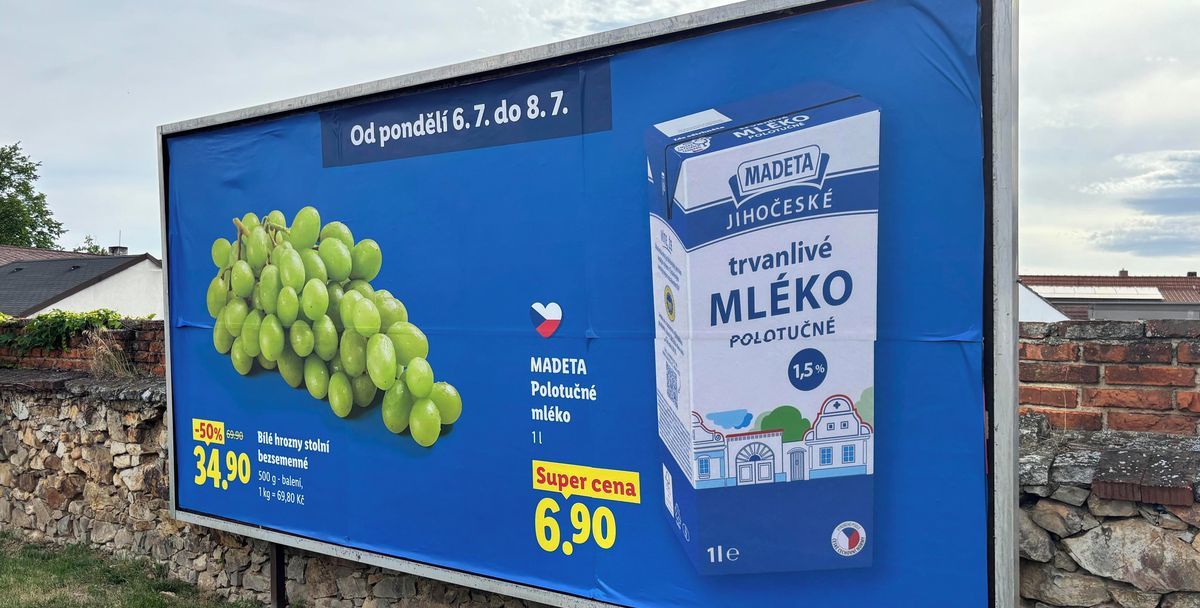
In early July, Lidl was selling milk for 6.90 crowns a litre, and this week Penny Market undercut that by another crown. Yet according to the State Agricultural Intervention Fund, dairies were paying an average of 9.80 crowns per litre of raw milk in May, with processing and packaging adding another 2–2.5 crowns to the cost, according to estimates from the Food Chamber.
Representatives of the Food Chamber say that an oversupply of milk on the market, combined with pressure from some retail chains, is forcing dairies to sell part of their output at a loss. "No business in the world can keep producing and selling at a loss for long. The maths simply doesn't add up," said the Chamber's president, Dana Večeřová.
The low prices aren't down to cheaper production — they reflect a surplus of milk on the European market. When there's more raw milk than can be sold at a reasonable price, it drags down prices for long-life milk, butter and cheese as well. The situation is being made worse by uncertainty over exports, including restrictions on certain products in the Chinese market, plus broader tensions in global trade. Industry figures show EU milk production rose 3.7% year-on-year in May, while in Czechia the increase was as much as 3.9%.
Meanwhile, producers' costs remain high: cows need feeding, vets need paying, energy and labour don't come cheap, and raw milk still has to be processed, packaged and delivered as a finished product. Bottled water, by contrast, carries almost none of these costs.
For retail chains, milk is a favourite item for promotions. Nearly everyone buys it, shoppers remember its price well, and a discount splashed across a leaflet makes a strong impression. What's more, customers usually pick up other items along with it, and it's those purchases that let the chain make up for the losses on the promotion.
"Behind the price cut is a falling purchase price for milk. We're passing that lower purchase price directly on to our customers by cutting prices across our whole dairy range," commented Lidl spokesperson Iveta Barabášová.
Tomáš Prouza, president of the Confederation of Commerce and Tourism, sees an upside to the situation, arguing that fierce competition for customers ultimately benefits the market. "Low prices are a win for shoppers — it's precisely because of these kinds of promotions, and the broader push towards rock-bottom prices, that food today costs 3.4% less than it did a year ago," he added.
Agricultural economist Tomáš Majer, however, warns that comparing the price of semi-skimmed milk directly with the purchase price of raw milk is misleading. Raw milk contains around 4% fat, whereas semi-skimmed milk has only 1.5%, with the rest separated off and used to make other products. "Semi-skimmed milk can really be seen as a by-product. It's a bit like being surprised that a chicken carcass is cheaper than a whole chicken," Majer explained.
Last week, representatives of European dairies held talks with EU Agriculture Commissioner Christophe Hansen. According to Jiří Kopáček, head of the Czech-Moravian Dairy Association, this is no longer a problem confined to a single product but a threat to the whole industry: producers argue that cut-price promotions can't be subsidised indefinitely out of profits from other goods.
As of the end of 2025, Czechia had nearly 1.4 million registered cattle, of which around 343,000 were dairy cows. According to the Ministry of Agriculture, the country's annual milk production stands at roughly 3.4–3.5 billion litres.
Source: novinky.cz