Mortgages in Czechia Get Pricier for the Fifth Month Running — Rates Hit Two-Year High
USD 21,04
Popular
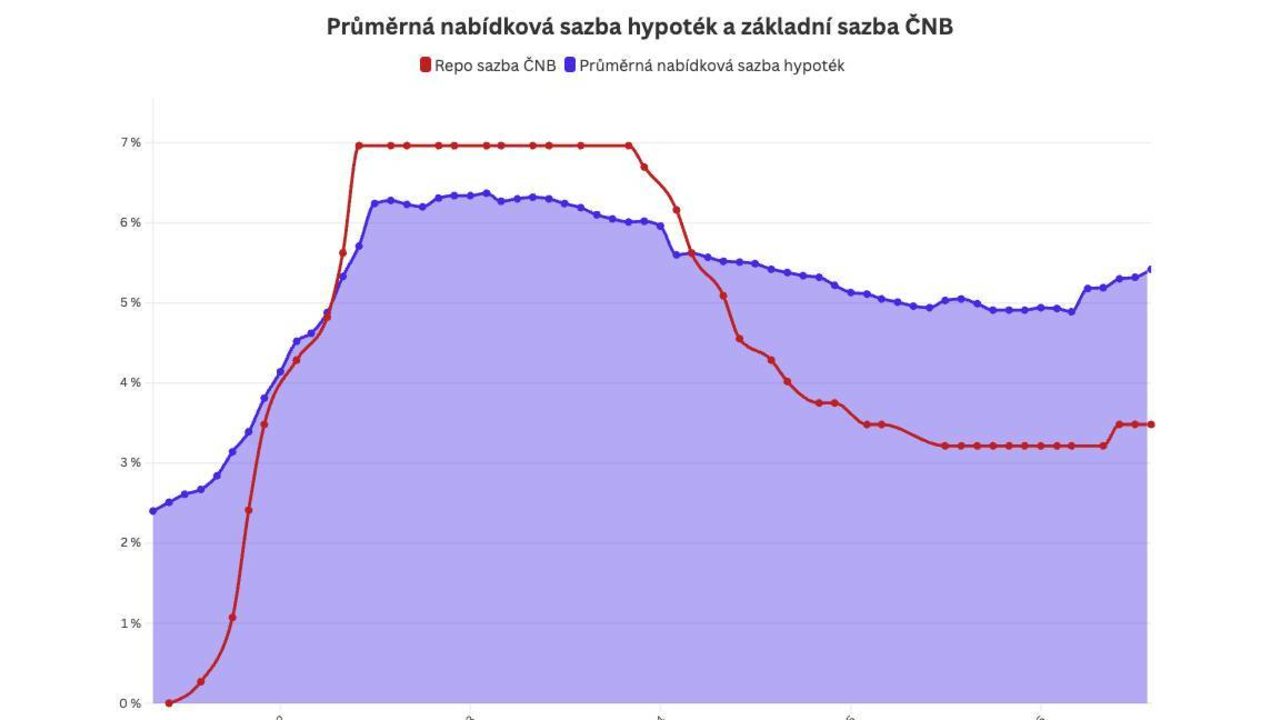
The average interest rate on mortgage loans in Czechia rose by a tenth of a percentage point in early August, reaching 5.42%. That's the highest level in two years, marking the fifth consecutive month of increases, according to the Swiss Life Hypoindex.
"It's becoming clear that the return to cheaper mortgages will be slower than many expected at the start of the year. The main reason is persistent geopolitical uncertainty and the related fears of a resurgence in high inflation," said Tom Kadeřábek, head of the product department at Swiss Life Select.
According to him, concerns about rising inflation are shared not only by the Czech National Bank (CNB) but by nearly all major central banks worldwide, which is why fairly tight monetary policy is currently in place. In June, the CNB raised its base rate by a quarter of a percentage point — to 3.75% — for the first time in four years, which is also partly affecting mortgage costs. Some analysts anticipate one more rate hike before the end of the year, though recent statements from CNB Governor Aleš Michl suggest the rate may remain unchanged at the upcoming meetings.
How Much You'll Pay on a Mortgage Now
The monthly payment on a model mortgage of 3.5 million crowns over 25 years now stands at 21,327 crowns — almost 1,100 crowns more than in March of this year. The price increase will affect not only new borrowers but also tens of thousands of people whose fixed-rate period is expiring this year.
Markets Have Already Priced in the Risks
Kadeřábek believes mortgage rates are likely nearing their peak. "Financial markets have already largely priced in the current risks," he said, adding that the most probable scenario for the coming months is for rates to hold near current levels before beginning a very gradual decline.
According to Pavel Janeček, an expert at Royal Bridge Partners, bank clients shouldn't try to guess the perfect moment to take out a mortgage, but should instead focus on their own financial situation. "If you've already found a suitable property today and the mortgage fits your long-term budget, there's little point in delaying the purchase in hopes of significantly lower rates down the road," he said.
Analysts note that beyond the rate itself, an increasingly important factor is the individual assessment of the borrower — their solvency, the size of their own funds, the loan-to-value ratio, the length of their relationship with the bank, and their use of other banking products. "A few years ago, the decisive factor was which bank offered the lowest rate. Today, competition is increasingly shifting toward individual terms. The final rate often depends more on negotiation than on simply checking a rate table," explained Jiří Sýkora, mortgage analyst at Swiss Life Select.
David Eim, deputy chairman of the board at Gepard Finance, noted that a rate just under five percent is now considered a good offer.
Source: novinky.cz