MP Turek fined 200,000 crowns for unauthorized construction at his Prague cottage
USD 21,04
Popular
Czech MP Filip Turek of the Motoristé party has been found guilty of two administrative offenses linked to illegal construction on his property in Prague's Dubeč district. Under a ruling by the building department of the Praha 15 municipal office, he has been fined a total of 200,000 crowns, with the decisions taking legal effect on July 3.
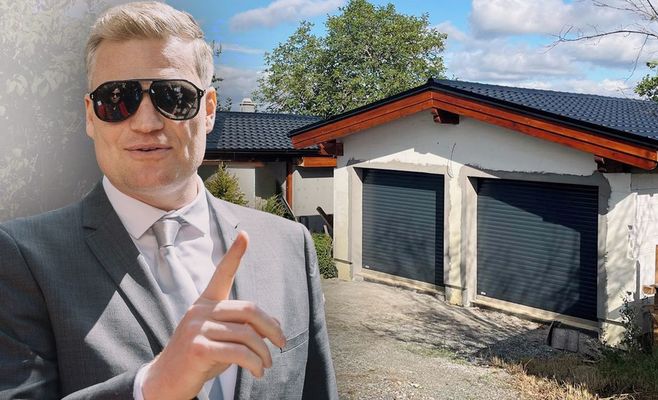
News of the violations came to light through documents obtained by our editorial team under the Freedom of Information Act. The first unauthorized structure — officially listed as a "garden cottage" — cost the politician a fine of 80,000 crowns. The second, which looks like a two-car garage but appears in the paperwork as a "fruit press," resulted in a fine of 120,000 crowns.
For both structures, Turek subsequently sought retroactive legalization — and ultimately succeeded. However, officials assessed the two violations differently: the rebuilding of the old cottage was ruled an unintentional offense, while in the second case, according to the authorities' findings, the MP acted with at least indirect intent.
Our editorial team reached out to Turek to ask whether he acknowledges the building-law violations and whether he has already paid the fines. As of publication, the government politician had not responded.
News of the violations emerged against the backdrop of another incident involving the MP: on Monday, at Prague's Ivana Pavlova square, his car collided with an ambulance, whose driver suffered multiple injuries in the crash and was hospitalized. Following the accident, Turek temporarily stepped down from his role as government commissioner for climate policy and the Green Deal, pending determination of who was at fault.
Negligence versus intent
The illegal construction by the politician — honorary president of the Motoristé party — first came to public attention back in June 2024. At that time, Turek was rebuilding and expanding, without a permit, an old cottage that had already stood on the property under previous owners. The neighboring structure had not yet been started at that point.
According to case materials, through his lawyer Turek stated that he was aware of the procedural violation — building without the appropriate permit — but acted in good faith, believing the structure continued a historically existing garden building for which local authorities had previously given approvals. He presented two statements from the Dubeč local council dated 1993 and 1999, but the building authority noted that these did not constitute a building permit.
Officials took a stricter view of the second structure, which was built while proceedings over the first one were already underway. Here, the violation was ruled intentional: Turek already knew he was building without a permit and was counting on legalizing the structure later. Last year, he told the authority that he began the unauthorized construction out of concern that building materials and contractor services would become more expensive.
"The building authority considers it proven that the accused acted with at least indirect intent, as he was aware that he was erecting a structure without prior permission," the authority's decision states.
The final fine turned out to be relatively lenient: the current building law allows for a fine of up to 2 million crowns for an individual, and up to 4 million crowns for an entrepreneur or company.
Legalization via the "fruit press"
In January of this year, our editorial team spoke with architect Igor Držvíkovský, who, through an intermediary, helped the politician legalize the unauthorized structures. This took place at a time when Prague's then-current zoning plan effectively did not allow new construction in Dubeč — except for structures related to gardening that form part of a garden, vegetable plot, or vineyard.
According to the architect, officials indicated that no one could live on the property, but fruit could be grown there — so it was decided to register the structures for exactly that purpose. In the end, the only realistic path to a permit was to legalize the buildings as a "fruit press." "The trick is that no one actually checks how the structures are really used... this press will probably never actually run," Držvíkovský noted.
The claim about the "fruit press" indeed made it into the project documentation: supposedly, the garden cottage, after being fully rebuilt, was to be used for producing fruit juice and preserves from the adjoining garden, while the second structure would serve as storage for garden equipment and harvested produce. Last year's legalization permit states that both buildings would serve garden work and the storage and processing of the harvest, including a covered "work area" for processing fruit.
Turek also pledged to plant, in his garden of more than 2,000 square meters, four cherry trees, eight plum trees, and 18 apple trees.
Mentions of leisure use and a garage
Despite the stated gardening plans, some earlier documents contain references suggesting that the cottage, which has a bathroom, was meant to serve for family leisure, while the carport was meant for parking cars. Space for parking a car is also included in the aforementioned garden-equipment storage building, which in certain documents (such as a sanitary authority opinion) is referred to simply as a garage.
Asked whether Turek had filed an application to put the structures into operation, Praha 15 municipal office secretary Aleš Cejnar told our editorial team: "As of today, the building authority has no record of any applications submitted for these structures." This means that official use of the buildings has not yet been authorized.
Read also: Prague Metro: map and tickets