Nazi Propaganda Without Commentary on Russian Justice Ministry Website: Columnist Draws Parallels with the Third Reich
USD 21,08
Popular
On the official website of Russia's Ministry of Justice, in a section devoted to an exhibition titled "Defending the Sovereignty of the Russian State: History and Modernity," Nazi propaganda films in Russian were posted without any explanatory commentary — including footage about the lives of Ostarbeiters deported from territories occupied by Nazi Germany, presented as a depiction of their supposedly "wonderful life" in the Third Reich.
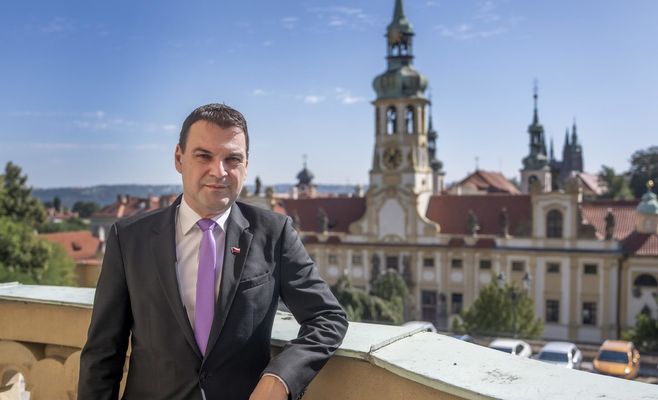
Journalist and columnist Sasha Mitrofanov writes about this in his column for Czech Radio Plus, pointing out that such materials were published by a state institution precisely without any debunking commentary — effectively amounting to unqualified praise of Nazi propaganda.
The Justice Ministry's exhibition includes several sections: a registry of "foreign agents," materials on the country's history, and photographs and documentary films. It was in the documentary film section that the Nazi propaganda footage appeared.
Mitrofanov draws parallels with several other events from recent years. In June 2020, at the opening of the Main Cathedral of Russia's Armed Forces in the "Patriot" park near Kubinka, Deputy Defense Minister Timur Ivanov announced that the museum complex "Road of Memory" was displaying personal belongings of Adolf Hitler — his military cap and uniform, seized by Soviet soldiers in Berlin in 1945 — calling them unique exhibits.
The columnist also recalls Vladimir Putin's words at a meeting with rabbis on July 9, 2014: "Goebbels used to say that the more incredible the lie, the faster people will believe it. And he achieved his goal — he was a talented man."
Another element of the Justice Ministry's exhibition is a detailed list of individuals designated by the Kremlin as "foreign agents," complete with elaborate graphics and photographs of those named. In Mitrofanov's view, this echoes two totalitarian practices at once.
On one hand, it imitates the Stalinist era in the USSR, when, from the late 1930s until Stalin's death in March 1953, "enemies of the people" were declared and subsequently vanished into the Gulag or were killed. However, the author notes, under Stalin, detailed public lists of "enemies of the people" were never actually published — in this respect, modern Russia has gone even further.
Film producer Alexander Rodnyansky, now living in emigration, also pointed to the near-total overlap between the actions of the current Russian regime and Nazi practices, publishing a facsimile of the front page of the Nazi newspaper Völkischer Beobachter featuring photographs of "enemies of the people" declared by Hitler.
Mitrofanov concludes his column with a comparison to the Soviet past: while Czechoslovak communists in the 1950s used the slogan "The Soviet Union is our model," in today's Russia, the slogan "The Third Reich is our model" is becoming increasingly fitting.
Read also: From Dinosaurs to Kafka: 7 Must-See Museums in Prague
Source: novinky.cz