Poll: Ruling coalition voters praise defense policy, opposition sharply disagrees
USD 21,01
Popular
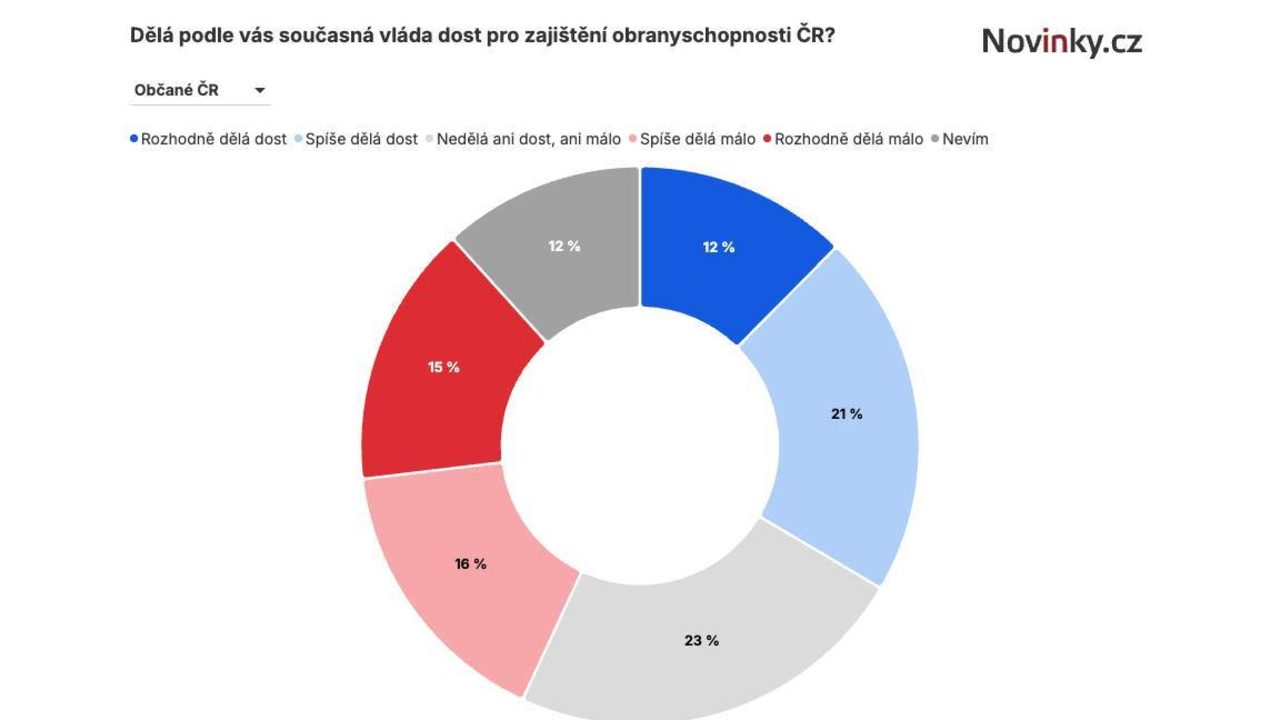
Czechs are sharply divided over how well the government is safeguarding the country's defense capability. According to a fresh poll by the NMS agency, 33% of respondents believe the authorities are doing enough for defense, while 31% hold the opposite view. Another 23% take a middle position, and 12% were unable to answer.
"Ensuring Czechia's defense capability is a topic that splits society. Voters of the ruling parties are generally satisfied with defense investment, while opposition voters are highly critical," commented NMS political analyst Tereza Fridrichová on the results.
Who's satisfied, and who isn't
ANO and SPD voters view the cabinet's actions most positively: 67% of ANO supporters and 63% of SPD supporters consider the measures sufficient. Voters of the coalition's third party, the Motorists (Motoristé), are more reserved, with only 48% satisfied.
The opposition sees things quite differently. Only 8% of voters of the Spolu coalition (ODS, TOP 09 and KDU-ČSL) called the government's work sufficient, along with 15% of Mayors and Independents (STAN) supporters and 18% of Pirates supporters.
NATO, money and Europe's joint defense
The poll also separately examined opinions on three specific areas of defense policy. 42% of respondents agreed that the government cooperates sufficiently with its NATO allies. 38% believe enough money is being allocated to defense, while 33% think the authorities are actively promoting Czechia's participation in a joint European air defense system.
76% of SPD voters and 64% of ANO supporters called defense spending sufficient. Motorists voters, however, again lag noticeably behind the rest of the coalition: only 37% of them consider defense spending adequate — nearly 40 percentage points less than among SPD supporters.
The Motorists' ambivalent role
"Motorists voters differ from ANO and SPD voters and may have mixed feelings about the current government. During the election campaign, the party ran under the slogan 'Get rid of Fiala, keep an eye on Babiš,' promising to act as a right-wing watchdog over Andrej Babiš. Today, however, it is itself part of his government, and whether it manages to fulfill that declared role is debatable," explained Otto Eibl, a political scientist at Masaryk University.
Among Spolu voters, only 10% consider defense spending sufficient. "Interestingly, both groups are assessing a budget that fails to meet NATO's 2%-of-GDP commitment. Yet, for instance, three-quarters of SPD voters believe the state spends enough on defense," Fridrichová noted. She pointed out that this year's defense budget falls short of the 2%-of-GDP threshold, meaning Czechia is not meeting the commitment made at the 2014 NATO summit in Wales.
According to the analyst, assessments of defense policy reflect less how people actually feel about specific spending figures and more how important they consider the topic of defense to be overall. Eibl added that Spolu and SPD voters may differ not only in their views on the war in Ukraine, but also in their very understanding of what actually threatens Czechia.
Source: novinky.cz