USD 21,08
Popular
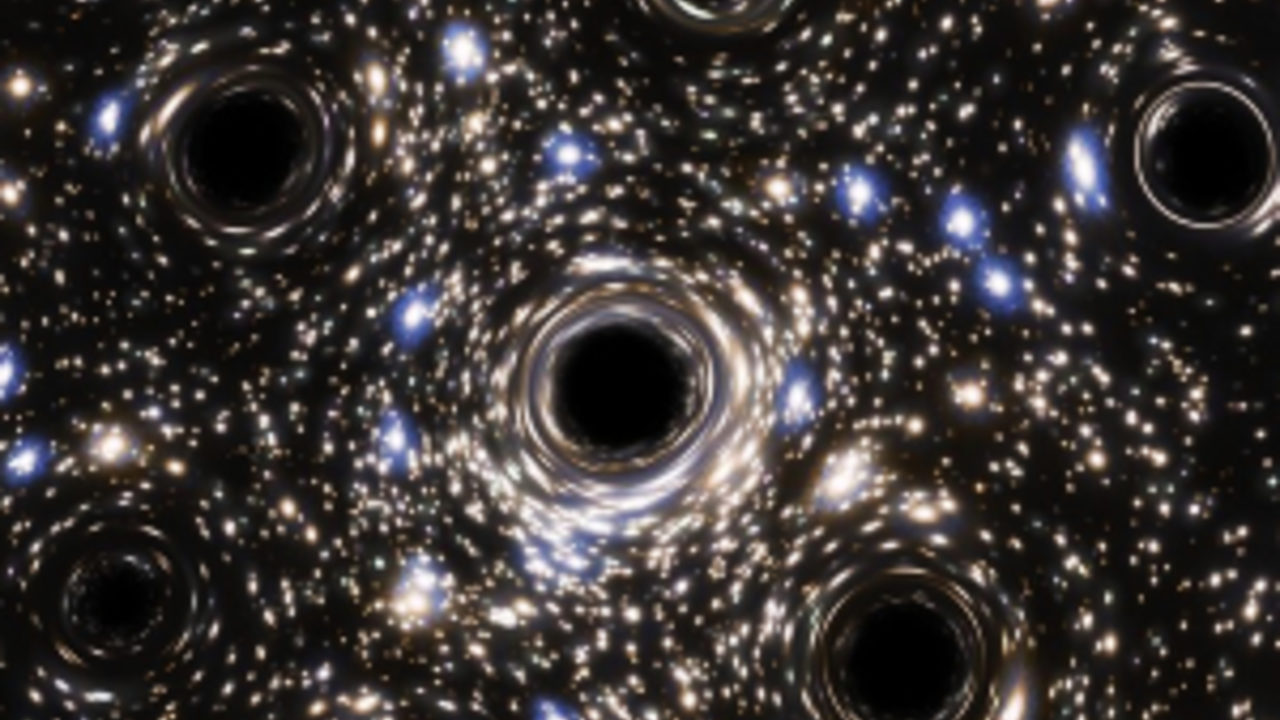
Astronomer Tom Wagg of the Flatiron Institute in New York and his colleagues have used computer modelling to estimate the number of stellar-mass black holes in our galaxy — and according to their calculations, there could be as many as 170 million of them.
Black holes cannot be observed directly: light cannot escape a gravitational singularity, and they only become detectable when they are actively feeding on matter and radiating energy in the process. Because of this, scientists still have only a hazy idea of how many such stellar-mass objects are lurking within the Milky Way — they've been dubbed "the ghosts of the galactic underworld."
Wagg's team built virtual models of the Milky Way and tracked billions of years of star formation, stellar death, black hole birth, and the galaxy's overall evolution. The simulation yielded not just a total count of these objects, but also their likely spatial distribution, their masses, and the nature of the supernova explosions that created them — effectively a map that future observations could use to test the model's predictions.
A figure of 170 million sounds staggering, but relative to the sheer scale of the galaxy, the density turns out to be fairly modest. According to the calculations, in the stretch of the Milky Way spanning roughly the distance from the Sun to the galactic centre, there's about one black hole per 60-light-year cube. Spread evenly across the galaxy's entire history, the appearance of 170 million black holes works out to a new one being born, on average, every 80 years.
The idea that millions of invisible black holes are drifting through the galaxy sounds unsettling. But researchers point out that the main "baby boom" of black holes happened long ago, during an era when star formation in the Milky Way was far more intense than it is today. That said, the scientists note, an old black hole doesn't "rust" — it keeps devouring matter with just as much appetite as ever.
Scientists also emphasise that black holes rarely stay put where they were born. Many form in asymmetric supernova explosions that give them a kick, sending them on a journey across the galaxy. In rare cases, this "kick" is so powerful that the black hole is flung clean out of the Milky Way altogether. In most cases, though, they simply wander the galaxy — leaving open the tantalising question of where the nearest such "rogue" black hole to us might currently be.
Source: osel.cz