Tick-borne borreliosis breaks records in Czechia: up to 90 new cases a day
USD 21,04
Popular
Czechia has seen a sharp rise in tick-borne borreliosis infections: in July alone, 2,792 people fell ill — a third of all cases recorded during the whole of last year. According to the State Institute of Public Health (SZÚ), roughly 90 new cases are now being logged every day on average, and the peak of the season appears to still be ahead, as summer has only just passed its midpoint.
"These numbers are genuinely huge," said SZÚ epidemiologist Hana Orlíková. She noted that part of the increase stems from a change in how data is recorded: since July of last year, information on borreliosis and other illnesses reported by GPs and paediatricians has been automatically fed into a central database. This has confirmed what doctors had long suspected — the actual number of infections is considerably higher than previously believed.
Ticks are moving up into the mountains
For comparison, in previous years the first seven months of the year typically saw between 1,500 and 2,000 registered cases. The spread of tick-borne diseases depends on how heavily infected the ticks themselves are, on weather fluctuations, and — increasingly in recent years — on climate change.
"Because of overall warming, we're seeing the tick season grow longer, and tick activity shifting into higher mountain areas," Orlíková notes. While mountain regions were once considered relatively safe from ticks, recent data show that people shouldn't let their guard down even there.
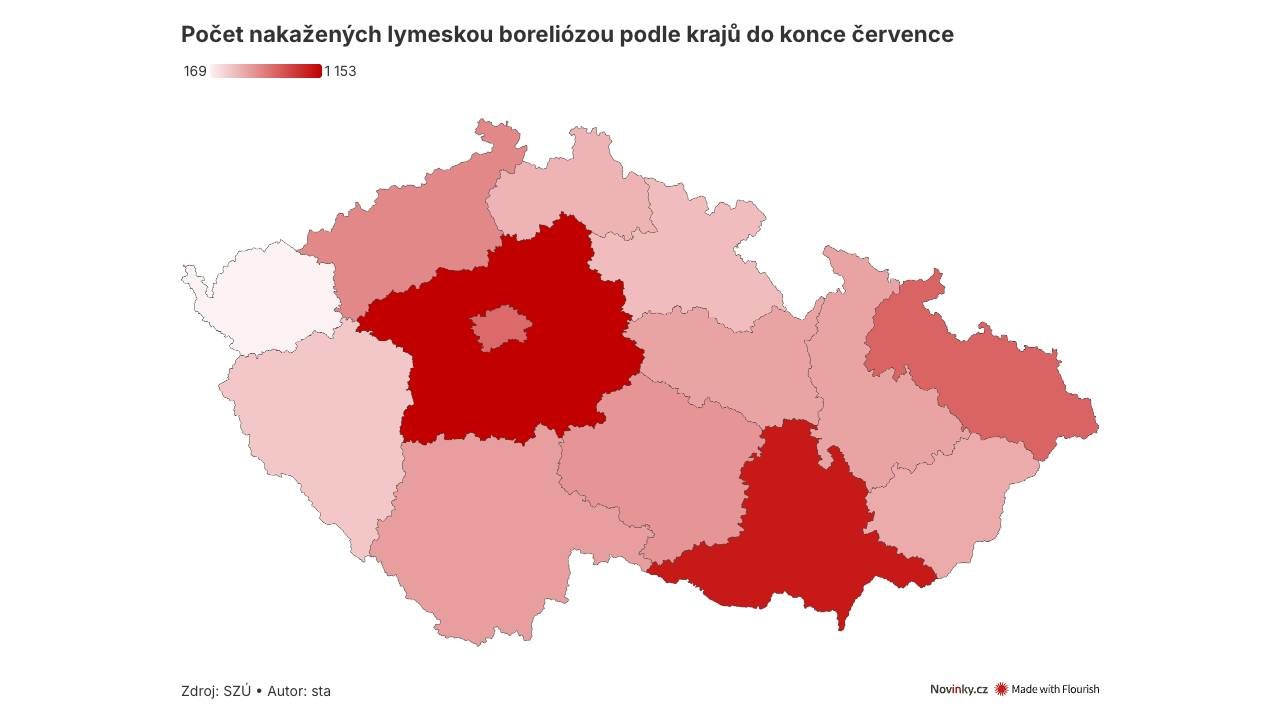
By the end of July, the highest number of cases had been recorded in the Central Bohemian Region — 1,153 patients — and the South Moravian Region, with 1,052 cases. However, the epidemiologist stresses that borreliosis can be contracted anywhere in Czechia.
Prague is no exception
The main issue is the high infection rate among ticks themselves: depending on the region, between 15 and 40% of ticks carry the infection. Notably, the situation in cities is often worse than in the countryside — and Prague is no exception.
"Prague's parks and wooded areas create a special microclimate where ticks feel particularly at home, so the risk of infection for city residents is real even during an ordinary walk," said Martina Marešová, director of the anti-epidemic department at the Prague Hygiene Station.
How to spot it and what to do
A typical symptom of borreliosis is a red patch of skin at the bite site with a paler area in the centre. "In that situation, don't put off seeing a doctor — the disease responds well to antibiotic treatment," Orlíková adds. The mark may fade on its own, but that doesn't mean everything is fine: the infection can resurface years later.
The most common form of the disease affects the skin: it starts as a red patch but, left untreated, can develop into skin infections and cause the affected area to thin out. There are more dangerous forms as well — such as Lyme neuroborreliosis, in which the infection attacks the nervous system, and in rare cases the heart and eyes are affected too.
Doctors remind people that the faster an attached tick is removed, the lower the risk of infection. The bite site should be disinfected, and the tick itself is best not handled with bare hands. A flat tweezer is ideal for removal — grip the tick as close to the skin as possible and gently loosen it. The classic twisting motion many people are used to isn't actually necessary.
Source: novinky.cz