26 июля 2026, 14:10 News

Why jeans have that tiny pocket: it wasn't originally for coins, but for pocket watches
Why jeans have that tiny pocket: it wasn

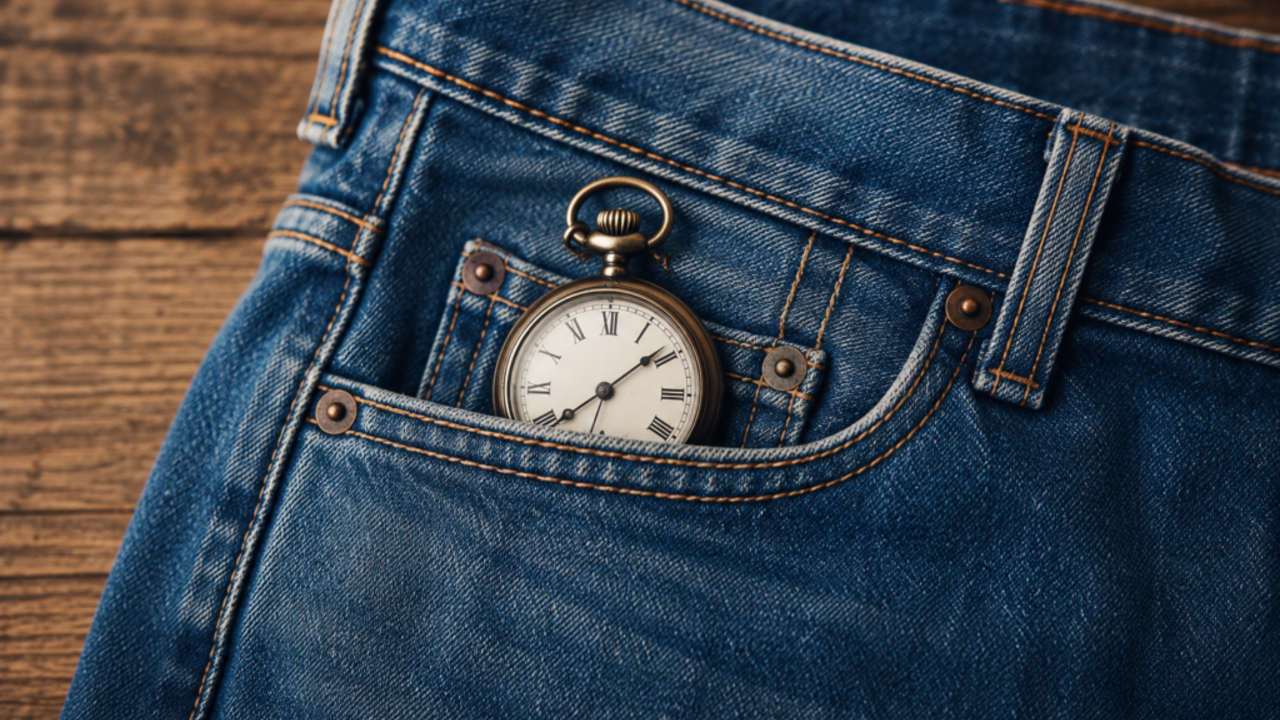
The tiny pocket above the right front pocket of jeans — barely big enough to fit a thumb — appears on almost every pair of classic jeans. Generations of wearers have puzzled over its purpose, repurposing it for loose change, a lighter, or earbuds, but it was originally designed to hold a pocket watch — an essential accessory for 19th-century men.

When Levi Strauss & Co. launched the first riveted jeans in 1873 for miners, cowboys and railroad workers, a fifth, smaller pocket was added to the four main ones. At the time, it was simply called the "watch pocket."

In the second half of the 19th century, pocket watches were a standard part of a man's wardrobe — worn on a chain, with a fairly fragile glass face. The narrow, deep little pocket protected the watch from knocks while working in mines, on ranches, or on horseback.

As American fashion historian Daniel Delis Hill explains, workwear was designed above all for functionality: every seam and every pocket served a practical purpose. That's why the pocket was made narrow and deep — to keep the watch securely in place even during heavy labor.

From the early 20th century, pocket watches began to be replaced by wristwatches, and it seemed the little pocket had lost its purpose. Even so, jeans manufacturers kept it — it became one of the recognizable hallmarks of the classic design.

Cheap flights from Prague
One search across every airline and travel agency.
Find tickets
Sponsored

Over time, people found their own uses for the pocket: stashing coins, keys, lighters, tickets, and later USB drives. Legends sprang up claiming the pocket was meant for gold nuggets, spare rivets, or even revolver cartridges, but historical sources support none of these theories.

Levi Strauss itself has repeatedly stated that, from the very beginning, it was indeed intended as a pocket for pocket watches. British fashion historian Shaun Cole notes that details of workwear often survive long after their original function has disappeared.

Today, this tiny pocket is one of the most enduring elements of modern clothing. Although pocket watches have long fallen out of use, manufacturers keep the detail alive out of respect for history and to preserve the recognizable look of jeans.

This element, now more than 150 years old, is a reminder of the era of the American gold rush, railroad construction, and cowboys. As American fashion historian Deirdre Clemente puts it, clothing is a chronicle of everyday life, and this unassuming little pocket tells the story of technological change and shifting human habits better than many history textbooks.

Source: epochaplus.cz
Share: Telegram VK WhatsApp

Related news

The Czech Ministry of Health is preparing a reform under which, starting in early 2027, surgeries to remove bladder and kidney tumors will only be performed at large specialized centers in major cities. In 2028, the list of procedures to be
On 7 July, Ostrava Zoo welcomed an unexpected new arrival: a male calf of the rare and endangered Rothschild's giraffe subspecies. According to zoo spokeswoman Šárka Nováková, this is the first offspring for the five-year-old mother and the
Satellite images are capturing a dramatic shift in the landscape across France, the Iberian Peninsula, the British Isles, Italy and several parts of Central Europe, including Czechia: in just a few weeks, vegetation has turned from lush gre
Czech President Petr Pavel said on Saturday at the Colours of Ostrava festival that he will announce his decision on whether to run in the next presidential election "at an appropriate time" sometime next year — for now, he said, it's still
Czech President Petr Pavel has said that dialogue between the head of state and the prime minister is essential, warning that the entire country will suffer without it. He made the comments at the Meltingpot discussion forum in Ostrava whil
In Germany, a 26-year-old railway employee originally from Bulgaria suffered life-threatening injuries after falling out of a train carriage travelling at roughly 120 km/h. The incident occurred on Friday evening near the town of Bruchhause
Hungarian President Tamás Sulyok has signed a constitutional amendment that prematurely terminates his term in office while also reshaping the Constitutional Court and changing the rules governing parliamentary deputies. The bill was passed
A new multi-storey car park worth around 300 million crowns has opened at the University Hospital in Ostrava-Poruba. Contrary to residents' hopes, however, it will for now be accessible only to hospital staff and ambulances.Many people in O
As of Monday, price caps on petrol and diesel are no longer in force in Czechia — the government has officially wound down its fuel price regulation mechanism. According to the cabinet official overseeing the issue, thanks to amended legisl
Germany's Retail Federation and Chamber of Commerce and Industry have called on the government to lift the country's ban on Sunday shopping. In their view, the restriction — rooted in Christian tradition — does nothing but hurt sales.In Ger
Germany has officially raised its terror threat level, Interior Minister Alexander Dobrindt announced, according to Reuters. He said potential targets could include German infrastructure, government institutions and individual citizens."The
Václav Havel's name has disappeared from a building on Ostrovní Street in Prague: above the door, where a sign reading "Václav Havel Library" once hung, there is now only an empty frame, and the plaque on the building's wall has vanished to