today at 14:10 News

Why jeans have that tiny pocket: it wasn't originally for coins, but for pocket watches
Why jeans have that tiny pocket: it wasn

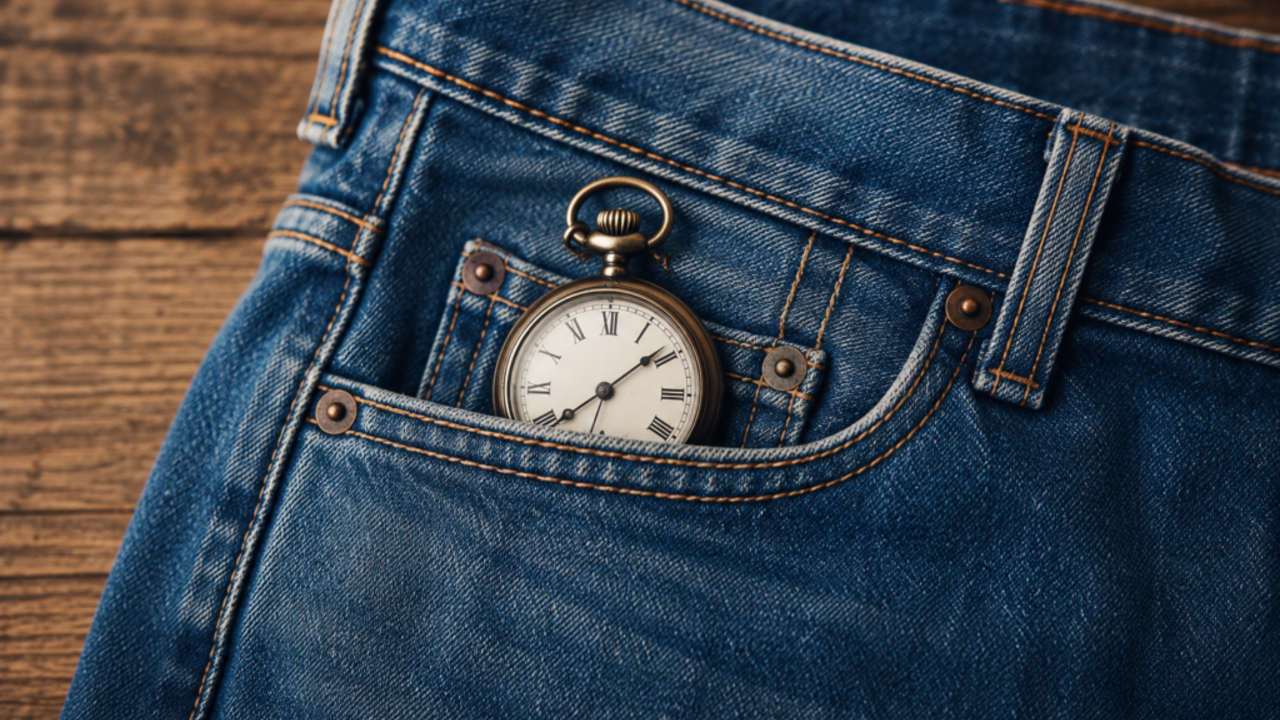
The tiny pocket above the right front pocket of jeans — barely big enough to fit a thumb — appears on almost every pair of classic jeans. Generations of wearers have puzzled over its purpose, repurposing it for loose change, a lighter, or earbuds, but it was originally designed to hold a pocket watch — an essential accessory for 19th-century men.

When Levi Strauss & Co. launched the first riveted jeans in 1873 for miners, cowboys and railroad workers, a fifth, smaller pocket was added to the four main ones. At the time, it was simply called the "watch pocket."

In the second half of the 19th century, pocket watches were a standard part of a man's wardrobe — worn on a chain, with a fairly fragile glass face. The narrow, deep little pocket protected the watch from knocks while working in mines, on ranches, or on horseback.

As American fashion historian Daniel Delis Hill explains, workwear was designed above all for functionality: every seam and every pocket served a practical purpose. That's why the pocket was made narrow and deep — to keep the watch securely in place even during heavy labor.

From the early 20th century, pocket watches began to be replaced by wristwatches, and it seemed the little pocket had lost its purpose. Even so, jeans manufacturers kept it — it became one of the recognizable hallmarks of the classic design.

Cheap flights from Prague
One search across every airline and travel agency.
Find tickets
Sponsored

Over time, people found their own uses for the pocket: stashing coins, keys, lighters, tickets, and later USB drives. Legends sprang up claiming the pocket was meant for gold nuggets, spare rivets, or even revolver cartridges, but historical sources support none of these theories.

Levi Strauss itself has repeatedly stated that, from the very beginning, it was indeed intended as a pocket for pocket watches. British fashion historian Shaun Cole notes that details of workwear often survive long after their original function has disappeared.

Today, this tiny pocket is one of the most enduring elements of modern clothing. Although pocket watches have long fallen out of use, manufacturers keep the detail alive out of respect for history and to preserve the recognizable look of jeans.

This element, now more than 150 years old, is a reminder of the era of the American gold rush, railroad construction, and cowboys. As American fashion historian Deirdre Clemente puts it, clothing is a chronicle of everyday life, and this unassuming little pocket tells the story of technological change and shifting human habits better than many history textbooks.

Source: epochaplus.cz

Share: Telegram VK WhatsApp

Related news

A simple Italian dish made of garlic, olive oil and spaghetti — aglio e olio — has won over food lovers around the world, yet it's precisely this simplicity that hides the biggest cooking mistakes. According to culinary experts, every singl
Jennifer Lopez has celebrated her 57th birthday, and by her own admission, she's in better physical shape now than she was in her twenties. The secret to her youthful looks isn't strict dieting or plastic surgery, but a disciplined sleep sc
The Brno city hall will once again put up for lease the premises of the former artisan bakery in Bergl Palace on Moravské náměstí, popularly known as "Muzejka." This was announced by Radka Loukotová, spokesperson for the city administration
The "scandi morning" trend is quietly nudging avocado toast off the menus of Europe's trendiest cafés. In its place, a simpler spread is taking over: soft-boiled eggs, good-quality bread, a slice of cheese, homemade jam, and whipped butter,
Czech climatologist Ladislav Metelka has published a detailed response to criticism from colleagues — associate professors Josef Šeják and Jan Pokorný — who accused the Czech Academy of Sciences' expert opinion AVex 4/2020 of violating the
An international study combining archaeobotanical data with historical sources has revealed how plants from the Americas — potatoes, tomatoes, maize, tobacco and cacao — made their way into Europe after 1492. According to the researchers, t
Scientists at Charles University in Prague, working together with the Czech National Institute of Public Health, are developing new methods for detecting the parasites behind cercarial dermatitis — better known as "swimmer's itch." The cond
Nutritionists and chefs alike point to a simple trick: boiling potatoes whole, in their skins, rather than cut into pieces, preserves far more vitamins and minerals, while also giving the dish noticeably better taste and texture.The secret
A woman in Czechia is raising her son Patrik, who has an extremely rare genetic disorder — ATR-X syndrome. Doctors were able to give her almost no information about the diagnosis, so she had to search for answers herself, eventually finding
On Wednesday, August 12, 2026, shortly before sunset, residents of Czechia will get to witness one of the most striking celestial events in decades — a partial solar eclipse, during which the Moon will cover up to 88.5% of the Sun's disc.A
The open-air Wallachian Wooden Village museum in Rožnov pod Radhoštěm will host two festive events on the weekend of 25–26 July 2026 — a Roma song festival and the traditional regional St Anne's Fair.The festival kicks off on Saturday, 25 J
Wildlife rescue stations across Czechia took in 21% more animals and birds in the first half of 2025 compared to the same period last year, according to the Czech Union for Nature Conservation (ČSOP).The workload traditionally peaks in May