8 Quirky Prague Museums You Won't Find in Standard Guidebooks: From Alchemy to a Cold War Bunker
USD 21,08
Popular
Beyond Prague Castle and Charles Bridge, the Czech capital hides dozens of tiny themed museums that big tour groups rarely reach. This list is for those who've already seen "postcard" Prague and want something more personal and offbeat: descend into an underground alchemist's laboratory, examine a painting under a microscope, or spend an hour in a genuine nuclear-war bunker. All these spots are compact, take 30–90 minutes to visit, and fit easily between lunch and an evening stroll.
Speculum Alchemiae, Staré Město
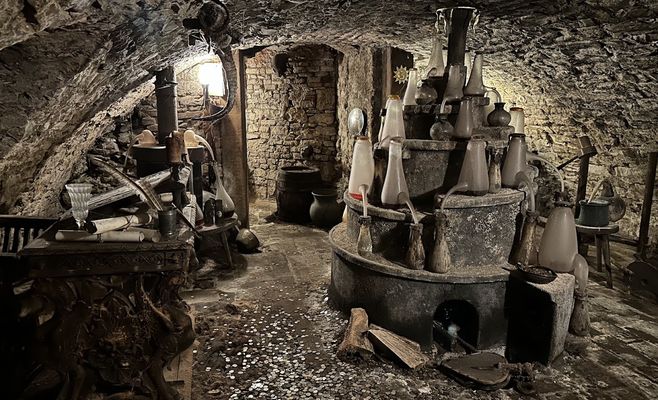
The house on Haštalská street in the Old Town stands on a spot where, according to legend, alchemists worked during the reign of Emperor Rudolf II. It's the city's most unusual small museum: a 30-minute guided tour through genuine underground alchemical workshops and tunnels, rediscovered after the 2002 Prague floods. A guided ticket costs around 200 CZK — the tour is short but atmospheric, ideal for anyone drawn to Prague's mystical history.
Muzeum alchymistů a mágů staré Prahy, Jánský vršek 8, Malá Strana
Another "alchemy" address, this time in Malá Strana. This is one of Prague's most mysterious museums — the house where the alchemist Kelley lived and worked, the man who convinced Emperor Rudolf II that he could turn base metals into gold. Inside you'll find one of the city's oldest staircases, along with laboratories, a study, and a library furnished as if the alchemist had just stepped out. Open daily from 10:00 to 20:00, the museum is compact and perfect for a quick but eventful visit.
Sex Machines Museum, Melantrichova, Staré Město
A controversial but genuinely one-of-a-kind entry on the map of the world's strangest museums. This is one of the city's most unusual museums, dedicated to devices, clothing, and objects related to human sexuality throughout history, with an exhibition spread across three floors and hundreds of items. The collection was assembled by collector Oriano Bizzocchi, who spent decades hunting down pieces in antique shops around the world. The museum sits just steps from Old Town Square, definitely not for kids, but one of the most talked-about Prague curiosities among foreign travelers.
Muzeum miniatur, Strahovské nádvoří 11, Hradčany
Right next to Strahov Monastery, near Prague Castle itself, hides a museum of micro-miniatures. It's one of the most unusual art forms in Prague: a collection of micro-miniature artworks so tiny they're invisible to the naked eye — created on a human hair or a mosquito's leg, and meant to be viewed through a microscope or magnifying glass. 20–30 minutes is enough to see everything, and it pairs nicely with a walk around Hradčany.
Bunkr Parukářka (Bunkr Bezovka), Žižkov
Beneath a park on the Svatého Kříže hill in Žižkov lies a genuine Cold War nuclear bunker. This underground complex was built between 1950 and 1955 and designed to shelter roughly 2,500 people in the event of nuclear war. Today it houses a Cold War Museum, an 11-meter climbing wall, and an original bar with a terrace right at the bunker's entrance. Tours are guided-only, by advance booking, with several routes of varying length and depth of exploration.
Muzeum Káji Saudka, 28. října 3, Praha 1
A comic-art museum dedicated to a single artist — Kája Saudek, the "king of Czech comics" — located above the Batalion club near Wenceslas Square. The museum sits right in the center of Prague, on 28. října street, above the Batalion club, which is itself decorated with Saudek's drawings evoking the atmosphere of 1950s–60s America. The exhibition includes about a hundred works spanning the artist's career from the 1950s to 2004, with the core focused on his most prolific period. Tickets cost 80 to 120 CZK, and the museum is open daily.
Muzeum smyslů (Museum of Senses), Jindřišská 20, Nové Město
An interactive museum of optical illusions just steps from Wenceslas Square, great for families and anyone who loves unusual photos. It's an interactive museum with more than 90 exhibits dedicated to optical illusions and perception, spread across 17 rooms. Located at Jindřišská 20, Praha 1, Nové Město, just a few minutes' walk from Wenceslas Square, the museum is open daily, including holidays.
Dům U Černé Matky Boží (Muzeum Českého kubismu), Ovocný trh, Staré Město
One of the few buildings in the world built entirely in the Cubist style stands just steps from Old Town Square. The "House of the Black Madonna," named after the statuette on its façade, is a landmark of Cubist architecture, and the main exhibit here is the building itself, completed in 1911 to a design by architect Josef Gočár. Inside you'll find paintings, tableware, and everyday objects in the Cubist style, with the building's spiral staircase being especially striking. Upstairs there's a cozy café, Grand Café Orient, decorated in the same style — a rare chance not just to see Cubism, but to have a coffee inside it.
All eight of these places share one thing in common: they tell Prague's story through an unconventional lens — mysticism, erotic history, comic-book culture, the Cold War, or architectural experimentation. Most are compact, inexpensive, and easy to combine with each other or with a walk through nearby neighborhoods like Malá Strana, Staré Město, or Žižkov.
See also:
