A Comet, an Eclipse and the Perseids: Czech Photographer Captures Three Celestial Events at Once
USD 21,01
Popular
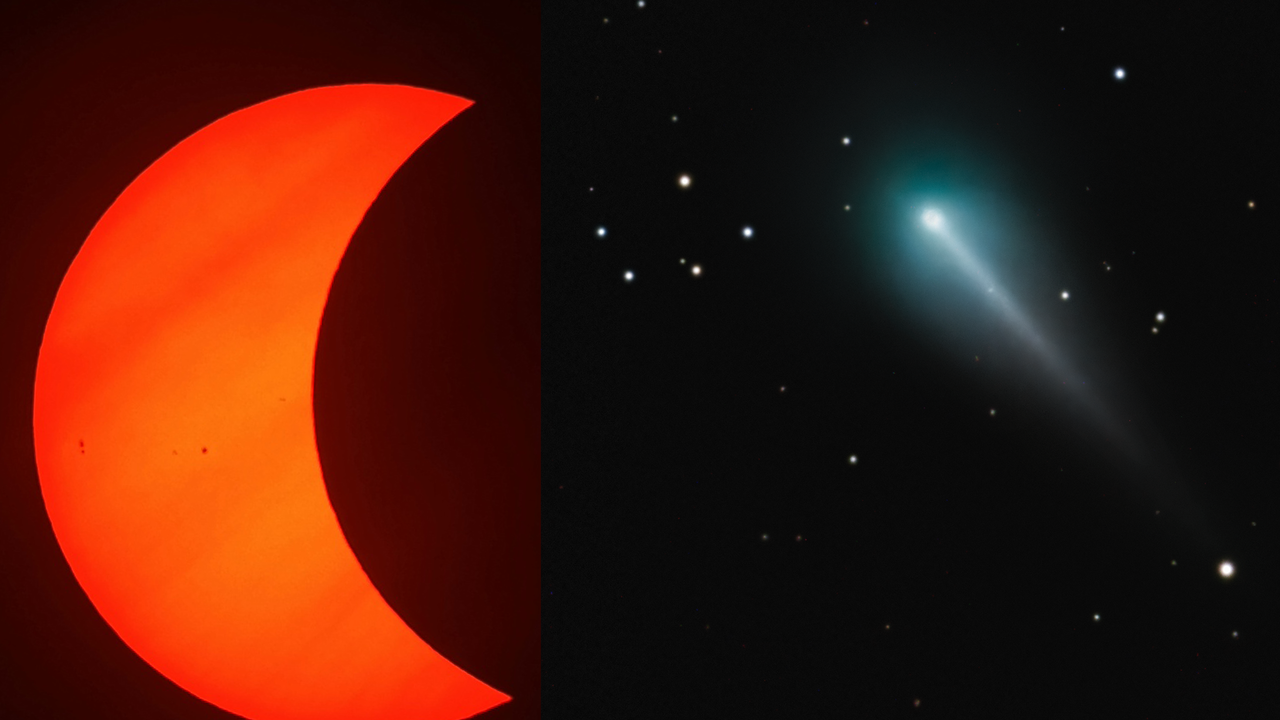
The second week of August treated sky-watchers in Czechia to three rare astronomical events all at once: a sudden outburst of comet 220P/McNaught, one of the most striking partial solar eclipses seen in the country in the past 26 years, and the peak of the Perseid meteor shower. All three coincided almost perfectly in time, turning it into a true test of stamina for astrophotographers.
A comet six hundred times brighter
The short-period comet 220P/McNaught, a member of the Jupiter family, orbits the Sun roughly once every 5.5 years. It was named after the Australian astronomer Robert McNaught, who discovered it in 2004. This year the comet delivered a surprise: at the turn of May and June its brightness surged more than six hundredfold, and in early August it flared up again. As a result, it became visible — and photographable — even through small amateur telescopes, clearly showing up in the constellation Cetus after just 15 minutes of exposure with an automated camera setup.
An eclipse not seen since 1999
The main event was the partial solar eclipse on August 12. The maximum phase occurred at around 20:11 local time, with the Moon covering roughly 88.5% of the Sun's disc over Prague — making it one of the most impressive eclipses visible from Czech territory since 1999. Shooting conditions were far from perfect: dense cloud cover rolled in from the direction of Germany, occasionally obscuring the Sun, though it never blocked the view entirely.
Observers had prepared well in advance, fitting solar filters to cameras and telescopes and scouting locations with a clear view to the west, since the eclipse peaked just as the Sun was already sitting low on the horizon. Crowds gathered at popular viewing spots — some filming on their phones, others simply watching, while those without filters took turns peering through a welding glass passed hand to hand.
A night of shooting stars
Rounding off this eventful astronomical stretch was the Perseid meteor shower — one of the best-known and most prolific annual "star showers." Its source is the periodic comet 109P/Swift-Tuttle, which leaves behind a trail of dust particles that burn up as meteors when they slam into Earth's atmosphere at high speed.
Two cameras ran simultaneously: one captured the Perseids using a long focal length, while the other spent a third consecutive night photographing a nebula region in the constellation Lacerta through a 50mm lens. Back home, while processing the images, a pleasant surprise turned up — the frames from the night of August 12–13 contained several clearly visible meteor trails, one of which even showed a diffuse afterglow caused by ionization of material as it passed through the atmosphere. The result was a composite image of three meteors caught over three nights in the very same patch of sky, set against the real structures of the nebula.
Source: novinky.cz