Germany Reignites Debate Over Banning AfD: A Thousand Lawyers Demand Constitutional Court Action
USD 21,01
Popular
More than a thousand German lawyers, judges and prosecutors have signed an open letter urging the federal government and parliament to launch proceedings to ban the Alternative for Germany (AfD) party through the Constitutional Court. The trigger was a new legal opinion from the Berlin-based Society for Civil Rights (GFF), which took 13 months to prepare and runs to more than a thousand pages of analysis.
A Thousand Lawyers Against AfD
The initiative's organiser — the Republican Lawyers' Association (RAV) — states: "As lawyers, we are obligated to defend the human dignity of all people. That includes taking a firm stand against parties like AfD, which contradicts the basic values of our constitution."
According to GFF experts, the report drew on an analysis of roughly 2.9 million social media posts, 77,000 parliamentary documents and 55,000 AfD press releases, along with more than 2,500 documented incidents. The authors conclude that the party "violates the principle of human dignity and the democratic principle" enshrined in Germany's constitution.
Last year, Germany's domestic intelligence agency (BfV) already classified AfD as a far-right organisation, noting that it is not only the rhetoric of individual figures that is extremist, but the character of the party as a whole, which promotes an ethnic concept of the nation incompatible with the country's constitutional order. However, a legal opinion alone cannot trigger a ban — only the federal government, the Bundestag or the Bundesrat can file such a petition with the Constitutional Court.
Why Not Everyone Supports a Ban
Critics of the initiative point to several risks. First, a court case could fail, which AfD would then use as proof of its legitimacy. Second, Germany's constitution allows a party ban only in exceptional cases — it is not enough to prove anti-constitutional views; one must demonstrate the party's active intent to abolish the free democratic order, with a realistic chance of success.
Chancellor Friedrich Merz's CDU insists that AfD must be defeated politically, by winning back its voters. Commentators also warn that public support for a ban from some judges could undermine confidence in their impartiality during any future proceedings.
Nevertheless, Vice-Chancellor and SPD co-chair Lars Klingbeil told Die Zeit that if the experts' findings are confirmed, banning AfD would become not merely an option but a "democratic duty to protect the country."
Ties to the Neo-Nazi Scene
Investigations by German media outlets — Correctiv, Der Spiegel, Die Zeit and Bayerischer Rundfunk — have repeatedly documented contacts between AfD politicians and their staff and far-right groups. Die Welt, for instance, pointed to Sebastian Schmidtke, former head of the Berlin branch of the neo-Nazi NPD and a convicted extremist whom authorities have described as a "committed neo-Nazi." He now works as a blogger and regularly interviews AfD politicians — this year the party even accredited him as a journalist at its party congress in Erfurt.
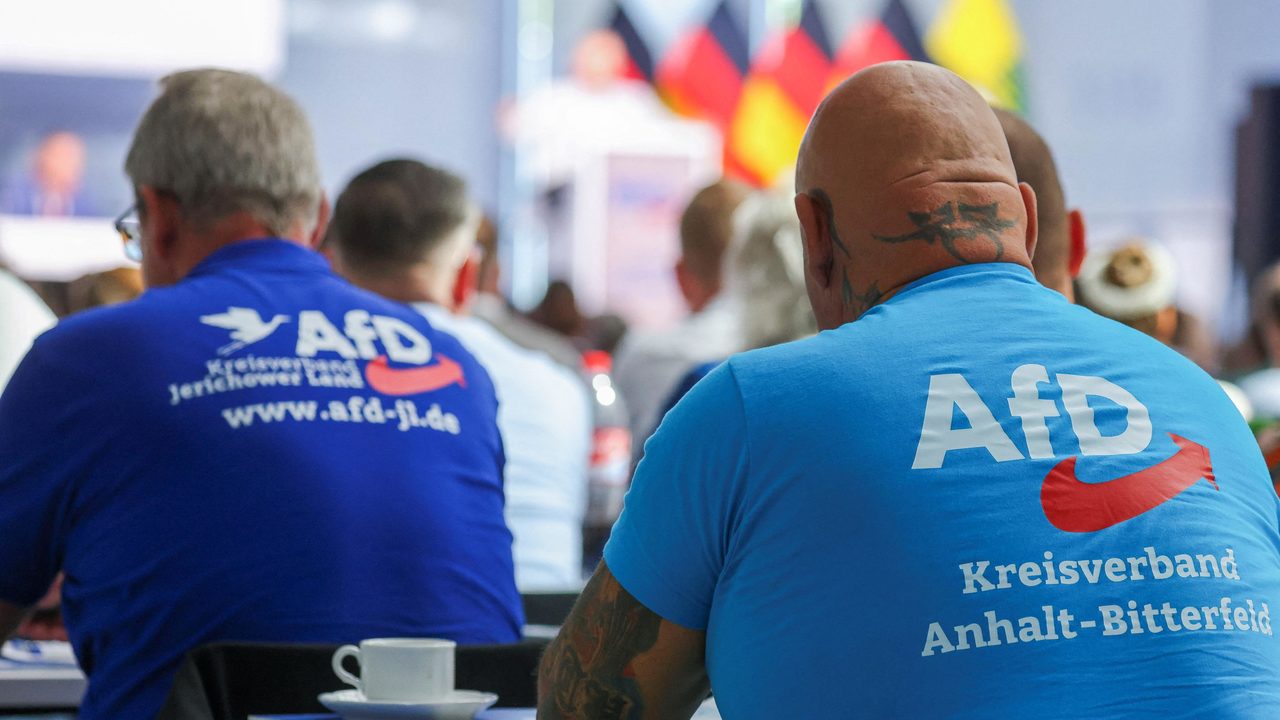
According to Correctiv, the party's new federal leadership, elected in July in Erfurt, is half fresh faces: of the 14 members of the executive board, six are newcomers, many of whom came up through the now-dissolved youth organisation Junge Alternative, which domestic intelligence classified as far-right. The influence of the camp around radical Thuringia leader Björn Höcke and party chair Alice Weidel has grown stronger — Weidel, who back in 2017 supported expelling Höcke from the party over his radical statements, has now instead brought his wing into AfD's mainstream.
At the congress, Weidel backed Höcke's proposal to revise the list of organisations deemed incompatible with party membership — a list that still includes the Identitarian Movement of Austrian extremist Martin Sellner, who promotes the concept of "remigration": not just deporting migrants, but also expelling German citizens with migrant backgrounds. German courts and the authors of the GFF report consider this concept incompatible with the principle of human dignity.
In May, Correctiv also reported on a meeting in Altenburg, Thuringia, organised by the publishing house Jungeuropa and financed by five AfD politicians. Guests included figures from the neo-Nazi scene, among them a member of the Hammerskins network, an associate of the NSU terror cell (which killed ten people between 2000 and 2007), and a member of the militant group Knockout51.
Impact on Elections and AfD's Prospects
The debate is already affecting electoral practice: ahead of local elections in Lower Saxony, stricter vetting rules have been introduced for mayoral and district council candidates, allowing election commissions to request assessments from domestic intelligence. Under the new rules, several AfD candidates have already been barred from running, including Bundestag member Martin Sichert.
The party itself calls this politically motivated pressure. 2026 is shaping up to be a pivotal year for AfD: in March, the party won 18.8% of the vote in Baden-Württemberg, nearly doubling its 2021 result, and around 20% in Rhineland-Palatinate, becoming the main opposition force there. In September, polls put AfD at around 40% in Saxony-Anhalt — meaning the party could win the post of state premier for the first time in its history. AfD is also considered the favourite in Mecklenburg-Western Pomerania, while in Berlin the party is expected to remain in opposition.
Source: seznamzpravy.cz