Mečiar: Havel offered me the post of federal PM in exchange for getting rid of Klaus
USD 21,04
Popular
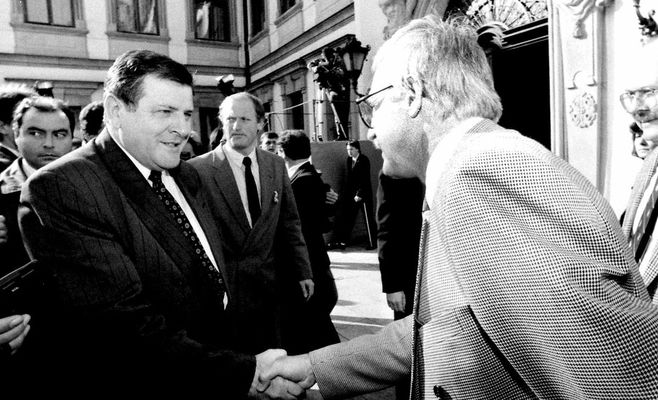
Former Slovak PM Vladimír Mečiar says that in 1990 President Václav Havel offered him the chance to head the federal government on condition that he secure the removal of Václav Klaus from the post of finance minister. Mečiar revealed this in a joint interview with Klaus for the Slovak news agency SITA.
"In 1990, President Havel invited me to a meeting where he offered me the post of chairman of the federal government if I got rid of Finance Minister Klaus. We barely knew each other at the time, but I knew he was the man setting the political course for Czechoslovakia. If that was the condition, I said thank you and declined," Mečiar recounted, adding that his instincts told him to refuse.
Václav Havel served as president from December 1989. In the years following the fall of the communist regime, the federal governments were headed by Marián Čalfa (until mid-1992) and Jan Stráský. Klaus himself served as finance minister under Čalfa during that period, and in the interview he admitted he knew nothing about the alleged Havel offer that Mečiar described.
"Havel did everything he could to make sure I simply wasn't part of that government and wouldn't have the role I ultimately ended up playing. I know that very well, of course," Klaus responded. His relationship with Havel was famously fraught, with the two politicians repeatedly criticizing each other in public.
"The fact that in the 1990 elections I won more preferential votes than all the other politicians combined made it a bit harder for Havel to push me aside completely," the former Czech president added.
In the interview, Mečiar also recalled the negotiations over the split of Czechoslovakia in 1992, which he conducted with Klaus while both men were serving as prime ministers of their respective national governments — at a time when the federation had effectively already collapsed, was no longer functioning, and the political parties had given up on reconciling their differences.
Klaus noted that the negotiations with Mečiar were rational and pragmatic, and led to a concrete outcome. Mečiar admitted he wasn't worried about unrest during the breakup of the federation, of the kind seen for example in the former Yugoslavia, since both politicians had control over the security apparatus. Klaus, for his part, said what he actually feared was indecision — that the talks might drag on endlessly and be blocked from various sides.