Noise from Poland's Turów mine again exceeds limits in Czech village of Uhelná
USD 21,01
Popular
In May, the border village of Uhelná (Liberec Region) recorded night-time noise levels from Poland's Turów coal mine above the permitted threshold — according to the Liberec Region governor's office, the average reading came to 41.1 dB, against a limit of 40 dB. In the neighbouring village of Oldřichov na Hranicích, the reading was 36.8 dB, within the norm.
According to Sykova, a spokesperson for the regional administration, the mine is perceived by local residents as a constant and easily recognisable source of noise — both in terms of volume and direction. After filtering out background interference (such as random noises), the readings no longer exceeded the 40 dB limit: the average in Uhelná came to 36.7 dB, and in Oldřichov to 35.1 dB. These figures are an improvement on the first measurement taken this year, when Uhelná recorded 41.1 dB and Oldřichov 36.8 dB.
Mine shuts down its largest excavator at night
According to Liberec Region governor Martin Půta (of the Mayors for the Liberec Region movement), noise is currently the thorniest issue in Czech-Polish relations over Turów. In response to the May measurements, PGE, the company that owns both the mine and the neighbouring power plant, has started shutting down its largest excavator, the K-22, at night. The effectiveness of this measure has yet to be confirmed, however, since noise from the mine is not measured in summer — it's impossible to separate it from the chirping of crickets and the sounds of people relaxing in nearby areas.
Mining plans through 2044
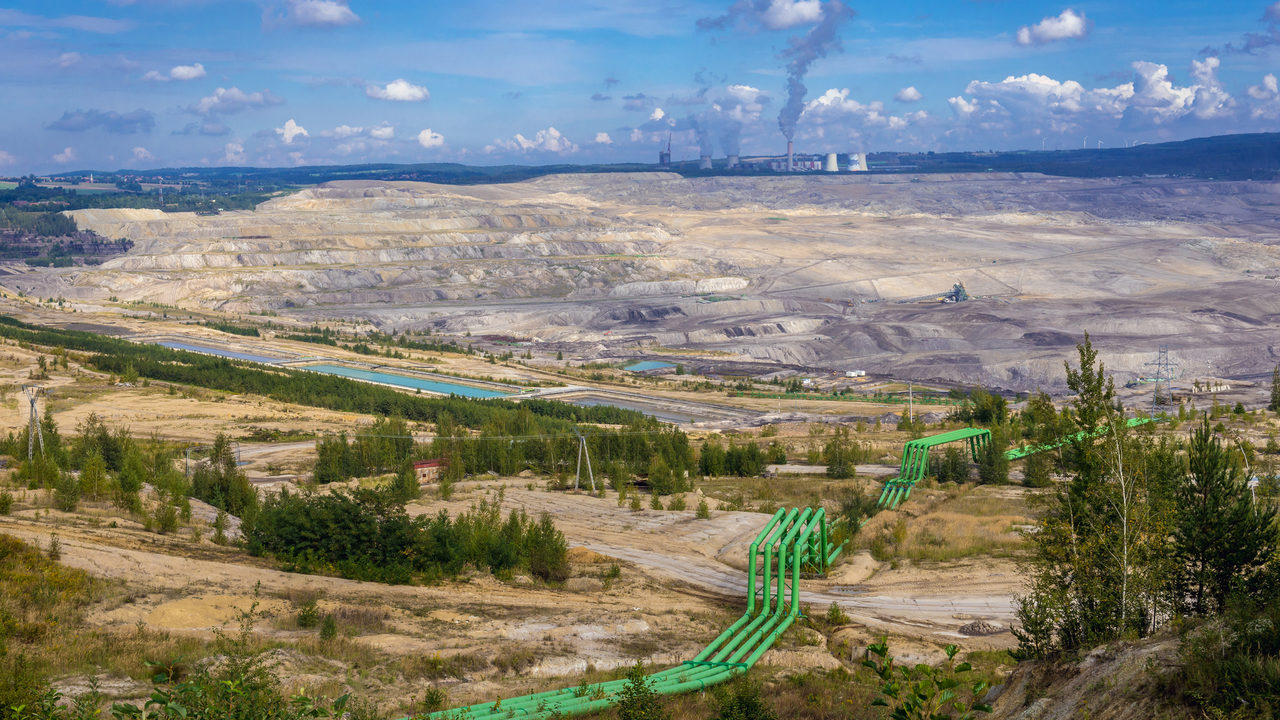
The Turów mine, located near the Czech-Polish border, primarily supplies coal to the adjacent power plant. PGE plans to continue mining there until 2044 and intends to expand the pit to 30 square kilometres along the road from Zittau to Bogatynia. Residents on the Czech side are meant to be protected from noise and dust by an embankment planted with greenery, while an underground barrier is designed to prevent water from draining away from Czech territory.
According to Půta, these measures are working: groundwater levels have stopped declining according to measurements, and sensors have not detected any ground subsidence. Monitoring of the mine's impact on Czech territory is required under an agreement signed by the Czech and Polish prime ministers in February 2022.
Compensation of 1.1 billion crowns
Under that agreement, Poland paid the Czech Republic €45 million (roughly 1.1 billion crowns) in compensation for damages caused. Of that sum, €35 million (849 million crowns) went to the Liberec Region's Turów fund, earmarked for measures to secure drinking water supplies in the border area.
However, Greenpeace, Bund Saxony and the local Uhelná Neighbours' Association argue that the agreement reached is not sufficient to fully protect residents of the border region.
Source: ekolist.cz