Putin Promises United Russia Victory in Duma Elections at Party Congress
USD 21,65
Popular
At the congress of the United Russia party, President Vladimir Putin declared that victory in the upcoming State Duma elections "will be ours" and pledged to carry out all the party's plans together with it. Independent observers, however, note that the outcome of the September vote is effectively predetermined, with the elections themselves designed mainly to create an appearance of political competition and reinforce Russia's image as a "functioning democracy."
The elections are taking place against a backdrop of growing war fatigue among the population and mounting economic costs from the invasion of Ukraine. More than four years into the fighting, Ukrainian strikes on Russian territory have grown increasingly effective, triggering a fuel crisis in the country and hitting major Russian companies. Polls show a rising share of Russians favoring peace, and the liberal Yabloko party unexpectedly gained support after calling for an end to the war — only to be barred from running.
The Merging of Party and Power
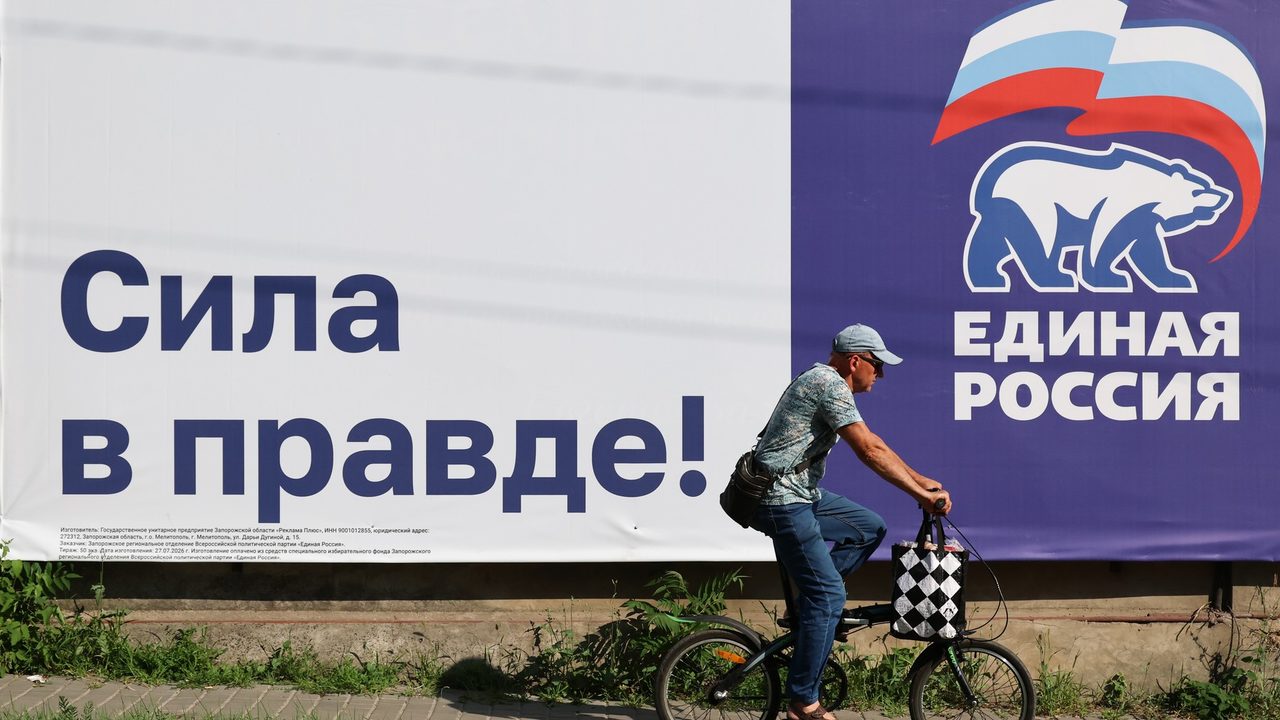
Putin's appearance at the United Russia congress served as further confirmation of the party's ever-tightening fusion with the Kremlin. Formally, the president is not a rank-and-file party member, yet in recent years the line between him and United Russia has effectively disappeared: the party uses Putin's image on campaign posters, while he openly voices his support for it. In the past, many Russians sympathetic to Putin would nonetheless vote against the party itself, whose ratings lagged well behind his personal popularity — but that gap has been steadily narrowing.
The party's formal leader remains former president Dmitry Medvedev, who has emerged since the start of the war as one of the most vocal advocates for its continuation. At the congress, he once again delivered harsh remarks about Ukraine and the West, calling Ukraine a "fictitious country." Medvedev himself, however, did not make it onto the election list — the top five candidates are headed by Foreign Minister Sergei Lavrov and Moscow Mayor Sergei Sobyanin.
A Pillar of the Kremlin System
United Russia was formed in 2001 through the merger of several pro-Kremlin groups and has since grown into one of the main pillars of Putin's system of power. Today the party holds a constitutional majority in the State Duma, and its members occupy key positions in the regions and state institutions.
Unlike many European parties, United Russia lacks a clear-cut ideology — its main unifying thread remains loyalty to the president and his policies. Since the start of the full-scale invasion of Ukraine, the party has become one of the loudest voices backing the war: its members help supply the army, while the party itself promotes Russian policy in occupied Ukrainian territories. It also pursues a broadly conservative agenda, opposing LGBT rights, and some of its members have proposed banning abortion as a way to address the country's demographic crisis.
United Russia's significance extends well beyond control of parliament: the party forms a political network linking the Kremlin to the regions and local elites, serving as one of the main channels through which presidential authority is translated into the everyday workings of the entire state apparatus.
Source: seznamzpravy.cz