A Mars Cloud 1,800 Kilometers Long May Freeze Out of Thin Air
USD 21,70
Popular
A thin white cloud that appears every summer day near a giant Martian volcano may form in a way never before documented in nature: water vapor freezing directly into ice without any dust grain to cling to. That is the proposal in a new paper in Nature Geoscience led by Dr. Jorge Hernández-Bernal of the Sorbonne, as described by Universe Today.
If the idea holds up, the cloud would be the first real-world example of a process that textbooks have long described but that scientists mostly treated as a laboratory curiosity.
The cloud that models could not explain
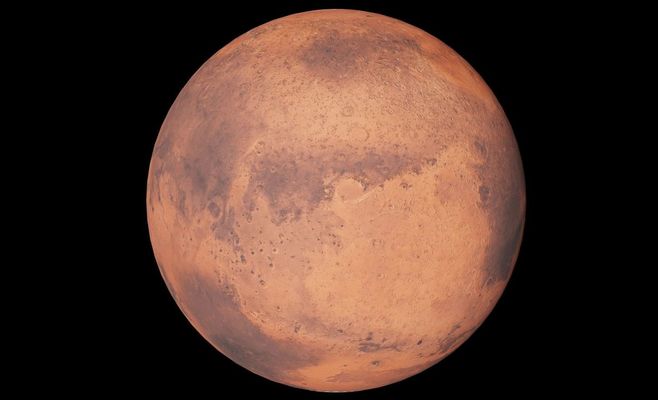
The feature is called the Arsia Mons Elongated Cloud, or AMEC. According to Universe Today, it stretches about 1,800 kilometers to the west of Arsia Mons, an extinct shield volcano roughly 20 kilometers high. It shows up each summer day and fades after a few hours, then returns the next morning.
Scientists have known about it for decades. Atmospheric simulations built on standard cloud theory have failed to reproduce it, Universe Today reported. Those runs produced either broad patches of haze or no long trailing streak at all. Researchers struggled to explain how such a narrow, bright band of water ice could hold together over such a distance.
How clouds normally form, and the exception
On Earth, rising air expands and cools, which raises its relative humidity. Water vapor molecules do not easily stick together on their own, so they usually need a surface. Tiny airborne particles, such as sea salt or pollution, serve that role. This process is called heterogeneous nucleation. Because Mars is dusty, scientists assumed dust grains played this part in the AMEC.
The alternative, homogeneous nucleation, lets water molecules collide and form droplets or ice seeds with no particle involved. Textbooks treat it as possible, Universe Today explained, but it requires extreme humidity. Researchers long assumed there was too much dust in planetary atmospheres for it to matter outside a lab.
What the simulations show near Arsia Mons
The team combined weather models with specialized cloud-physics tools from the Mars Planetary Climate Model to simulate the volcano's summer surroundings. Their results, as Universe Today summarized them, describe a chain of events:
- Westward winds strike the volcano head-on and are pushed sharply upward, creating gravity waves, which are standing ripples in the atmosphere.
- Air passing through these waves expands and cools rapidly, by about 30 degrees in less than fifteen minutes, according to the report.
- Summer air on Mars is relatively free of dust, at about 0.1 dust grains per cubic centimeter, so little dust is available to absorb the vapor.
- Relative humidity in the area climbs to around ten million percent.
- Under those conditions, vapor freezes spontaneously into hundreds of ice crystals per cubic centimeter.
- Winds then carry the new ice out of that small pocket and stretch it into a long, pencil-thin tail.
This is a modeling result. The paper's title says the process is evidenced by the elongated clouds, but the account from Universe Today describes simulations rather than direct measurements of the freezing itself. The researchers suggest the cloud could be an example of the process, not that the question is settled.
Why it matters
This finding does not change anything for daily life on Earth. Its importance is in how scientists understand cloud formation, which underpins models of climate and weather on any planet with an atmosphere.
If cloud formation without particles can happen on Mars, researchers may need to consider it elsewhere. Universe Today noted that places with very high relative humidity and few dust particles could, at least in theory, see the same effect. The examples it gave were the icy plumes of Saturn's moon Enceladus and Earth's own polar mesosphere. For now, the report said, the Martian streak is the only known natural example of this rare process.
The result also changes how scientists read an old puzzle. A cloud that looked like a failure of existing models may instead be a sign that those models left out a mechanism that only works in unusual conditions.
What remains to be tested
Because the conclusion rests on simulations, it is likely to be examined by other researchers who may test whether the same process appears elsewhere in the solar system. Universe Today did not describe any planned follow-up observations or missions tied to the study.
Around Prague, based on reporting by Universe Today