Could Webb's Mysterious Red Dots Be Black Holes Born Before the First Stars?
USD 21,70
Popular
Astronomers at Johns Hopkins University say one of the James Webb Space Telescope's puzzling Little Red Dots could have started life as a primordial black hole, a type of black hole that would have formed in the first moments after the Big Bang, according to Space.com. The idea is still a theory, not a confirmed discovery.
The team tested whether a Little Red Dot called Abell 2744-QSO1, or QSO1, could be explained this way. Their findings were published in June in the journal Physical Review Letters.
What are the Little Red Dots?
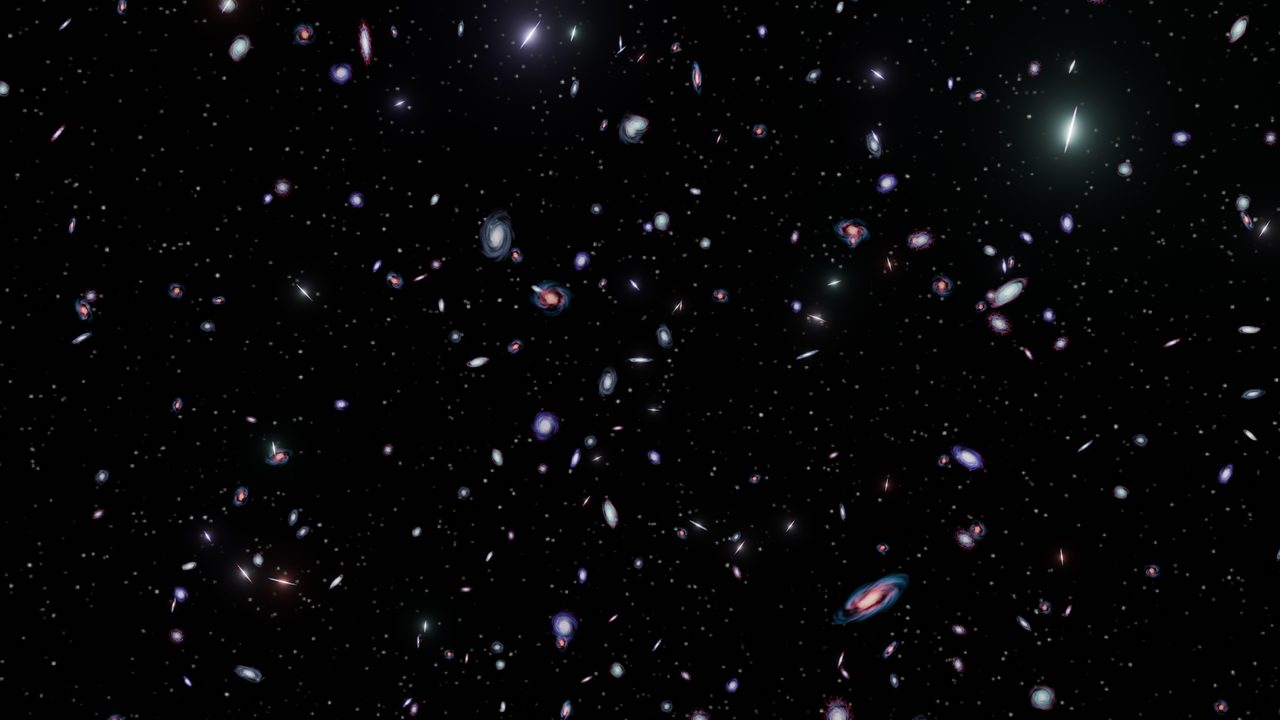
Little Red Dots are compact cosmic objects that Webb has spotted in the early universe. Space.com reports that they seem to vanish completely before the universe is two billion years old, which has made them one of the telescope's many surprises.
What is a primordial black hole?
Ordinary black holes form when a massive star dies and collapses. Primordial black holes would have a different origin. Researcher Valerio De Luca said they come from the physics of the very early universe, before the first stars, when space was expanding exponentially. If they exist, they would be older than stars, dust and any element heavier than hydrogen and helium.
Scientists have discussed the idea since Stephen Hawking proposed it in the 1970s, but Space.com notes that no hard evidence has turned up. A central difficulty is telling a primordial black hole apart from a conventional one.
Why did the team pick QSO1?
QSO1 sits about 13.1 billion light-years from Earth, and Webb sees it as it was just 700 million years after the Big Bang. The object stands out because it is made almost entirely of hydrogen and helium, the universe's first elements. That could make it more pristine than other Little Red Dots.
De Luca said Little Red Dots could surround ordinary black holes, and probably many do, but some might be primordial black holes if those exist. The open question, he said, is which ones are which.
What did the researchers actually do?
They built models of how a Little Red Dot like QSO1 could form from a primordial black hole. Such a formation would need very specific conditions, in part because observations of the universe limit how many primordial black holes can exist and how many can sit in one cluster, according to researcher Loris Del Grosso.
The team examined three possible scenarios. The most likely, they found, is a smaller primordial black hole that swallowed surrounding gas and energy until it reached the size of QSO1. Del Grosso said the door was already open to the idea and the work has pushed it open a little farther by showing that some scenarios are more likely than others.
Why it matters: what would proof change?
The work does not show that primordial black holes exist. It narrows down how one could produce an object like QSO1, which gives astronomers something concrete to test.
The stakes are large. De Luca said scientists lack a clear picture of what happened right after the Big Bang. If primordial black holes are real, something must have created them, and he called that prospect a groundbreaking discovery in physics.
What happens next?
Del Grosso and colleagues plan to examine the other 100 or so Little Red Dots that Webb has seen, to estimate how many of them could have begun as primordial black holes. Space.com reports that this could eventually supply the evidence that these long-theorized objects were real.
Read next
Webb Telescope Finds Dense Star Clusters That May Have Birthed Black Hole Seeds
Hidden Black Hole or Neutron Star Blamed for Star's Eruptions Every 113 Days
Three Feeding Black Holes Found in One Galaxy 12.5 Billion Light-Years Away
Around Prague, based on reporting by Space.com