Science & Space By

Europe's Reusable Space Rider Mockup Hits the Ground After Parachute Fails

A full-scale mockup of the European Space Agency's Space Rider, the continent's planned first reusable spacecraft, crashed during a drop test on Oct. 6 after its main steerable parachute came off while opening, Space.com reported. ESA says an independent investigation is looking into the cause.

At an ESA Council media briefing on Oct. 22, Géraldine Naja, the agency's director of space transportation, said she hopes the failure will not change the remaining schedule or qualification work. She added that the remaining activities are not on the critical path for Space Rider's development.

How the test unfolded

The mockup was about the size of a minivan and reproduced the size and flight characteristics of the vehicle's reentry module, including avionics for autonomous guidance and navigation. It was released from a helicopter at an altitude of approximately 2 miles (3 kilometers) over a military range on the Italian island of Sardinia.

According to Naja, the smaller drogue parachute opened as planned and began slowing the descent. The larger parafoil then detached as it deployed, leaving the vehicle in freefall until it hit the ground. ESA has recovered all of its components.

The road to this test

Why the parachute matters so much

Space Rider is an uncrewed vehicle meant to carry scientific experiments to orbit for up to two months and then bring them back to Earth for analysis. Its wingless, lifting-body shape relies on a steerable parachute, or parafoil, to guide it toward a landing area. That allows runway-style touchdowns, which Space.com described as more precise than other parachute-assisted recoveries now in use.

The October test was meant to demonstrate exactly that ability, which is a critical requirement if the vehicle is to be flown again after missions in orbit.

What this means for the program

An ESA spokesperson told Space.com that the test was not completed as planned because of an anomaly during the parafoil deployment sequence, following several successful tests with representative vehicle masses. The agency has not named a cause.

Naja called the incident unfortunate but important, saying that many earlier tests had succeeded and that testing and validation are part of developing any space system. For now, the practical consequence is that the parafoil system will have to be shown to work reliably before Space Rider can be trusted to return experiments from orbit.

What happens next

The independent investigation is meant to establish the root cause and inform the next steps, according to ESA. The agency has targeted Space Rider's first orbital mission for later this decade, and Naja's comments suggest that goal has not changed, though ESA has not announced when the next drop test will take place.

Around Prague, based on reporting by Space.com
Share: Telegram WhatsApp

More science news

Euclid Telescope Maps More Than 900m Galaxies and 15,000 Cosmic Lenses
The European Space Agency's Euclid mission has published its first major batch of data, and it contains more than 900m galaxies, The Guardian reported. The release also includes about 15,000 potential
Rare Elite Shoe and Slave-Trade Rings Found on Danish Ship Sunk After Mutiny
Maritime archaeologists working on a 17th-century shipwreck off the coast of Sweden have recovered the rear half of an unusually fine man's shoe and two metal rings once used as currency in the transa
Earth May Have Made Its Own Oceans: Hundreds' Worth Brewed in Fiery Air
Earth may have made much of its own water while it was still forming, instead of relying on icy comets or meteorites to deliver it, according to new research in Nature Geoscience reported by ScienceDa
Physicists Measure Gravity Between Two Specks Weighing 7.6 Milligrams Each
Physicists in China have measured the gravitational attraction between the smallest pair of masses yet, and Newton's law of gravity still held, ScienceAlert reported. The team, led by Shan-Qing Yang o
First Land Animals Could Barely Turn Their Heads, Study Finds
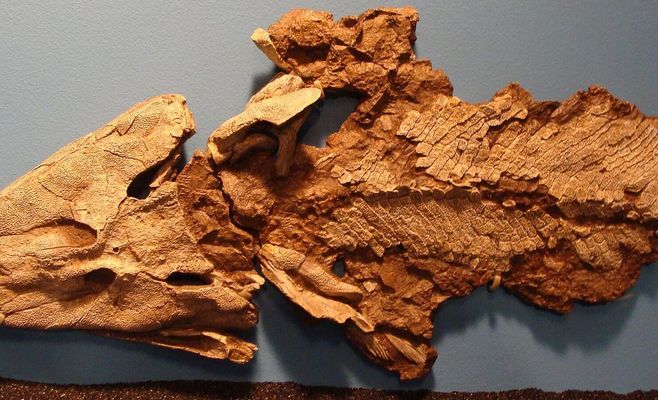
The first animals to move from water to land nearly 380 million years ago may have been able to barely turn their heads, according to a study published Oct. 14 in the journal Nature. The result challe
Supercomputer Simulation Recreates 2 Billion Years of the Early Universe
Researchers at MIT, Harvard University and other institutions have built a supercomputer simulation that follows how the first stars, galaxies and black holes pulled the universe out of its cosmic dar

Related news

The European Space Agency's Euclid mission has published its first major batch of data, and it contains more than 900m galaxies, The Guardian reported. The release also includes about 15,000 potential cases of strong gravitational lensing,
Maritime archaeologists working on a 17th-century shipwreck off the coast of Sweden have recovered the rear half of an unusually fine man's shoe and two metal rings once used as currency in the transatlantic slave trade, Live Science report
Earth may have made much of its own water while it was still forming, instead of relying on icy comets or meteorites to deliver it, according to new research in Nature Geoscience reported by ScienceDaily. Lab experiments suggest that rocky
Physicists in China have measured the gravitational attraction between the smallest pair of masses yet, and Newton's law of gravity still held, ScienceAlert reported. The team, led by Shan-Qing Yang of Sun Yat-sen University, used two silic
The first animals to move from water to land nearly 380 million years ago may have been able to barely turn their heads, according to a study published Oct. 14 in the journal Nature. The result challenges a decades-old explanation for why n
Researchers at MIT, Harvard University and other institutions have built a supercomputer simulation that follows how the first stars, galaxies and black holes pulled the universe out of its cosmic dark age. The model, called Lumina, covers
A gap of 1.2 billion years in the rock record of the Grand Canyon may have been caused by slow movements deep inside the planet, according to new research published Nov. 4 in the journal Nature. Live Science reported that a model of Earth's
A single nuclear explosion high above Earth could knock out almost every satellite in low-Earth orbit within a month, according to a new study reported by ScienceAlert. The work, by researchers at the University of Wisconsin–Madison and Pri
NASA has started a fresh effort to work out how to bring Mars rock samples back to Earth, Space.com reported. The effort is called the Perseverance Sample Retrieval Architecture, or PSRA, and it follows years of cost concerns that have trou
The magnetic fields of Uranus and Neptune may change dramatically within a few decades, according to new computer modeling reported by Universe Today. If the models are right, the fields that Voyager 2 measured on its flybys were a snapshot
Archaeologists in Kazakhstan have found a gold figurine of a bear in a burial mound that is about 2,200 years old, Live Science reported. The mound had been looted in ancient times, but the thieves did not empty it completely. The bear is d
Tiny grains of dust that drifted to Earth from the Kuiper Belt carry the chemical fingerprint of ancient water that looks nothing like the water in our oceans, according to ScienceAlert. A team led by planetary scientist Lindsay Keller of N