First Land Animals Could Barely Turn Their Heads, Study Finds
USD 21,91
Popular
The first animals to move from water to land nearly 380 million years ago may have been able to barely turn their heads, according to a study published Oct. 14 in the journal Nature. The result challenges a decades-old explanation for why necks evolved, Penn State said in a release carried by ScienceDaily.
Researchers argue that necks may not have arisen to help animals look around. Instead, they may have emerged as part of broader skeletal changes that let animals use their front limbs for movement.
The idea scientists long accepted
For decades, the leading explanation was that necks gave early tetrapods, the ancestors of four-limbed vertebrates, better control over their heads as they adapted to life outside the water. An animal in shallow water or on land could benefit from looking downward or side to side to find prey and spot threats without repositioning its whole body.
Modern fish generally lack a distinct neck because their shoulder structures connect directly to the skull, so they usually turn their bodies to look in another direction. Separating the head from the shoulders therefore seemed like a key step toward greater mobility.
Why the question was hard to test
Working out how ancient animals actually moved has been difficult. Much of the backbone of these fish was soft tissue, which rarely survives long enough to become a fossil. Tom Stewart, an assistant professor of biology at Penn State and a member of the research team, said researchers can look to living animals as stand-ins for the past, much as living birds can teach scientists about extinct dinosaurs.
To investigate, an international team combined new fossil evidence with experiments on living fish and computer models of ancient anatomy. One living fish played a central role: the sturgeon, sometimes described as a living fossil because it keeps several ancient anatomical features.
What Devonian fish reveal
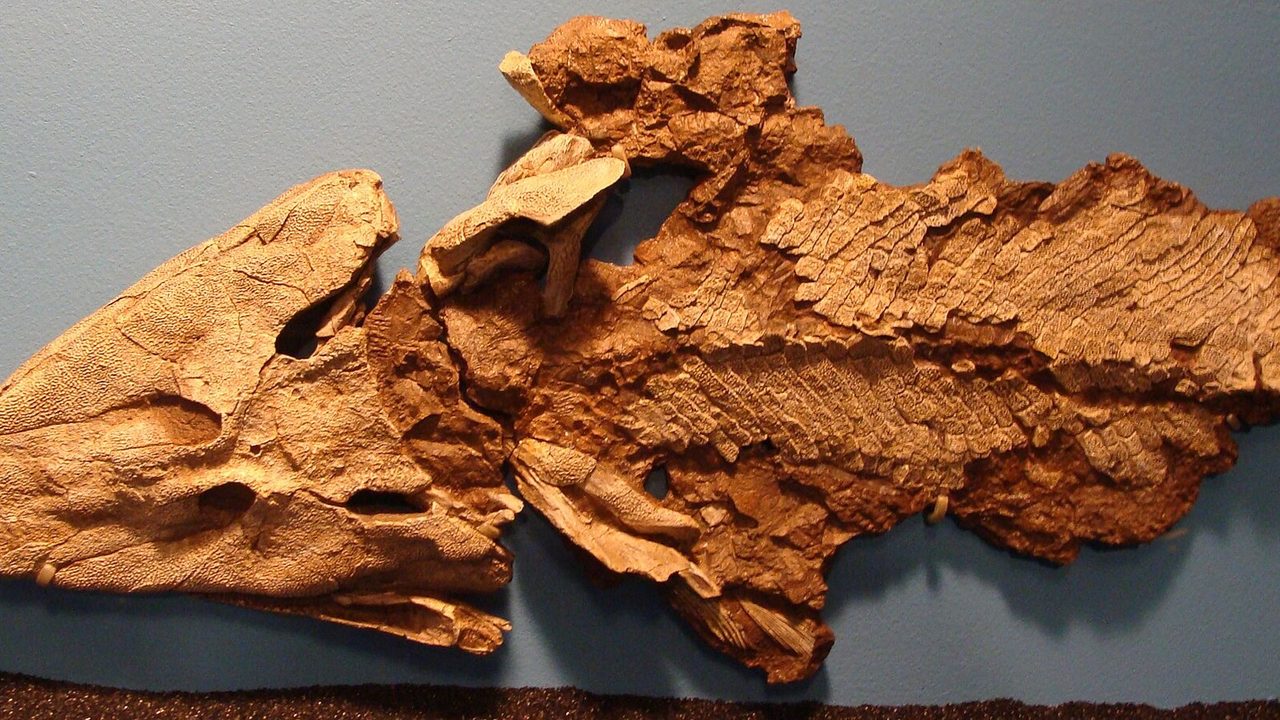
Some of the best evidence for the move onto land comes from fish of the Devonian Period, roughly 420 to 360 million years ago. These animals mixed aquatic traits with newer ones. Some had stronger fins that may have helped support their weight, and certain species show a clear separation between the skull and the shoulders, creating the first distinct necks.
One key example is Tiktaalik, a fossil fish first described in 2006. Its remains were found on Ellesmere Island in Nunavut, Canada. Because Tiktaalik is one of the closest relatives of limbed vertebrates, it helps researchers reconstruct steps such as the shift from suction feeding in water to biting on land, and the change from swimming to walking.
Stewart said it had been reasonably assumed for decades that separating the head from the shoulders allowed freer head movement, so the idea that neck mobility drove the change in the tetrapod body plan had prevailed until now.
Why it matters for how we understand evolution
The study does not change the fact that necks appeared during the move onto land. It changes the likely reason. If early necks were stiff, the new separation between head and shoulders probably did not exist mainly to improve looking around. It may instead be linked to how the front limbs were being used.
Stewart said this was a time of radical reorganization of the Earth, with some of the first forests forming, and that many skeletal changes happening then are still reflected in human bodies today. Understanding when and how the lineage that includes humans made the jump to land, and which parts of the anatomy were changing, is an important part of that story, he said.
Read next
Spinosaurus Likely Spent Nearly All Its Time Underwater, Study Finds
Armored Amphibian Fossils From China Suggest a Creature That Never Left the Sea
A Barrel-Shaped Jurassic Squid Relative Turns Up in Wyoming Fossils
Around Prague, based on reporting by ScienceDaily
Cover photo: Eduard Solà / Wikimedia Commons, CC BY-SA 3.0, cropped