Science & Space By

Giant Black Holes Ruled Out as Dark Matter by Big Bang Afterglow
Physicists have struck another suspect from the list of possible explanations for dark matter. According to Universe Today, a new study in Physical Review Letters concludes that stupendously large black holes, known as SLABs, cannot account for a significant share of the invisible material that shapes galaxies.

The finding rests on the oldest light in the universe. If such black holes had existed in large numbers, they would have left a telltale mark on it, and the data show no such mark.

What are stupendously large black holes?

They are a hypothetical subtype of primordial black holes, objects that may have formed in the early universe. Universe Today reported that SLABs, if they exist, would have masses up to 10 billion billion times that of the sun. They are purely theoretical, in contrast to the supermassive black holes that astronomers do observe.

The idea is that they formed directly from dense patches of matter after the Big Bang. They would not have needed to go through the life cycle of a massive star, which ends in a supernova explosion.

How did researchers test the idea?

The team first modeled how SLABs would affect the cosmic microwave background, the relic radiation from the Big Bang. That light was released when the universe was about 380,000 years old. It looks mostly smooth, but sensitive instruments can pick up small fluctuations.

The researchers then compared their model with real observations, largely from the European Space Agency's Planck satellite. According to Universe Today, the actual background lacks the grainy texture that a population of SLABs would have imprinted on it. The authors write that such black holes would produce disturbances larger than current Planck limits allow, which excludes them as a significant part of dark matter.

The paper is titled “Closing the Mass Window for Stupendously Large Black Holes.” The lead author is Christopher Gerlach, a theoretical physicist at Johannes Gutenberg University in Mainz, Germany.

Why is old Planck data still useful?

Planck ended its mission in 2013, yet scientists keep extracting new results from its measurements. Universe Today said better computing power, new datasets that did not exist then and improved ways of filtering out interference from the Milky Way all help. Gerlach said that new insights 13 years after the shutdown show how important the satellite remains.

What does this mean for the search for dark matter?

Earlier work had already all but ruled out ordinary primordial black holes as the sole source of dark matter. Gerlach and his colleagues describe the new result as closing a remaining gap in the range of black hole masses, with Universe Today noting that SLABs ranged from 100 million to 10 billion billion solar masses in the scenario they tested.

Dark matter is still unexplained. Other candidates, including hypothetical particles such as WIMPs and axions, remain on the table. The study narrows the field rather than solving the puzzle, which fits the idea, raised by Universe Today, that dark matter may eventually be identified by a process of elimination.

Does it affect explanations for the early galaxies Webb found?

Yes. When the James Webb Space Telescope found early galaxies that were more massive than models of galaxy formation predicted, researchers looked for explanations. A 2022 study suggested that primordial black holes, making up a fraction of dark matter, could have helped those galaxies grow quickly.

The new authors write that their results challenge scenarios that attribute the early massive galaxy candidates to fluctuations caused by primordial black holes. Universe Today described that explanation as unlikely to be true given the results. The reported work is a published study, and the question of why Webb sees such massive early galaxies remains open.

Around Prague, based on reporting by Universe Today

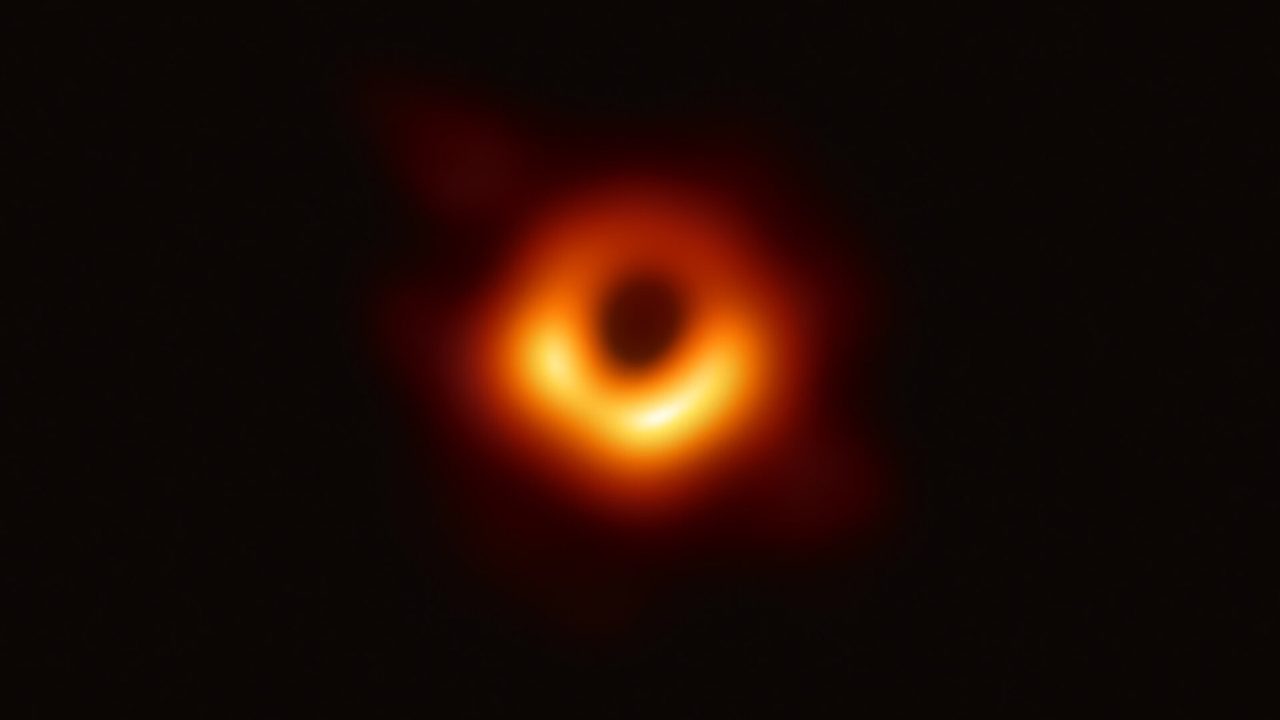
Cover photo: Event Horizon Telescope / Wikimedia Commons, CC BY 4.0, cropped
Share: Telegram WhatsApp

More science news

Physicists Calculate How Far Time Could Run Backward: One Femtosecond
A new mathematical study asks how far time could effectively be made to run backward in a quantum system, and the answer is almost nothing. According to ScienceAlert, physicists Yakir Aharonov of Tel
Leonid Meteor Shower Peaks Nov. 17, but Expect Just 15 an Hour
The Leonid meteor shower, famous for storms that once rained tens of thousands of meteors an hour, is heading for a lean year. Space.com reported that this year's display is expected to be weak, with
Distant Galaxy Group Is Low on Star-Making Gas, Astronomers Find
Astronomers have measured how much of the raw material for new stars remains in a dense, distant group of galaxies, and the answer is not much. According to Universe Today, galaxies in the group, know
Radio Pulses Every Eight Minutes Traced to a Dead Star Orbiting a Sun-Like One
Astronomers have tracked a mysterious repeating radio signal to a pairing of a white dwarf, the remnant of a dead star, and a living star much like the sun, Space.com reported. The system, called GPM
Leonid Meteors Peak Nov. 17, but a Storm Isn't Expected This Year
The Leonid meteor shower peaks on Nov. 17 at about 3:00 Universal Time, and the Moon is cooperating this year, according to Universe Today. Forecasters expect only a modest show of roughly 20 meteors
Earth’s Own Air Fueled 85% of Particles in May 2024 Solar Superstorm
Earth’s own atmosphere may have helped turn the May 2024 solar storm into one of the most powerful in decades, according to a study in Science Advances. Satellite measurements showed that roughly 85%

Related news

A new mathematical study asks how far time could effectively be made to run backward in a quantum system, and the answer is almost nothing. According to ScienceAlert, physicists Yakir Aharonov of Tel Aviv University and Avshalom C. Elitzur
The Leonid meteor shower, famous for storms that once rained tens of thousands of meteors an hour, is heading for a lean year. Space.com reported that this year's display is expected to be weak, with long stretches when not a single Leonid
Astronomers have measured how much of the raw material for new stars remains in a dense, distant group of galaxies, and the answer is not much. According to Universe Today, galaxies in the group, known as COSMOS-Gr30, hold only about 20% to
Astronomers have tracked a mysterious repeating radio signal to a pairing of a white dwarf, the remnant of a dead star, and a living star much like the sun, Space.com reported. The system, called GPM J071507−114153, sits about 5,000 light-y
The Leonid meteor shower peaks on Nov. 17 at about 3:00 Universal Time, and the Moon is cooperating this year, according to Universe Today. Forecasters expect only a modest show of roughly 20 meteors per hour, not the dramatic storm the sho
Earth’s own atmosphere may have helped turn the May 2024 solar storm into one of the most powerful in decades, according to a study in Science Advances. Satellite measurements showed that roughly 85% of the charged particles fueling the dis
Magma that is heated beyond the point where its crystals would normally stay stable can go for more than eight hours without forming new crystals, according to a University of Manchester-led study. In the same experiments, magma that had no
Earth has a temporary new companion. Astronomers have confirmed that a tiny asteroid called 2026 QQ8 was pulled into orbit around the planet in April, and it is expected to stay until January 2027, Live Science reported. The object is about
SpaceX is preparing its most ambitious test yet of Starship, its giant new rocket, and the company's own plans could leave NASA with a problem, NPR reported. As SpaceX shifts resources to Starship, it has said it will stop flying the smalle
The European Space Agency's Euclid space telescope released its first major batch of data on Thursday, Nov. 12, capturing light from more than a billion objects across a huge stretch of sky, Space.com reported. The release, called DR1-Found
A new study of asteroid Bennu's sample has turned up a surprise inside a single molecule, according to Universe Today. Researchers at Penn State measured the carbon in a molecule called beta-alanine from Bennu and from the Murchison meteori
Scientists have set a new record for the coldest temperature ever recorded, according to Live Science: 10 picokelvins, barely above absolute zero. The measurement came from an experiment aboard China's Tiangong space station, where a laser