Science & Space By

Hubble Images a Galaxy Warped Into Arcs as NASA Preps for Roman Telescope
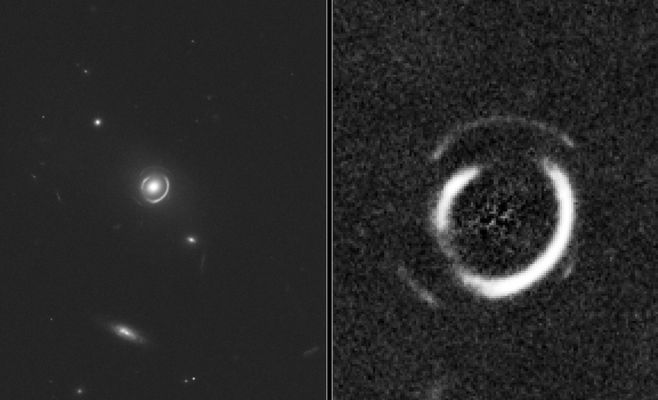
NASA’s Hubble Space Telescope has captured a distant galaxy that is magnified and stretched into a pair of arcs by the gravity of a closer galaxy, the agency announced. The image is one of many gravitational lens observations Hubble is collecting to prepare for science with the new Nancy Grace Roman Space Telescope.

The picture is dominated by a large barred spiral galaxy, but NASA says the real prize is the lens in the lower-right corner, where a precise chance alignment lets one galaxy act like a giant magnifying glass for another.

How a galaxy becomes a lens

According to NASA, gravitational lensing happens when the mass of a foreground object, such as a galaxy, warps spacetime. Light from something behind it bends, distorts and brightens as it passes around the foreground object. The effect only appears when the two galaxies line up closely enough.

In this image, the foreground lens is an elliptical galaxy about 4.5 billion light-years away. NASA notes that the light now reaching Hubble began its journey when the solar system was still forming. The background galaxy is about eight billion light-years away. It shows up as one large, obvious arc to the upper left of the foreground galaxy and a much smaller, flipped copy of the same galaxy to the lower right. NASA calls this an arc-counterarc pair.

Nearly everything else in the frame is also a galaxy, apart from a few foreground stars. The barred spiral, named for arms that extend from a bar of stars in its center, is about the size of the Milky Way, which astronomers think is a barred spiral too. A tiny spiral to its left may be a satellite galaxy, similar to the Large and Small Magellanic Clouds that orbit the Milky Way.

Why it matters: weighing dark matter

The heavier the foreground galaxy, the stronger the lens and the more it bends light. By measuring how much the background galaxy is distorted, researchers can work out how much mass the foreground galaxy holds, NASA explains.

That matters for the study of dark matter, the invisible substance that makes up most of the mass in the universe. The visible matter in the lens galaxy is not enough to account for the amount of distortion seen, so astronomers can use the difference to calculate both the galaxy’s total mass and how much dark matter it contains.

Two telescopes, different strengths

Hubble sees the cosmos mainly in visible and ultraviolet light, with some infrared coverage. Roman sees mostly infrared wavelengths and some visible light. NASA says Hubble delivers high-resolution views of individual objects, while Roman has a much wider field of view suited to panoramas.

That difference shapes the plan. Hubble can examine these lenses only one at a time, while Roman’s broad view of the sky will turn up a far larger sample of them.

What happens next

Astronomers are using Hubble’s sharp images to build a computer model that can better analyze the distortions caused by dark matter. NASA says that tool will help them handle Roman’s large images once they arrive. Hubble will also follow up on interesting lenses that Roman detects, so the two observatories are expected to work together to build a more complete picture of the cosmos.

Around Prague, based on reporting by NASA
Share: Telegram WhatsApp

More science news

Hubble Images Cosmic Lenses That Could Test a Dark Matter Theory
NASA has released a gallery of gravitational lenses photographed by the Hubble Space Telescope, and the images are meant to prepare the ground for the new Nancy Grace Roman Space Telescope. Astronomer
Committee Confirms AI-Built Proof That Yang-Mills Theory Exists, Not the Mass Gap
A committee led by 2004 Nobel laureate in physics David Gross has confirmed that computer code delivered by OpenAI proves pure Yang-Mills theory, the version involving only gluons, exists in four dime
Black Holes Show Warning Signs 1 to 10 Days Before Launching Jets
Black holes can fire narrow streams of superheated material into space, and astrophysicists may now have a way to see one coming. A new study in The Astrophysical Journal found that in four black hole
Plant-Based Coating Could Replace Plastic Lining in Paper Coffee Cups
Researchers at the University of Waterloo in Canada have developed a coating made entirely from plant cellulose that can stand in for the polyethylene lining found inside paper coffee cups, ScienceAle
Euclid Telescope Maps More Than 900m Galaxies and 15,000 Cosmic Lenses
The European Space Agency's Euclid mission has published its first major batch of data, and it contains more than 900m galaxies, The Guardian reported. The release also includes about 15,000 potential
Rare Elite Shoe and Slave-Trade Rings Found on Danish Ship Sunk After Mutiny
Maritime archaeologists working on a 17th-century shipwreck off the coast of Sweden have recovered the rear half of an unusually fine man's shoe and two metal rings once used as currency in the transa

Related news

A committee led by 2004 Nobel laureate in physics David Gross has confirmed that computer code delivered by OpenAI proves pure Yang-Mills theory, the version involving only gluons, exists in four dimensions, according to the Pasquale Pillit
Black holes can fire narrow streams of superheated material into space, and astrophysicists may now have a way to see one coming. A new study in The Astrophysical Journal found that in four black hole systems, telltale changes in X-ray ligh
Researchers at the University of Waterloo in Canada have developed a coating made entirely from plant cellulose that can stand in for the polyethylene lining found inside paper coffee cups, ScienceAlert reported. The team says it could make
The European Space Agency's Euclid mission has published its first major batch of data, and it contains more than 900m galaxies, The Guardian reported. The release also includes about 15,000 potential cases of strong gravitational lensing,
Maritime archaeologists working on a 17th-century shipwreck off the coast of Sweden have recovered the rear half of an unusually fine man's shoe and two metal rings once used as currency in the transatlantic slave trade, Live Science report
Earth may have made much of its own water while it was still forming, instead of relying on icy comets or meteorites to deliver it, according to new research in Nature Geoscience reported by ScienceDaily. Lab experiments suggest that rocky
Physicists in China have measured the gravitational attraction between the smallest pair of masses yet, and Newton's law of gravity still held, ScienceAlert reported. The team, led by Shan-Qing Yang of Sun Yat-sen University, used two silic
The first animals to move from water to land nearly 380 million years ago may have been able to barely turn their heads, according to a study published Oct. 14 in the journal Nature. The result challenges a decades-old explanation for why n
Researchers at MIT, Harvard University and other institutions have built a supercomputer simulation that follows how the first stars, galaxies and black holes pulled the universe out of its cosmic dark age. The model, called Lumina, covers
A gap of 1.2 billion years in the rock record of the Grand Canyon may have been caused by slow movements deep inside the planet, according to new research published Nov. 4 in the journal Nature. Live Science reported that a model of Earth's
A single nuclear explosion high above Earth could knock out almost every satellite in low-Earth orbit within a month, according to a new study reported by ScienceAlert. The work, by researchers at the University of Wisconsin–Madison and Pri
NASA has started a fresh effort to work out how to bring Mars rock samples back to Earth, Space.com reported. The effort is called the Perseverance Sample Retrieval Architecture, or PSRA, and it follows years of cost concerns that have trou