Science & Space By

Webb Photo Shows Golden Galaxies Bending Light From the Early Universe
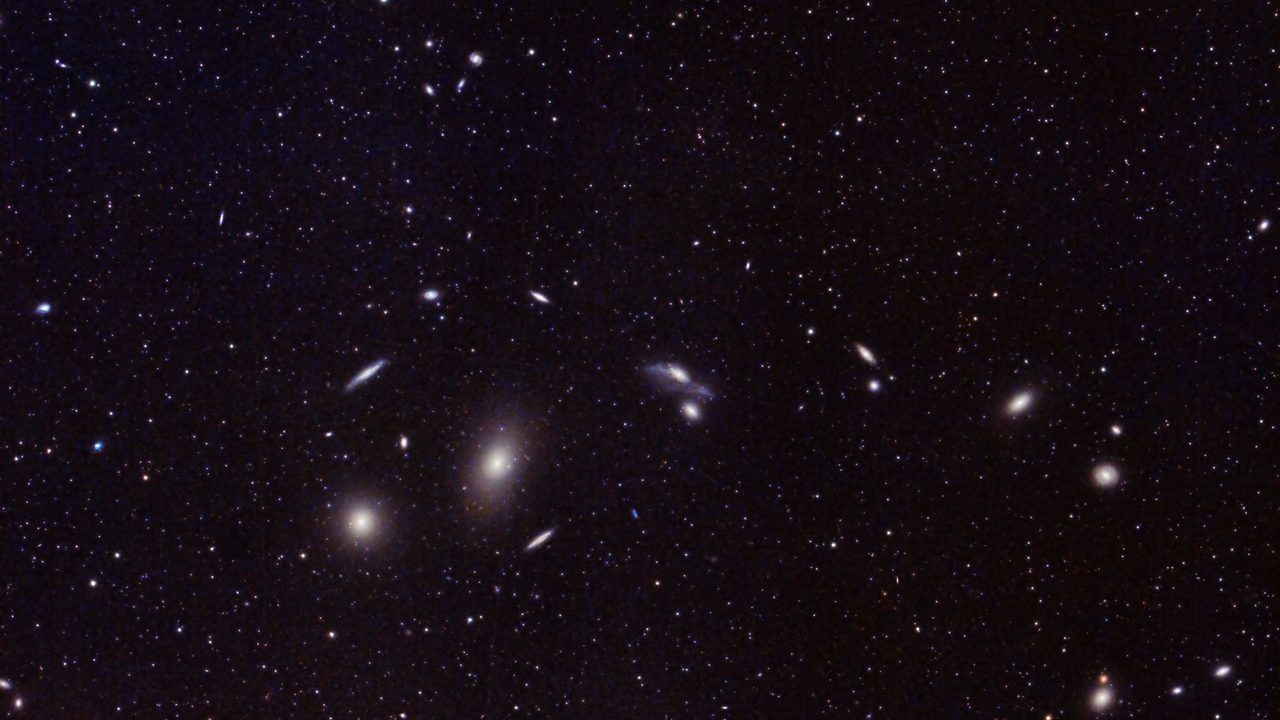
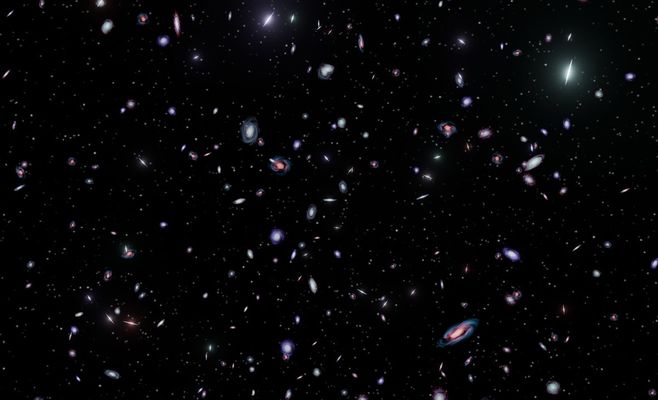
The James Webb Space Telescope has released a new Picture of the Month showing a cluster of golden galaxies that works as a natural magnifying glass for much older galaxies behind it. According to Universe Today, which cited the European Space Agency, the image shows the galaxy cluster MACS J0454.1-030 and the warped light of objects far beyond it.

The result gives astronomers a rare view of galaxies from the early Universe. One of them is seen as it was just 800 million years after the Big Bang.

What the Webb image shows

Universe Today reports that the golden galaxies in the picture belong to the cluster itself. It says the cluster existed when the Universe was 8 billion years old. The orange and red galaxies in the lensed areas are described as considerably older. The red ones in particular existed when the Universe was just 2 billion years old.

The outlet says light from these galaxies traveled about 6 billion light-years to reach the telescope. It describes the picture as the product of Webb's observations of the cluster, which it calls famous.

How a galaxy cluster acts as a lens

The effect behind the image is called gravitational lensing. A galaxy cluster has enormous mass, and that mass warps the fabric of space and time around it. Light from more distant objects passing through that warped region bends and is magnified.

Universe Today notes that astronomers routinely use this effect to study distant objects that telescopes could not otherwise see. The outlet says the technique has opened new windows into the cosmos, and that it is especially powerful when paired with next-generation instruments such as Webb.

Based on various analyses of the image, astronomers estimate that some objects in the lensed area are magnified by a factor of more than 300.

A galaxy from 800 million years after the Big Bang

Astronomers also determined that one galaxy in the image existed just 800 million years after the Big Bang. According to Universe Today, analysis of its light suggests the galaxy was in the middle of a merger, and that the merger set off an enormous burst of star formation.

Current cosmological models suggest that this is how galaxies in the early Universe grew and became more complex. Universe Today says that process eventually produced the elliptical and lenticular galaxies astronomers regularly observe near the Milky Way. The article presents this as what the models suggest, not as a final conclusion drawn from this single galaxy.

Why it matters for understanding the early Universe

For general readers, the image is a visual example of how astronomers see farther back in time than any telescope could manage alone. The cluster does part of the work by magnifying faint light, and Webb collects and records it. Without that boost, objects like the merging early galaxy would be much harder to study.

The finding also helps test an idea about how galaxies are built. Models say early galaxies grew through mergers and bursts of star formation. A galaxy seen in the middle of such a merger fits that picture, though Universe Today describes the evidence as a suggestion from light analysis, so it is one piece of a larger body of research.

The image also shows galaxies from several eras in one frame. The golden cluster galaxies come from a time when the Universe was 8 billion years old. The lensed orange and red galaxies are from earlier times, and the red ones go back to when the Universe was 2 billion years old. Seeing them together gives a sense of how different the cosmos looked at different stages of its history.

What the report does not settle

The report describes the analyses and estimates in general terms. It does not name the research teams behind them, and it does not say whether the findings have been published in a peer-reviewed journal. The magnification figure of more than 300 applies only to some objects in the lensed area, not to the whole image.

Around Prague, based on reporting by Universe Today

Share: Telegram WhatsApp

More science news

Dire Wolves Weren't Really Revived, Researchers Say: They Were Edited Gray Wolves
The dire wolf was not brought back from extinction, two U.S. scientists argue in a new paper. According to ScienceAlert, the animals that biotech company Colossal Biosciences announced in 2025 were gr
Astronomers Map Cosmic Hydrogen From 4.5 Billion Years Ago in a First
Astronomers have made the first direct measurement of the large-scale structure of cosmic hydrogen, the gas that fed the first stars and galaxies, according to Universe Today. The team from the MeerKL
A Hot Jupiter Vanished From View After Seven Years. A Hidden Planet Did It
A giant planet that astronomers had tracked for seven years has dropped out of sight, and a new study says the cause is a second, unseen planet pulling it off course. The world, called TOI-2535 b, is
Telescope Finds a 26-Light-Year Gas Jet, Hinting at a Black Hole Next Door
A team of Japanese astronomers has found a jet of cold molecular gas stretching 26 light-years from LMC P3, a strong gamma-ray source in the Large Magellanic Cloud, according to Universe Today. The fi
Could Webb's Mysterious Red Dots Be Black Holes Born Before the First Stars?
Astronomers at Johns Hopkins University say one of the James Webb Space Telescope's puzzling Little Red Dots could have started life as a primordial black hole, a type of black hole that would have fo
Voyager 1 Hits One Light-Day From Earth, and NASA Wants Your Phone Lit Up
Voyager 1, the most distant human-made object, will have traveled one light-day from Earth on Wednesday, Nov. 18, NASA said. That is more than 16 billion miles (25.9 billion kilometers), and it means

Related news

Astronomers have made the first direct measurement of the large-scale structure of cosmic hydrogen, the gas that fed the first stars and galaxies, according to Universe Today. The team from the MeerKLASS Collaboration says the hydrogen foll
A giant planet that astronomers had tracked for seven years has dropped out of sight, and a new study says the cause is a second, unseen planet pulling it off course. The world, called TOI-2535 b, is about 1,000 light-years away. According
A team of Japanese astronomers has found a jet of cold molecular gas stretching 26 light-years from LMC P3, a strong gamma-ray source in the Large Magellanic Cloud, according to Universe Today. The finding strengthens the case that the obje
Astronomers at Johns Hopkins University say one of the James Webb Space Telescope's puzzling Little Red Dots could have started life as a primordial black hole, a type of black hole that would have formed in the first moments after the Big
Voyager 1, the most distant human-made object, will have traveled one light-day from Earth on Wednesday, Nov. 18, NASA said. That is more than 16 billion miles (25.9 billion kilometers), and it means any light sent from Earth would need 24
NASA will hold a public homecoming event for the Expedition 74 crew at Space Center Houston at 6 p.m. CST on Tuesday, Nov. 17, the agency announced. Six astronauts and cosmonauts from the International Space Station mission will share highl
Gravity may be able to break and reconnect in new arrangements, much like the magnetic fields that power solar flares, according to a new theoretical study reported by ScienceAlert and Live Science. The work comes from physicists Luca Comis
A robot in orbit has assembled a structure without a human working the controls, which Caltech researchers and DARPA describe as a first for space construction, Space.com reported. The robot built part of a reflective antenna, and the finis
A new study argues that millions of small whirlpools of hot gas, churning across the Sun's surface, could supply the energy that keeps its outer atmosphere, the corona, far hotter than the surface below it. Universe Today reported on the pa
NASA's twin ESCAPADE spacecraft have each completed an engine burn close to Earth that is meant to send them on to Mars, Space.com reported. The first probe did it on Nov. 7 and the second followed on Nov. 9, and NASA says both maneuvers we
The Summer Triangle, a famous pattern of three bright stars, has not left the night sky even though summer is long over. According to EarthSky, stargazers in the Northern Hemisphere can find it in November and December, high in the west in
Prestin, a protein inside the inner ear, is drawing attention from two research groups asking different questions. At UConn Health, researchers are testing whether blood levels of prestin can signal tinnitus. At Yale School of Medicine, a n