Spain, the New Hegemon of World Football: The Team Czechia Will Face on October 3
USD 21,04
Popular
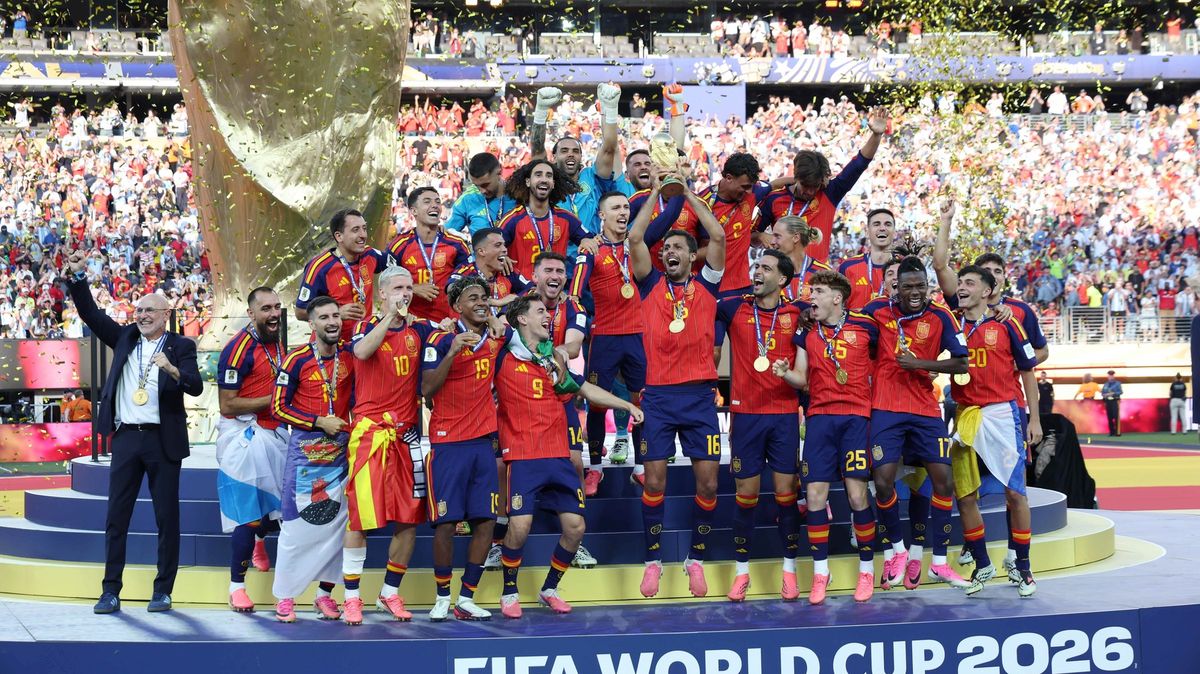
Spain have been crowned world champions, conceding just a single goal across eight matches and showing utter dominance over every opponent they faced. On October 3 in Oviedo, the Czech national team will take on the reigning world champions in the Nations League — and judging by Spain's current form, it will be a tough night for the Czechs.
While celebrations continue across Spain — with honking cars filling the streets, firecrackers going off, and the whole country eagerly awaiting the team's return from the Americas on Monday afternoon — the triumph has been overshadowed by tragedy. In the town of Ciudad Rodrigo, a fountain collapsed under the weight of a celebrating crowd, and a thirteen-year-old boy died.
It would be hard to find a starker contrast between two teams. Spain haven't lost in 38 consecutive matches in regulation or extra time — a world record. The Czech team, by contrast, returned from their last major tournament with a single point and genuine disgrace. Since then, the side has been searching for a new coach following Miroslav Koubek's resignation, and for a new attacking leader after Patrik Schick stepped away from international duty.
Spain's road to the top was a long one. Well into the 21st century, the national team's best World Cup result remained a fourth-place finish in 1950, with their only major title coming at Euro 1964. The country produced legendary players over the decades — goalkeeper Ricardo Zamora, Basque forward Telmo Zarra, Ladislao Kubala, Alfredo Di Stéfano, captain Fernando Hierro, and goal-scorers Emilio Butragueño and Raúl — yet the gold medal eluded them for generations.
The breakthrough finally came in 2008 under coach Luis Aragonés. "We suffered for a long time. We lacked cohesion, the right winning mentality... Football has rewarded our patience," the 70-year-old coach said at the time. Since then, Spain's trophy cabinet has grown impressive: gold at Euro 2008, gold at the 2010 World Cup, gold at Euro 2012, bronze at Euro 2020, gold at Euro 2024, and gold at the 2026 World Cup. Notably, the Spanish women's team are also reigning world champions — the result of a unified, effective development system for both men and women.
It was Aragonés who first began selecting squads based on functionality rather than star status — a principle for which he even left captain Raúl off the Euro 2008 squad, drawing fierce criticism from Madrid's fans. He returned with the gold medal anyway. Today's Spain has moved on from classic tiki-taka, but the underlying principles remain: possession without exhausting sideways passing, immediate pressing after losing the ball, airtight defense, sharp and direct attacks, team cohesion without star egos, and strict tactical discipline paired with creative freedom.
The team's current coach is 65-year-old Luis de la Fuente, who worked his way up through every level of Spain's youth setup and has spent thirteen years with the federation. He left no player off the World Cup squad simply on reputation — he even overlooked young Real Madrid defender Dean Huijsen. Under his guidance, Spain have won youth and junior European titles, reached an Olympic final, and became European champions two years ago. "I coach an outstanding group of lads. They have talent and the best possible approach to football and to life. We are a family," the coach says.
The symbol of Spain's success is Manchester City midfielder Rodri — the reigning Ballon d'Or winner, team captain, and, according to experts, the tournament's most important player, despite not scoring a single goal or recording an assist. The team's top scorer, with five goals, was the unassuming workhorse Mikel Oyarzabal. The decisive goal in the final, scored in extra time, came off the boot of substitute Ferran Torres.
Spain's bench players turned into genuine game-changers throughout the tournament: Mikel Merino came off the bench twice to decide the outcome of two tense knockout matches, even with stars like midfielder Fabián Ruiz and Barcelona wonderkid Pedri warming the bench.
A special mention goes to goalkeeper Unai Simón, who conceded just one goal the entire tournament — to Belgium's Charles De Ketelaere in the quarterfinal. Simón set a record clean-sheet streak of 650 minutes and was named the tournament's best goalkeeper. In the final, not a single shot was registered on his goal. His defense was anchored by young center-back Pau Cubarsí, named the tournament's best young player, and the experienced Aymeric Laporte.
The only blemish on Spain's tournament remains the curious opening match, when the team unexpectedly failed to beat Cape Verde and drew heavy criticism as a result. But that detail will now go down merely as a quirky footnote in the story of the future world champions' triumphant campaign.
Source: seznamzpravy.cz