The death toll from the largest Ebola epidemic in the history of the Democratic Republic of Congo appears to be significantly higher than official statistics show, judging by satellite images of cemeteries in the country’s northeast. According to the government, more than 11,200 people have fallen ill and about 5,500 have died.
Reuters journalists compared satellite images of three cemeteries in Bunia and the main cemetery in Mongbwalu with how they looked before the epidemic. They found far more new graves than the number of Ebola victims in the official reports.
A cemetery that can’t keep up
Mambo Charles, the caretaker of the CECA cemetery in Mongbwalu, has worked in his trade for many years, but says he has never seen a spring like this one. “I have never seen people die like this,” he told reporters in July. According to him, more than two hundred people have been buried here since March. He points out the grave where, he says, the first Ebola victim was laid to rest: “After that, people kept dying one after another.”
The effect is most visible in Mongbwalu itself, where, according to medics, the disease first appeared. By August, noticeably more people had been buried at the CECA cemetery than in the years before the epidemic. That increase alone exceeds the official number of Ebola victims by a quarter for the entire town and surrounding villages. Gravediggers and local officials showed journalists hundreds more graves of Ebola victims at seven other cemeteries.
Official records also confirm the rise in mortality. Registrar Jean-Léonard Benzilieze Guat recorded 190 deaths in his books between April and June, but registered only 51 births over the same period. And even then, only a small share of cases make it into the register: “Many people are buried without anyone telling us. Funeral processions often pass by me, and I can’t stop them. I’m afraid I’ll be told I’m to blame for that person’s death,” he explains. So he prefers to step aside and records only those who come to the office themselves. For the first quarter, he logged just ten deaths in all of Mongbwalu, which, he says, clearly does not reflect reality.
The gold mines in Mongbwalu make matters worse. They draw workers from across the country, many of whom have no relatives here, so there is simply no one to report a death. According to Guat, many of the dead ended up in the ground without a single test.
At first, doctors suspected malaria
Doctors realized that something serious was happening in the town even before the lab results came in. In early May, patients began arriving at the local hospital with symptoms resembling malaria or typhoid fever. Instead of recovering, they quickly got worse, and many died.
“We were often brought dead bodies. And far more people came in with similar symptoms,” says Richard Lokudu, director of the hospital in Mongbwalu. “We didn’t yet know what was going on, but we already knew we had a problem. Possibly one we didn’t yet know about.”
At first, samples were tested for a different strain of Ebola. Positive results came only in mid-May and pointed to the Bundibugyo virus. This is a rare form of Ebola for which there is neither a drug nor a vaccine. The Congolese authorities declared the epidemic on May 15. By then, local medics had counted a hundred unexplained deaths in the town over the previous six weeks, according to a Health Ministry report obtained by Reuters.
From Mongbwalu, the infection spread quickly: many people fled to Bunia, the main city of Ituri province, and to other places. According to the government, this is the largest Ebola epidemic in Congo’s history, and Africa CDC assesses that the country still does not have the situation under control.
The Reuters analysis is the first detailed attempt to estimate how many victims have gone missing from the official statistics. It is consistent with the World Health Organization’s estimate: as early as July, the epidemic was two to four times larger than the available figures indicated. Congo’s Health Ministry did not respond to the analysis.
Every unregistered death is a lost trail: medics do not know whom the person met or whom they might have infected, while the virus keeps spreading. The teams tasked with tracking down suspected cases are already overwhelmed: they lack vehicles, many places can be reached only by broken roads, and false beliefs about the disease circulate among the population.
Most big U.S. retailers will be closed on Thanksgiving Day, Thursday, Nov. 26, 2026, and reopen early on Black Friday. Walmart, Target, Costco, Best Buy, Home Depot and Lowe's all keep their doors shu
The move came in a sharp market-wide rally. The Nasdaq Composite gained 6.51% and the S&P 500 climbed 4.73%. The Dow Jones Industrial Average added 3.01%, or 1,447.98 points, to close at 49,595.31. Mi
American drivers complain about gas that costs more than $3.60 a gallon, but by world standards U.S. fuel is cheap. For the week of Nov. 16, regular gasoline averaged $3.81 a gallon in the United Stat
Gas prices are falling fast heading into Thanksgiving. AAA's national average for regular was $3.637 a gallon on Monday, Nov. 23, down 17.5 cents from a week earlier and about 66 cents below a month a
Alphabet shares jumped 6.34% on Monday, November 23, 2026, riding a broad AI-stock rally after Nvidia reinstated Jensen Huang as CEO. Google's parent company closed at $282.10, up $16.81 from the prev
Monday's surge after Jensen Huang returned as Nvidia's CEO erased only part of the damage from the AI-driven selloff, and analysts say the questions that started it remain open. Fortune reported that
NATO's North Atlantic Council met Monday to discuss Russian missiles that crashed onto Polish territory, and allied airborne early-warning aircraft are already helping to protect Polish airspace, Poland's defense minister said on Nov. 23. W
In Iran, 29-year-old singer Parasta Ahmadi has been punished with 74 lashes for an online concert she gave in a sleeveless dress and without a hijab. According to the BBC, the punishment was carried out on Monday, although the court handed
Russia is producing one ballistic missile every five hours and is still speeding up, Ukrainian Defense Minister Khmara told the NATO Parliamentary Assembly in Berlin on Nov. 23. He argued that the pace is putting growing strain on Ukraine's
NATO will provide Poland with an AWACS long-range radar detection aircraft. This was announced by Polish representative Zalewski after a meeting of Alliance delegates in Brussels. According to him, the system will give Warsaw a deeper opera
All three Calgary police officers charged with manslaughter in the death of Jon Wells have denied wrongdoing through their lawyers, and they are due back in court in January, according to CBC News, CityNews Calgary and the Calgary Herald. T
Moscow has unveiled a bronze memorial plaque to Felix Dzerzhinsky, founder of the Cheka, not far from the Kremlin. As Reuters notes, he is regarded as one of the organizers of the Red Terror, in which hundreds of thousands of people died. T
Tajikistan has started the process of leaving the International Criminal Court, the presidency of the court's governing body said on Monday. Al Jazeera reported that the country formally notified the United Nations of its decision, and that
Three Calgary police officers have been charged with manslaughter and assault causing bodily harm in the death of Jon Wells, a 42-year-old unarmed member of the Blood Tribe who died in custody in Calgary, Alberta, in September 2024. CBC New
At least 29 bodies have been recovered and 50 people rescued after an overcrowded boat carrying mourners to a funeral capsized in Nigeria's Bayelsa State on Friday, a spokesperson for the National Emergency Management Agency (Nema) told the
The European Commission has proposed a new package of sanctions on Russia that would bar Russian athletes and former soldiers from entering the EU, sharply cut the number of Russian tourists and take unusual action against Kyrgyzstan over c
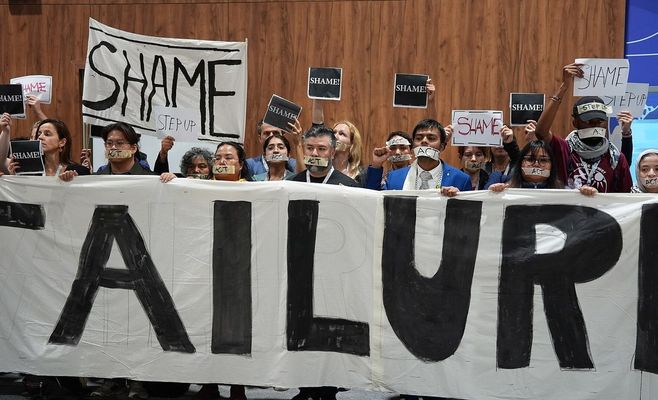
The COP31 climate summit in Antalya, Turkey, ended Sunday without its central political agreement, the Antalya Pacts, after countries split over fossil fuels and money for developing nations. Al Jazeera reported that the European Union and
Police in Denmark and Germany said Monday that the emailed bomb threats sent to schools in both countries appear to be hoaxes, and they told schools there was no reason to evacuate. According to the Pasquale Pillitteri site, no devices have