10 Must-See Attractions in Prague: From Prague Castle to Vyšehrad
USD 21,08
Popular
Prague rightfully holds the title of one of Europe's most beautiful cities, where Gothic, Baroque, Art Nouveau and bold Deconstructivism sit side by side on a compact patch of land. This guide is perfect for first-time visitors to the Czech capital who want to see the highlights in 2–4 days: from the royal castle on the hill to the modern Tančící dům (Dancing House) on the riverbank. You can walk the whole route, splitting it over a couple of days, but it's best to check tickets and opening hours on official websites before your visit — schedules in Prague often change with the seasons.
Pražský hrad (Prague Castle)
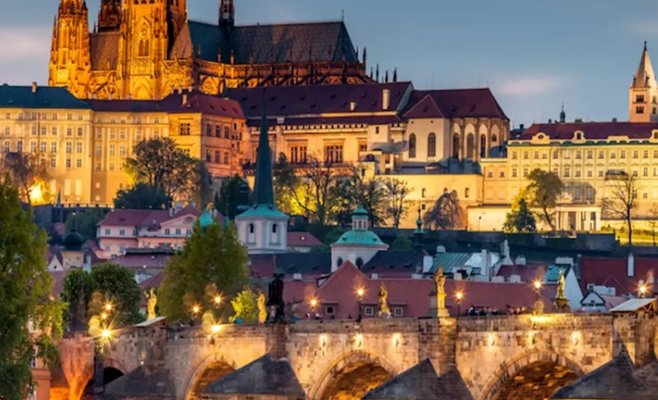
Located in Hradčany, Prague 1, address: Hradčany, 119 08 Praha 1. Pražský hrad is one of the largest ancient castles in the world, covering 70,000 m² — roughly the size of 10 football pitches. Inside you'll find the Royal Palace with elements of Romanesque architecture, Zlatá ulička (Golden Lane), and the main star of the show — Katedrála svatého Víta (St. Vitus Cathedral). Pražský hrad grounds are open year-round from 6:00 to 22:00, while the individual attractions are open from 9:00 to 17:00 in summer and 9:00 to 16:00 in winter. A basic ticket covering the main sights costs 450 CZK, while a ticket to the permanent exhibitions costs 300 CZK. The easiest way to get there is from Malostranská metro station, or by tram 22 or 23 to the Pražský hrad stop.
Katedrála svatého Víta (St. Vitus Cathedral)
Located in the third courtyard of Pražský hrad. Katedrála svatého Víta is the cathedral church of the Prague Archdiocese and the largest church building in the Czech Republic. There's no separate ticket for it — it's only accessible as part of the combined Castle ticket, and only a small part of the interior near the entrance can be seen for free. Plan on spending 3–4 hours exploring the whole Castle complex without rushing.
Karlův most (Charles Bridge)
Connects Staré Město and Malá Strana. This is Prague's most famous landmark and the main pedestrian crossing between Staré Město and Malá Strana, construction of which began in 1357 under Charles IV. When describing this bridge, only superlatives come to mind — the most famous, the most beautiful, the oldest. To see the bridge without crowds of tourists and street vendors, come around 6 am — at that hour only a few photographers remain, along with a quiet Vltava.
Staroměstské náměstí (Old Town Square) and the Astronomical Clock
Staré Město, Prague 1. Staroměstské náměstí is the heart of Prague's Old Town, and among its standout sights is the legendary Astronomical Clock on the tower of the Old Town Hall: every hour from 8 am to 8 pm, the figures on the clock come to life, drawing crowds of tourists. Around the square stand Týnský chrám (Church of Our Lady before Týn), Kostel svatého Mikuláše (Church of St. Nicholas) and the Jan Hus Monument — you could easily spend hours here just admiring the facades.
Vyšehrad
Prague 2, the oldest district, perched on a rocky hill above the Vltava. This is the oldest part of Prague, sitting on the riverbank atop a rocky hill, often called a rival to Pražský hrad. Its main landmark is the Bazilika svatého Petra a Pavla (Basilica of St. Peter and St. Paul): open daily, from 10:00 to 17:00 November through March, and from 10:00 to 18:00 April through October. Nearby is Vyšehradský hřbitov (Vyšehrad Cemetery) — the resting place of prominent figures of the Czech nation such as Karel Čapek, composer Bedřich Smetana and painter Alfons Mucha, with the central avenue leading to the Slavín pantheon. The easiest way to get there is by metro to Vyšehrad station — there are noticeably fewer tourists here than in the center, and the river views are excellent.
Tančící dům (Dancing House)
Prague 2, Nové Město, address: Rašínovo nábřeží 80 / Jiráskovo náměstí 6. The building is listed among the world's hundred most unusual buildings and serves as an architectural metaphor for the legendary dancing duo of the 1940s — Ginger Rogers and Fred Astaire. It was built on the site of a late-19th-century neoclassical building destroyed by American bombing of Prague. On the 7th floor there's an observation deck with views of the Vltava, Petřín and Malá Strana. It's a 15–20 minute walk from Karlův most along the embankment.
Václavské náměstí (Wenceslas Square)
Nové Město, Prague 1. Sooner or later, every traveler visiting the Czech capital ends up on this square, since it sits right in the heart of Prague and connects to many other attractions. It's more of a broad boulevard than a classic square — packed with shops, hotels and the Národní muzeum (National Museum), a convenient meeting point before a walk through the center.
Petřín Hill and Petřínská rozhledna (Petřín Tower)
Malá Strana, Prague 1, tower address: Petřínské sady, Prague 1. Petřínská rozhledna is an unusual and eye-catching landmark resembling the Eiffel Tower in Paris, offering views over the whole of Prague. The tower was built in 1891 for the opening of an international exhibition in Prague — the result was a new exhibition tower on Petřín Hill, modeled on the Eiffel Tower but five times smaller. To reach the observation deck you'll need to climb 299 steps, or simply take the lift. The easiest way up the hill is by funicular from the Újezd stop.
Josefov — the Jewish Quarter
Staré Město, Prague 1. This is an old district with a rich history dating back to the 10th century: the Maiselova synagoga, Španělská synagoga, Staronová synagoga, and Klausova synagoga, the Jewish Town Hall, the Old Jewish Cemetery and the Franz Kafka Monument are among the most-visited sights in the area. A combined ticket covers the synagogues and the cemetery — the route takes 2–3 hours at a leisurely pace.
Strahovský klášter (Strahov Monastery)
Hradčany, address: Strahovské nádvoří 1/132, 118 00 Praha 1. A museum, library and religious center all in one — that's Strahovský klášter, one of the oldest and most famous monasteries in Prague, built back in 1140 for the Premonstratensian order of monks. The library interior is truly beautiful: it's divided into two halls, each with its own book collection, making it a perfect spot for book lovers. It's worth combining a visit to the monastery with a walk up to Petřínská rozhledna — the path between the two is one of the most scenic in the city.
Even if you only have a couple of days in Prague, this list covers the essentials: the Gothic spires of the Castle and Týnský chrám, the romance of Karlův most, the bohemian atmosphere of Vyšehrad and Josefov, the bold architecture of Tančící dům, and the panoramas from Petřín Hill. From there, it's a matter of taste — whether to duck into the quiet courtyards of Malá Strana or head out of town to Karlštejn or Český Krumlov.
