9 Spots in Czechia's National Parks: Šumava, Krkonoše and České Švýcarsko for a Wild Nature Getaway
USD 21,08
Popular
Czechia isn't just Prague and castles — it also has three major national parks with glacial lakes, ancient primeval forests, waterfalls and rock cities. This is a guide for anyone wanting to escape the city for a day or two: the routes here work both for families with kids and for hardcore hikers up for hours on mountain trails. Below are nine tried-and-tested spots in Šumava, Krkonoše and České Švýcarsko, with addresses, landmarks and practical details.
Plešné jezero, Šumava
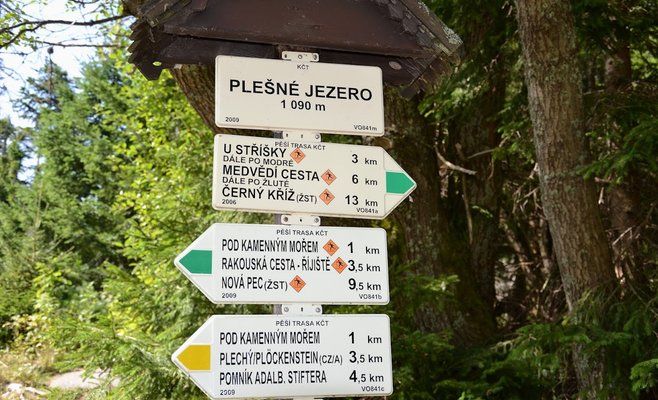
One of five large glacial lakes in southern Šumava, sitting at the foot of Plechý — the highest peak on the Czech side of the range. This ellipse-shaped glacial lake lies on the slope of Plechý (1378 m), the highest point of the Czech part of Šumava, and measures 260 metres long by 90 metres wide. The route to the lake starts in the village of Jelení Vrchy, where you can leave your car in a paid parking lot (100 CZK in season, 80 CZK off-season); from there an easy path follows the old Schwarzenberg Canal, and the full loop around the lake runs about 3.5 km.
Boubínský prales, Šumava
Near the village of Zátoň (Prachatice district) lies one of Europe's oldest primeval forests. The reserve sits 3.5 km northeast of Zátoň and was declared protected way back in 1858 — making it the third-oldest nature reserve in the Czech lands, covering 666.41 hectares. The forest's core is fenced off and closed to visitors, but since 29 June 2023 you can once again approach the local pond via a boardwalk trail with a small bridge. Nearby stands a lookout tower on the summit of Boubín — entry to both the tower and the forest area is free, and the 21-metre tower has 109 steps.
Povydří, Antýgl – Čeňkova Pila, Šumava
The romantic gorge of the Vydra river between the settlements of Antýgl and Čeňkova Pila is considered a signature sight of southern Šumava. Povydří is a protected natural monument and also falls within Šumava's first zone, stretching between the villages of Srní and Horská Kvilda. It's known for its educational trail starting at Antýgl and leading to Čeňkova Pila through the Vydra canyon, famous for its rocky riverbed — this stretch of Šumava is considered the most beautiful and romantic. The trail is easy and even manageable with a stroller.
Černé jezero a Čertovo jezero, Šumava
The two best-known glacial lakes of northern Šumava lie above the town of Železná Ruda. From the Špičácké sedlo saddle, 5 km from Železná Ruda, an easy path leads to Černé jezero (Black Lake), nearly 40 metres deep — its dark colour comes from conifer pollen sediment settled on the bottom. The site lies within a nature reserve — the Black and Devil's Lake reserve sits in an untouched part of Šumava and ranks among the most visited destinations in the whole range.
Sněžka, Pec pod Sněžkou, Krkonoše
Czechia's highest peak and the symbol of Krkonoše National Park. At 1602 m, Sněžka is the country's tallest mountain, offering panoramic views over Czechia and neighbouring Poland. The summit is bare and rocky, home to a Polish cottage with a weather station, a Czech post office with a snack bar, and the round Chapel of St. Vavřinec from 1681. The most scenic and demanding ascent runs through the Obří důl gorge — the most beautiful but also the toughest route up Sněžka. For those who'd rather skip the climb, a chairlift runs from Pec pod Sněžkou.
Pančavský vodopád a Labský důl, Krkonoše
Pančavský vodopád is the tallest waterfall in Czechia, and Labský důl is one of the most beautiful gorges in the mountains. At 148 m, Pančavský vodopád is the country's highest waterfall, cascading down from Pančavská louka into Labský důl. Near the falls is the Ambrožova vyhlídka lookout, offering a panorama over Labský důl, the Kozí hřbety ridges, Kotel and Lysá hora. A classic route is the popular 17-km loop from Špindlerův Mlýn to Kotel mountain, passing Pančavský vodopád, on through Labská bouda to the source of the Elbe (Labe), and back via Labský vodopád and Labský důl — one of the busiest trails in all of Krkonoše.
Mumlavský vodopád, Harrachov, Krkonoše
The country's most famous waterfall is just a kilometre from the town of Harrachov. Mumlavský vodopád, on the Mumlava river, lies about 1 km above Harrachov, reached via a blue-marked trail. The path is easy and suitable for a family outing with kids — the gentle blue trail leading to the falls passes the Šindelka museum, with its forestry and hunting exhibition, and the Mumlavská bouda restaurant. The spot also has a bit of film history: a scene from the movie "Wedding Trip to Ilza" ("Šeříková Ilza") with Libuše Šafránková and Josef Abrahám was filmed here at the waterfall.
Pravčická brána, Hřensko, České Švýcarsko
The symbol of České Švýcarsko and the largest natural rock arch in Europe, a few kilometres from the village of Hřensko. Pravčická brána, the emblem of the České Švýcarsko national park, sits in northern Bohemia near Hřensko — with an opening 16 m high, an arch span of 26.5 m at the base, and a bridge 8 m wide, it's the largest natural rock bridge in Europe. Climbing onto the arch itself is no longer allowed: frequent visits caused increased erosion of the upper sections and damage to the arch, so tourist access to the bridge was banned back in 1982. Nearby stands a historic inn — Italian craftsmen built the sprawling Sokolí hnízdo mansion, whose famous restaurant has drawn tourists for more than 150 years. You can walk there from Hřensko along the red trail markers in about an hour.
Edmundova a Divoká soutěska, Hřensko, České Švýcarsko
Two rock canyons on the Kamenice river with boat rides through them — the park's second most popular attraction after Pravčická brána. You can travel either downstream or upstream; Edmundova soutěska (also called Tichá soutěska) is 960 metres long, while Divoká soutěska is 450 metres. The boat trip through Tichá soutěska takes 20 minutes, through Divoká soutěska 15 minutes, and the boatman shares the history of the gorges and surrounding rock formations along the way. Divoká soutěska is open freely in season, while entry to Edmundova soutěska is only possible with a guide in groups: access is guided-only, in groups of up to 25 people, departing every hour from 10:00 to 17:00. Tickets are sold only on-site at the Hřensko tourist centre on the day of your visit.
The three parks each offer a completely different experience: Šumava means the quiet of peat bogs and glacial lakes, Krkonoše brings rugged alpine scenery and the country's highest point, and České Švýcarsko delivers dramatic sandstone scenery complete with boat rides. When planning a trip, check current trail restrictions (some routes get closed periodically after fires or windstorms) and bring sturdy shoes — nearly everywhere involves hours of walking over rocks and roots.
See also:
