A Guide to Czech Murals: From Prague and Brno to Ostrava and Liberec
USD 21,62
Popular
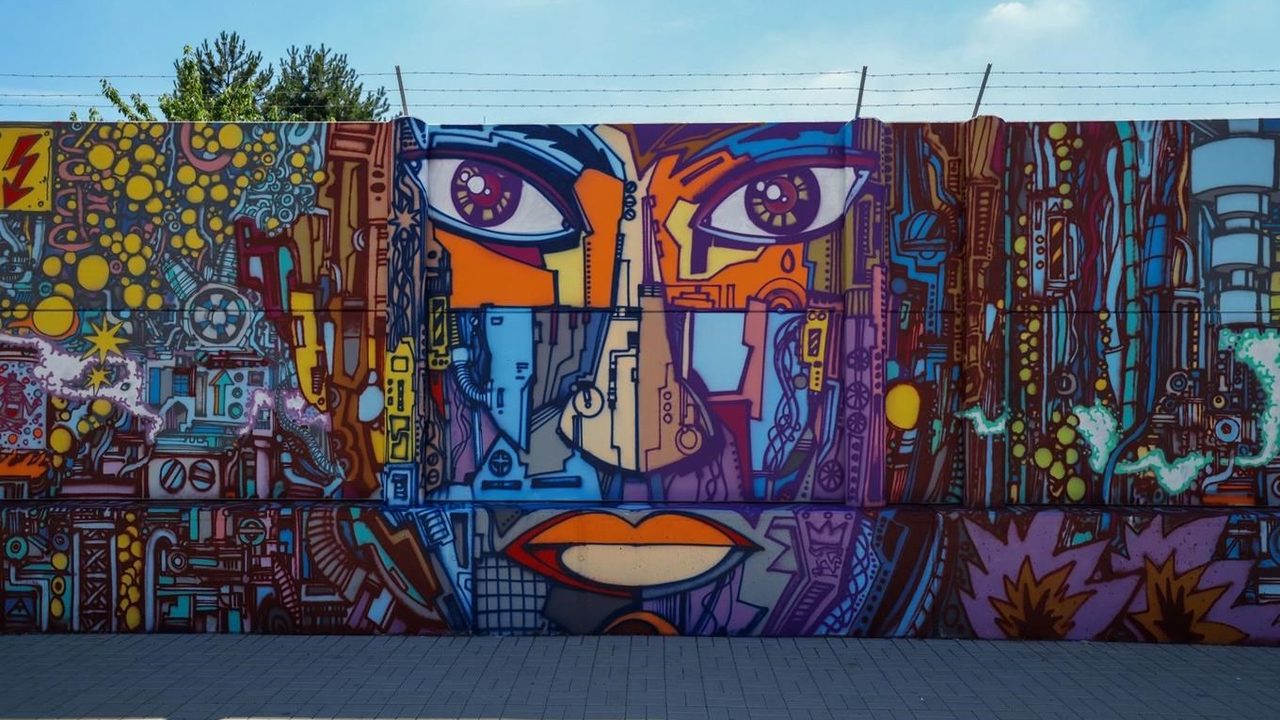
The number of murals in Czechia keeps growing — large-scale wall paintings that, unlike illegal graffiti, are created with the consent of building owners, cities or festival organisers. Across the country, such works are turning drab walls into open-air galleries that anyone can visit for free.
A new gallery in Prague-Ruzyně
The main highlight of 2026 is the Ruzyně Mural on Vlastina Street in Prague-Ruzyně. A concrete wall stretching over 700 metres has been transformed into a monumental open-air gallery. Thirty Czech and international street artists worked on the project, united by the theme "The Beauty of the City in Motion" — with the individual sections of the painting visually flowing into one another.
The project is part of the international Urban Pictus festival, which has long specialised in transforming public spaces through large-scale murals. Czech artists involved include Michal Škapa, Toy_Box, Chemis, Sany and Jakub Titykalo, while the international line-up features Tim Marsh, Bona Berlin, Luca Ledda, Smoka, Juanjo Surace and Krem. According to the organisers, this is the third-longest collaborative mural in Europe, and the section dedicated to kindness and good deeds will eventually be complemented with stories submitted by local residents themselves.
Prague: from the airport to Holešovice
Prague has so many murals that they could form entire sightseeing routes district by district. One of the most striking is "Cosmos" near Václav Havel Airport: a 5,250-square-metre work by Michal Škapa covering a 350-metre CTP warehouse, best seen from the air during take-off or landing on the airport's main runway.
The same artist created the "Jellyfish Universe" mural in Karlín. Other notable works can be found in Spořilov (the "Labyrinth" mural), near the Bořislavka metro station, in Nové Butovice, by the Czech Photo Centre, and in Holešovice, where there's a mural honouring David Attenborough as well as the "Mezikrok" piece in the Vnitroblock complex. In Prague 7, look out for the mural dedicated to Milada Horáková; in Prague 3, there's a work under the railway bridge on Seifertova Street; and in Anděl, a mural pays tribute to Doctors Without Borders.
A special place belongs to the painting near the Vychovatelna tram stop in Prague 8, dedicated to Operation Anthropoid: it tells the story from the paratroopers' landing and the assassination attempt on Reinhard Heydrich to the final battle in the crypt of the church on Resslova Street. Meanwhile, the "Ukrainian Girl" mural by the artist Chemis in Nusle has already disappeared during a building renovation — a reminder that some street art only survives until the next round of repairs.
Brno, Ostrava and other cities
Brno has taken a particularly systematic approach to mural art: as part of the "Brno City Gallery" project, house façades in the so-called "Brno Bronx" have been turned into an open-air gallery, with works visible on Bratislavská, Francouzská, Stará, Příkop and other streets. Murals can also be found at the tram terminus in Lesná, on the Mendel University campus, near the Great Synagogue, and even in the neighbouring town of Šlapanice, where a mural was created based on the fairy tale "Three Wishes for Cinderella."
Ostrava is rightly considered one of the country's street art capitals. On a retaining wall above Bazaly, a mural titled "Wall of Our Tribe" by Jan Bóža Lörincz appeared after he won a competition organised by the city together with the Moravian-Silesian Region. The city is also known for its horse mural above the Černý kůň food market and for "Ostrava Madonna" by American artist Nils Westergaard.
Street art can be found in other regions too: a dragon mural in Liberec pays homage to the region's glassmaking traditions; in Ústí nad Labem, an artist known by the pseudonym Zadek depicted Volodymyr Zelensky in a Star Wars style as a hero fleeing robots marked with the letter Z; and in Zlín, an underground passage hosts a gallery of the region's famous figures — from Baťa and Emil Zátopek to Otto Wichterle and Hermína Týrlová.
As the organisers point out, the main charm of mural art lies in its accessibility: there's no need to visit a museum or wait for an opening — simply walking past a building, a railway crossing or a former factory hall is enough to find yourself in the middle of an entire artwork.
Read also: 6 Prague cemeteries where history and art matter more than mourning: a guide to necropolis-museums
Source: kudyznudy.cz