Taiwanese comedian who joked about Xi Jinping hit by a car

USD 21,86
Popular
Five men have been charged in Taiwan with staging, for money, a car accident meant to maim the comedian Huang Yihao over his jokes about Chinese leader Xi Jinping, prosecutors say. The client in mainland China has not yet been identified by investigators.
Two and a half minutes of jokes
Huang Yihao performs xiangsheng, a genre of rapid-fire verbal banter and rhythmic parody. In a routine lasting about two and a half minutes he took aim at Xi Jinping's appearance, his doctoral dissertation, the change to the constitution, Hong Kong, covid lockdowns, censorship and Winnie the Pooh. A clip from a December 2025 performance spread across social media.
In late May an unknown person hurled four bags of a mixture of paint and human feces at the club where the comedian performs. The accused later admitted that an unidentified Chinese national had paid him; the attack was promised 50,000 Taiwan dollars. China's Taiwan Affairs Office said at the time that it knew no details and that accusations of transnational repression were unfounded.
A staged accident
According to prosecutors, from 25 July a man named Cheng tracked the comedian: he found out where he lived and how he got around, collected details about his car and, investigators claim, fitted a GPS tracker to his scooter. He passed the information to a mainland Chinese resident whom the prosecution calls simply “K”. Cheng himself denies in court installing the tracker.
“K” offered Cheng 450,000 Taiwan dollars (about 300,000 Czech crowns) to seriously injure the comedian in a staged accident: to break his arms and legs so that he could not return to the stage on 20 September. A quarter of a million was to be paid up front, with another 200,000 once the job was done. A man named Zou joined the plot and hired three perpetrators: one sat behind the wheel, a second watched for the comedian's appearance, and a third filmed the collision as proof for the client.
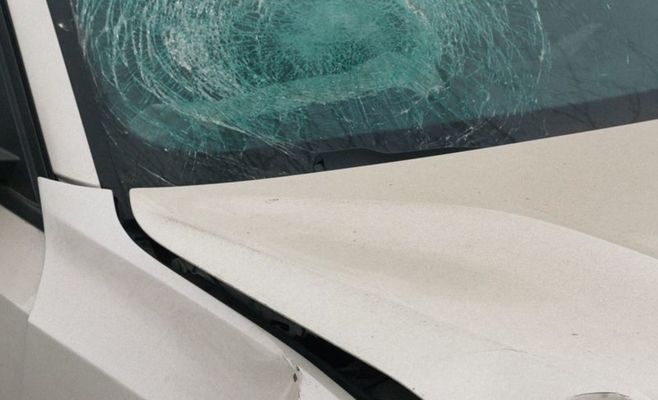
On 11 September, surveillance cameras show, they waited outside the comedian's home in New Taipei from 7:31 a.m. In the afternoon, as Huang was returning on his scooter, the lookout gave a signal and the car deliberately drove into him. According to the comedian, the car came out from the right and the scooter took the first impact, which softened the consequences. Huang got away with a bruised right hip. The attackers got out of the car, apologised and offered help, and later, under the pretext of settling an insurance claim, obtained a copy of his medical report from him and sent it to “K”.
The client was unhappy: the injuries turned out to be minor and, prosecutors say, he refused to pay the remaining 200,000. Suspicion was raised by the cameras, which showed that part of the group had been waiting outside the comedian's home since early morning, and investigators began checking whether the crash was linked to his political performances.
What investigators and the comedian say
“This case concerns a serious incident in which the Chinese Communist Party is suspected of using transnational repression to suppress dissent in our country with extreme violence, through the hands of irresponsible elements,” prosecutors said. However, no evidence has yet been published that “K” worked directly for the Chinese state or the party; his identity is being established.
After a series of raids in October, five people were charged. Cheng admitted to attempting to cause grievous bodily harm; the driver denies that classification and insists on a lesser charge. On 22 October the court kept four in custody and released the man who filmed the collision on bail of 100,000 Taiwan dollars with electronic monitoring. Prosecutors are seeking more than five and a half years in prison for Cheng and between two years and seven months and more than five years for the others.
The comedian told Taiwanese media he is not surprised that local intermediaries were used, but he did not expect to become a target: “I spent just two and a half minutes on a Taiwanese stage criticising Xi Jinping, and then I became the target of a feces attack and a deliberate hit-and-run.” He also asked what such a case means for freedom of speech on the island.
The case has come to court on the eve of Taiwan's local elections, to be held on 28 November. Local intelligence services warn that Beijing is stepping up its attempts to influence voters and public debate. Taiwan's counterintelligence chief Tsai Ming-yen placed Huang's case within the broader picture of transnational repression and noted that such operations typically use criminal gangs or private detective agencies tied to organised crime. Authorities are now checking whether the people behind these networks are directed and financed by the Chinese Communist Party.
Around Prague, based on reporting by seznamzpravy.cz