Science & Space By

A 3D-Printed Honeycomb Taught Its Own Vibrations to Fall Into Step
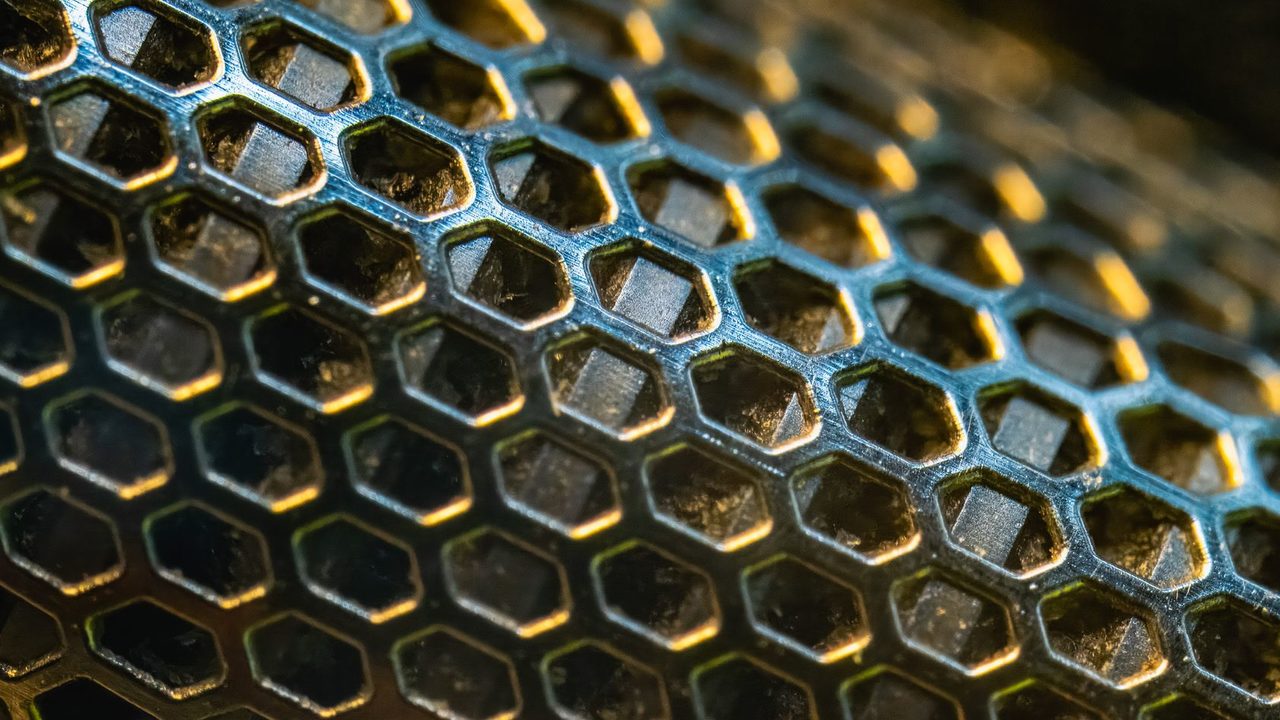
Physicists have found a new way for a time crystal to form: not by pushing a material with an outside rhythm, but by letting competing vibrations settle into a shared beat on their own. ScienceAlert reported that an international team led by Jonas Veenstra of the University of Amsterdam saw this happen in a 3D-printed, two-dimensional metamaterial.

The finding is a laboratory result about how matter can organize itself in time. It points to a possible way around the fragility that has long made these systems hard to build.

What is a time crystal?

ScienceAlert describes a time crystal as a state of matter whose parts follow a strictly repeating pattern in time, like a recording whose beats could be cut at regular intervals and laid perfectly on top of one another. The parts can be atoms, sound waves or topological defects. Once thought impossible, time crystals have been seen in systems ranging from atomic lattices to levitating styrofoam.

What did the team build?

The researchers made a metamaterial, a material whose properties come from its structure rather than what it is made of. It had 37 units in a honeycomb-like lattice. Each unit was made of three elastic hexagons fitted with sensors, actuators and a tiny electronic controller.

The components were programmed to respond to one another unevenly. When one hexagon compressed, its clockwise neighbor compressed too, while its counterclockwise neighbor expanded. This created what physicists call non-reciprocal interactions, in which one part influences another without being influenced back in the same way.

What happened when it was set in motion?

The team nudged the honeycomb with small, random disturbances. At first the units vibrated quickly, at around 30 times per second. Gradually, larger waves traveling around the material's edge overwhelmed the small oscillations. As those waves grew longer, they slowed, until the whole honeycomb moved together in one synchronized rhythm.

The researchers call this process “wave coarsening.”

Does that make it a time crystal?

A synchronized wave alone is not enough. The team had to show that the order could survive random jostling. According to ScienceAlert, they used mathematical analysis and computer simulations, adding noise to their model. The rhythm stayed coherent, even as the modeled system approached an effectively infinite size. So the case for a time crystal rests on that analysis and those simulations, alongside the physical honeycomb experiment.

What was the ring experiment?

To test a different design, the researchers built a single elastic ring fitted with 24 motors, programmed to produce non-reciprocal interactions between neighboring sections. They floated it on an air table to minimize friction. Once activated and disturbed, waves traveled around the ring and bent it into shifting polygon shapes. As the waves lengthened and slowed, the polygons gained fewer sides until one large-scale pattern dominated.

ScienceAlert noted that the team did not separately establish that the ring forms a time crystal. It did, however, shed light on wave coarsening.

The analysis suggests a feedback loop. As waves grow, they shift the system's dynamics toward longer wavelengths, which then grow stronger still. The dominant waves become larger and slower until they hit the limit set by the size of the material. The researchers also found that the process can be interrupted: in their mathematical model, adding friction changed which waves were able to grow.

Why does it matter?

There is no everyday application in the reporting, and the work is at the stage of lab demonstration and modeling. Its significance is for basic physics. Time crystals are easily knocked into disorder, and disturbances are especially damaging in systems with only one or two spatial dimensions. A stable rhythm emerging in a two-dimensional material is therefore notable.

The result also suggests that a material can organize its own vibrations without a rhythm imposed from outside. According to ScienceAlert, that could open a new way for matter to form lasting patterns in time. How far the approach extends beyond these designs has not been shown.

Around Prague, based on reporting by ScienceAlert
Share: Telegram WhatsApp

More science news

Twin NASA Probes Fire Engines Near Earth in a First for Mars Missions
NASA's twin ESCAPADE spacecraft have each completed an engine burn close to Earth that is meant to send them on to Mars, Space.com reported. The first probe did it on Nov. 7 and the second followed on
Summer Triangle Stays in the Evening Sky as Autumn Deepens
The Summer Triangle, a famous pattern of three bright stars, has not left the night sky even though summer is long over. According to EarthSky, stargazers in the Northern Hemisphere can find it in Nov
What Prestin, the Inner Ear's Molecular Motor, Does and What's Unknown
Prestin, a protein inside the inner ear, is drawing attention from two research groups asking different questions. At UConn Health, researchers are testing whether blood levels of prestin can signal t
Perseverance Rover Finds Ruby-Like Mineral Glowing Red on Mars
NASA’s Perseverance rover has detected corundum on Mars, the mineral structure that makes up rubies when it contains chromium. According to a NASA blog post by Roger C. Wiens, the principal investigat
Curiosity Rover Drills Rock Packed With Possible Crystals on Mars
NASA’s Curiosity rover has drilled its 49th hole in Martian rock, a target named Nazca. According to a NASA mission blog written by planetary mineralogist Susanne P. Schwenzer of The Open University i
Fossil Fuel Emissions Fall 0.4% as Iran War Squeezes Oil Use
Global carbon dioxide emissions from burning oil, gas and coal are projected to fall 0.4% this year, according to the 2026 Global Carbon Budget report. Live Science reported it is the first annual dro

Related news

The Summer Triangle, a famous pattern of three bright stars, has not left the night sky even though summer is long over. According to EarthSky, stargazers in the Northern Hemisphere can find it in November and December, high in the west in
Prestin, a protein inside the inner ear, is drawing attention from two research groups asking different questions. At UConn Health, researchers are testing whether blood levels of prestin can signal tinnitus. At Yale School of Medicine, a n
NASA’s Perseverance rover has detected corundum on Mars, the mineral structure that makes up rubies when it contains chromium. According to a NASA blog post by Roger C. Wiens, the principal investigator for the rover’s SuperCam instrument,
NASA’s Curiosity rover has drilled its 49th hole in Martian rock, a target named Nazca. According to a NASA mission blog written by planetary mineralogist Susanne P. Schwenzer of The Open University in the United Kingdom, the team picked th
Global carbon dioxide emissions from burning oil, gas and coal are projected to fall 0.4% this year, according to the 2026 Global Carbon Budget report. Live Science reported it is the first annual drop in fossil fuel CO2 since the coronavir
The first sip of black coffee is often a shock, yet millions of people end up looking forward to it every morning. Scientists at the University of California, San Francisco, say they have found part of the reason: a slow-acting dopamine pat
NASA's new X-70 Fractal is a crewed research aircraft meant to test flight-control technology that the agency says will let it explore maneuverability "in ways never before demonstrated in crewed flight." The idea of reshaping an aircraft i
Martian dust looks less likely to chew through spacesuits than the sharp grit on the Moon, but it carries toxic chemicals and sticks stubbornly to surfaces, according to a new study based on NASA's Perseverance rover. Universe Today reporte
Astronomers have identified the youngest white dwarf ever found orbiting a millisecond pulsar, catching the pair at an early and rare stage of their shared evolution, according to Universe Today. The pulsar, called NGC 362D, sits in the glo
Mars is widely seen as a volcanically dead planet, but a new study suggests its interior may not be fully quiet. Researchers report that an orbiter has picked up traces of hydrochloric acid gas high above one of the planet's largest volcano
Astronomers have found what is behind a giant star's repeated, supernova-like flare-ups: a hidden companion that is either a black hole or a neutron star. According to NASA, the companion pulls material off the massive star every 113 days a
NASA has opened a $1 million competition that asks U.S. students to help design the future Moon Base. Administrator Jared Isaacman announced the Moon Base Student Challenge on Sunday, Nov. 8, at NASA's Kennedy Space Center Visitor Complex i