Distant Galaxy Group Is Low on Star-Making Gas, Astronomers Find
USD 22,10
Popular
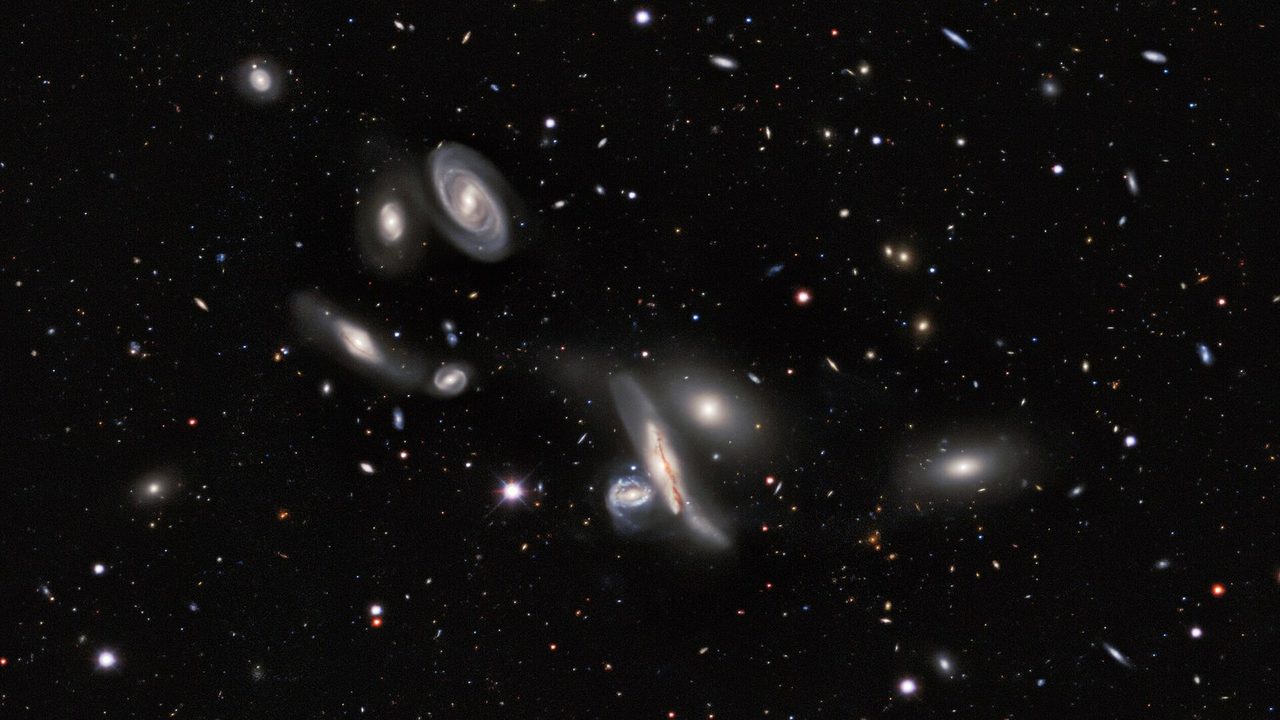
Astronomers have measured how much of the raw material for new stars remains in a dense, distant group of galaxies, and the answer is not much. According to Universe Today, galaxies in the group, known as COSMOS-Gr30, hold only about 20% to 40% of the molecular gas found in typical main-sequence galaxies.
The finding, from a study to be published in Astronomy and Astrophysics, offers a clue to a long-standing question: why the universe makes far fewer stars than it once did. The lead author is Jonathan Freundlich of the University of Strasbourg.
The key numbers
- 6 or 7: the number of new stars the Milky Way forms in a year, according to Universe Today.
- 10 billion years ago: the period called Cosmic Noon, when star formation was as much as 30 times greater than it is today.
- 97%: the approximate drop in the star formation rate since then.
- Eight galaxies: the members of COSMOS-Gr30 surrounded by a large structure of ionized gas that the team detected.
- 20% to 40%: the share of molecular gas that galaxies in this dense environment hold compared with typical main-sequence galaxies.
- Less than one-third: the portion of gas pushed out of the member galaxies into the diffuse structure that is cold enough to form stars.
How the team measured the gas
Stars form from cold, dense gas, so astronomers suspect that something removed or heated much of the gas as the universe aged. Molecular hydrogen, the main ingredient of star-forming clouds, is nearly impossible to detect directly in radio observations. Researchers instead observe carbon monoxide, the second most abundant component of those clouds, and apply a standard conversion to estimate the hydrogen.
The team used the NOEMA array and the 30m telescope of the Institut de Radioastronomie Millimetrique to observe carbon monoxide emission from the group. They also relied on deep observations from the Multi-Unit Spectroscopic Explorer on ESO's Very Large Telescope, which revealed the ionized gas surrounding the eight galaxies. One of them hosts an active galactic nucleus, a bright, energetic core.
Because the researchers measured gas both inside the galaxies and in the space between them, they could see more of the picture than studies that look at galaxies alone. The authors write that the ionized gas is not pristine and was likely expelled from the galaxies by internal processes, such as star formation and outflows from the active nucleus, and by external ones in the dense environment, such as ram pressure stripping and tidal interactions.
Why it matters for understanding the universe
Most galaxies live in groups, so understanding what happens to gas there is central to explaining the decline in star formation. Universe Today notes that measurements of gas supplies in galaxy groups are rare, which makes a direct look at a dense group useful.
The results suggest that gas stripped from galaxies in such an environment mostly does not return to the star-making pool, since less than one-third of it is cold enough to form stars. That points to environmental effects as a driver of the slowdown, alongside processes inside the galaxies themselves. The study describes one group, so it is a test case rather than a final answer for all dense environments.
Read next
Black Hole Jets Light Up Gas Far Beyond a Galaxy’s Stars, Study Finds
Astronomers Catch a Star-Forming Cloud Shedding Its Magnetic Brakes
Some White Dwarf Stars Glow Pink and Yellow, Astronomers Find
Around Prague, based on reporting by Universe Today
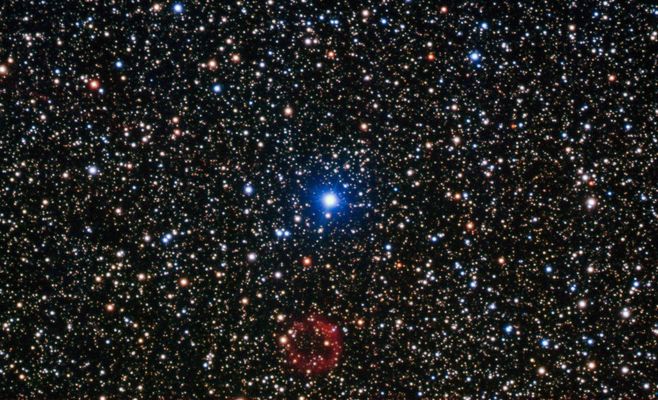
Cover photo: DESI Legacy Imaging Surveys/LBNL/DOE & KPNO/CTIO/NOIRLab/NSF / Wikimedia Commons, CC BY 4.0, cropped