Science & Space By

Earth’s Own Air Fueled 85% of Particles in May 2024 Solar Superstorm
Earth’s own atmosphere may have helped turn the May 2024 solar storm into one of the most powerful in decades, according to a study in Science Advances. Satellite measurements showed that roughly 85% of the charged particles fueling the disturbance came from Earth’s upper atmosphere, not from the Sun, Nagoya University said in a release carried by ScienceDaily.

Researchers also detected an extraordinary 40% weakening of Earth’s magnetic field high above the planet during the event.

What happened in May 2024?

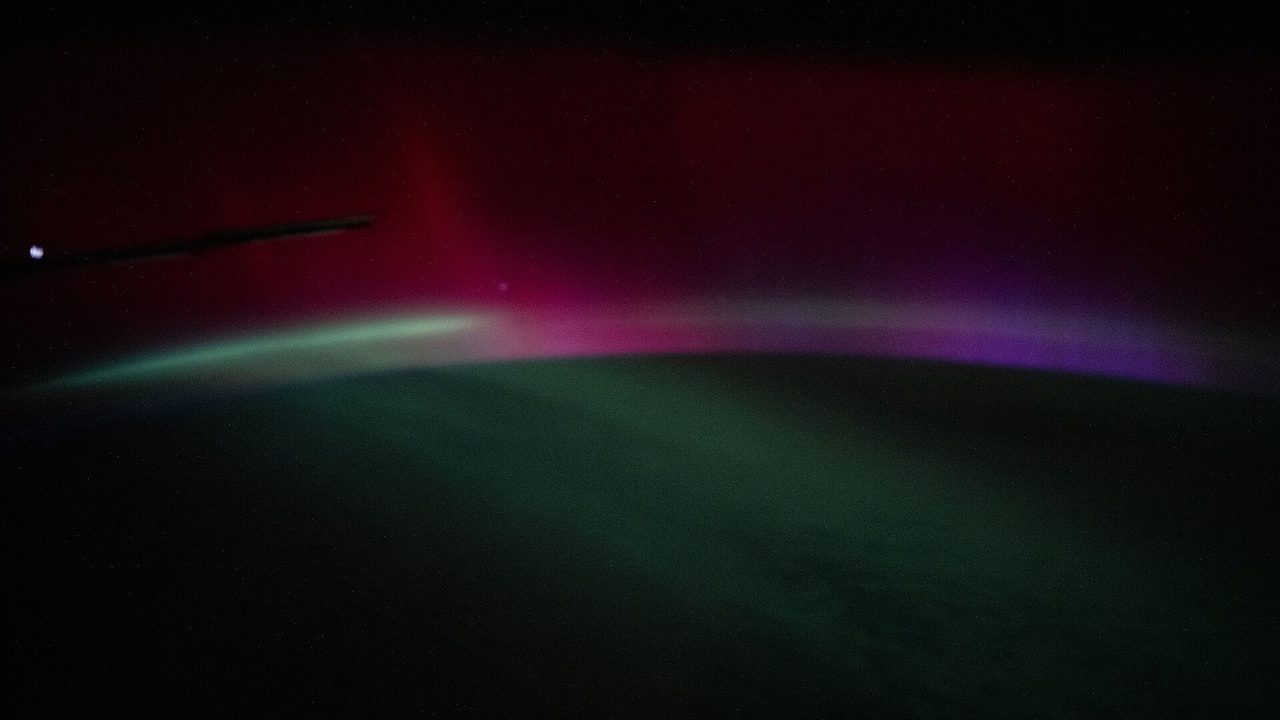
A large sunspot released several powerful eruptions in rapid succession. The clouds of magnetized plasma combined before hitting Earth’s magnetosphere, the region controlled by the planet’s magnetic field. The result, on May 10 and 11, was one of the strongest geomagnetic storms in decades, known as the “Gannon storm” or “Mother’s Day storm.” It sent auroras across skies in places where northern and southern lights are rarely seen.

It pushed a measure of geomagnetic disturbance called the SYM-H index to a minimum of −518 nanotesla. That is the second-largest disturbance recorded since 1981. The previous storm of comparable strength came in November 2004. The storm also produced the strongest magnetic disturbance ever measured in the ring current, a vast belt of electrically charged particles around Earth.

What did the researchers find?

For decades, scientists have debated where ring current particles come from. Two sources are known: the solar wind and Earth’s ionosphere, an electrically charged layer of the upper atmosphere. Some researchers expected the solar wind to remain important in an extreme event with particularly dense solar wind.

Japan’s Arase satellite, launched in 2016 and operated by the Japan Aerospace Exploration Agency, flew through the ring current region shortly after the storm began and again as it neared its peak. Its instruments can measure both the mass and energy of individual ions. Lead author Naritoshi Kitamura of Nagoya University called it the first simultaneous observation of ring current ions and solar wind during a storm this large. He said approximately 85% of the ions were oxygen from Earth’s own ionosphere.

Why would that make the storm stronger?

The ions from Earth are much heavier than those supplied by the solar wind. According to the release, that may have strengthened the magnetic disturbance and caused the ring current to reach its greatest intensity unusually close to the planet. The findings suggest the atmosphere may play a much larger role in the severity of extreme geomagnetic storms than scientists had recognized. The release describes this as a possibility rather than a settled conclusion.

Why does it matter?

Storms like this are more than light shows. Kitamura said some super or extreme storms pose radiation risks to spacecraft, disturb GPS signals and communications, and cause power outages. Knowing how a storm develops is therefore a practical question as well as a scientific one.

The ring current’s ions circle the planet and generate their own magnetic field, which partly opposes Earth’s natural field and weakens the field measured at ground level. Scientists use those changes as a key signal of a storm’s strength.

What comes next?

The result strengthens the case for a proposed Japanese satellite mission designed to study how particles from the atmosphere enter space and influence powerful geomagnetic storms.

Around Prague, based on reporting by ScienceDaily

Cover photo: NASA Johnson Space Center / Wikimedia Commons (public domain)
Share: Telegram WhatsApp

More science news

Leonid Meteors Peak Nov. 17, but a Storm Isn't Expected This Year
The Leonid meteor shower peaks on Nov. 17 at about 3:00 Universal Time, and the Moon is cooperating this year, according to Universe Today. Forecasters expect only a modest show of roughly 20 meteors
Superheated Magma Held Off Crystals for Over Eight Hours in Lab Tests
Magma that is heated beyond the point where its crystals would normally stay stable can go for more than eight hours without forming new crystals, according to a University of Manchester-led study. In
Earth Has a New Minimoon, a 6-Foot Rock That Will Orbit Into 2027
Earth has a temporary new companion. Astronomers have confirmed that a tiny asteroid called 2026 QQ8 was pulled into orbit around the planet in April, and it is expected to stay until January 2027, Li
SpaceX's Starship Push Could Leave NASA Without a Ride to the ISS
SpaceX is preparing its most ambitious test yet of Starship, its giant new rocket, and the company's own plans could leave NASA with a problem, NPR reported. As SpaceX shifts resources to Starship, it
Euclid Telescope Releases Map of Over 900 Million Galaxies
The European Space Agency's Euclid space telescope released its first major batch of data on Thursday, Nov. 12, capturing light from more than a billion objects across a huge stretch of sky, Space.com
Bennu Asteroid Sample Reveals Huge Isotope Gap Inside One Molecule
A new study of asteroid Bennu's sample has turned up a surprise inside a single molecule, according to Universe Today. Researchers at Penn State measured the carbon in a molecule called beta-alanine f

Related news

The Leonid meteor shower peaks on Nov. 17 at about 3:00 Universal Time, and the Moon is cooperating this year, according to Universe Today. Forecasters expect only a modest show of roughly 20 meteors per hour, not the dramatic storm the sho
Magma that is heated beyond the point where its crystals would normally stay stable can go for more than eight hours without forming new crystals, according to a University of Manchester-led study. In the same experiments, magma that had no
Earth has a temporary new companion. Astronomers have confirmed that a tiny asteroid called 2026 QQ8 was pulled into orbit around the planet in April, and it is expected to stay until January 2027, Live Science reported. The object is about
SpaceX is preparing its most ambitious test yet of Starship, its giant new rocket, and the company's own plans could leave NASA with a problem, NPR reported. As SpaceX shifts resources to Starship, it has said it will stop flying the smalle
The European Space Agency's Euclid space telescope released its first major batch of data on Thursday, Nov. 12, capturing light from more than a billion objects across a huge stretch of sky, Space.com reported. The release, called DR1-Found
A new study of asteroid Bennu's sample has turned up a surprise inside a single molecule, according to Universe Today. Researchers at Penn State measured the carbon in a molecule called beta-alanine from Bennu and from the Murchison meteori
Scientists have set a new record for the coldest temperature ever recorded, according to Live Science: 10 picokelvins, barely above absolute zero. The measurement came from an experiment aboard China's Tiangong space station, where a laser
Researchers have documented 280 Paleolithic motifs engraved on the walls of Cova de la Font Major, a cave in Catalonia, northeastern Spain, ScienceAlert reported. The figures sat in plain view for decades while cave enthusiasts, treasure hu
SpaceX is aiming to launch its Starship megarocket on its 15th flight test as soon as Friday, Nov. 13, and the mission may give people across much of the United States something to look up for. Space.com reported that the upper stage, calle
A team of physicists led by researchers at Shanxi University in China says it has found a way to get around a quantum measurement limit that has stood since 1927, by using information from both before and after the moment being measured, Sc
A star that has imitated a supernova 27 times and counting is being drained by an unseen companion, either a black hole or a neutron star, according to Space.com. NASA's Chandra X-ray Observatory caught the telltale X-rays that point to the
NASA has released a gallery of gravitational lenses photographed by the Hubble Space Telescope, and the images are meant to prepare the ground for the new Nancy Grace Roman Space Telescope. Astronomers plan to use them to weigh the invisibl