Physicists Measure Gravity Between Two Specks Weighing 7.6 Milligrams Each
USD 21,91
Popular
Physicists in China have measured the gravitational attraction between the smallest pair of masses yet, and Newton's law of gravity still held, ScienceAlert reported. The team, led by Shan-Qing Yang of Sun Yat-sen University, used two silicon wafers each weighing 7.6 milligrams and published the work in Nature Communications.
The aim is to push gravity experiments toward the scale where quantum effects might appear. The result is not quantum gravity, but the researchers call it a significant step toward bridging the classical and quantum regimes.
The key numbers
- 7.6 milligrams: the weight of each silicon wafer, the lightest pair of masses for which gravitational attraction has been measured, according to ScienceAlert.
- 92 milligrams: the weight of each of the two tiny gold spheres in a 2021 experiment, which was then the lightest demonstration of this kind.
- 16 wafers: the number mounted around a rotating wheel, each passing the test mass in turn.
- 10 minutes: the time for one rotation of the wheel, so the tiny tug repeated 16 times per rotation, giving a clear signal to pick out from noise.
- 471 attonewtons: the force measured at the closest separation, or 0.000000000000000471 newtons. ScienceAlert described it as around 20 billion times weaker than the gravitational force holding a 1-milligram grain of sand to Earth.
- 5.3 percent: the uncertainty on the gravitational constant the team calculated, a value consistent with the internationally recommended one.
How the experiment worked
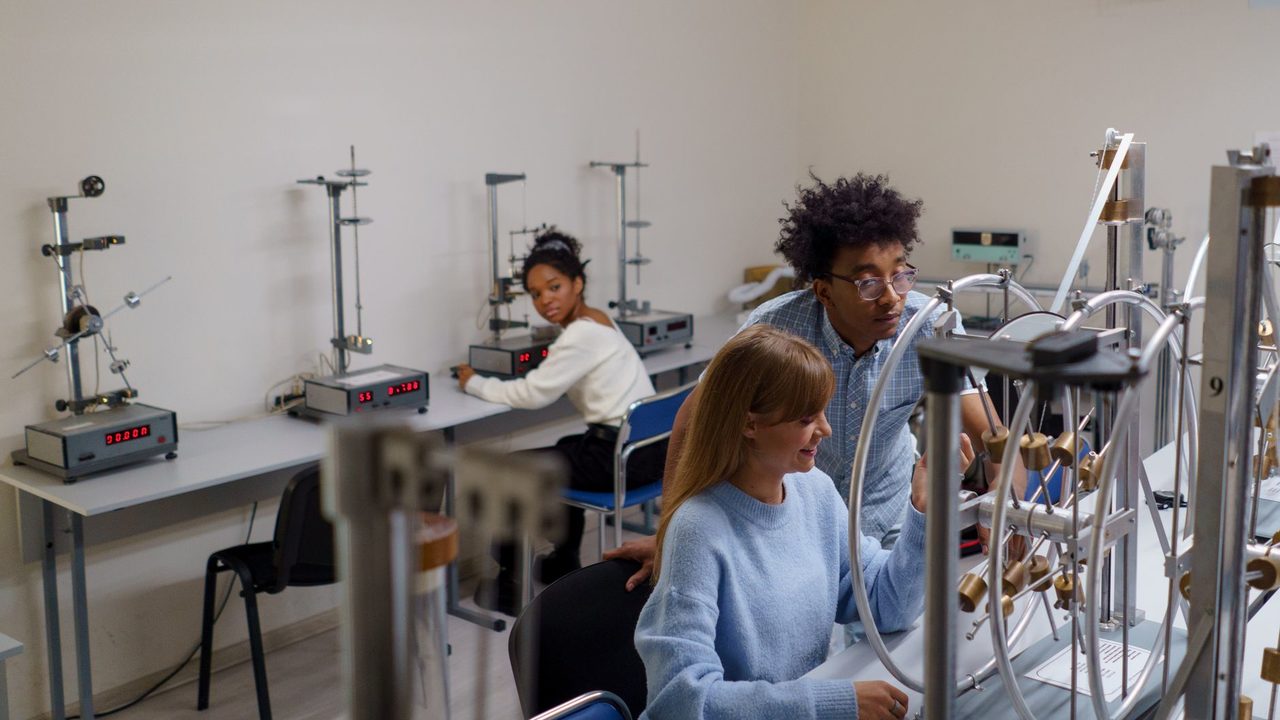
The setup is a modern version of the experiment made famous by 18th-century English scientist Henry Cavendish, which uses a torsion balance, a rod hung from a thin wire, to isolate the weak pull between small masses from Earth's overwhelming gravity.
The team made a miniature balance with deep silicon etching, placing a 7.6-milligram wafer at one end of the rod and a counterweight at the other. Instead of a single nearby mass, they used the rotating wheel of wafers. Everything sat in a vacuum chamber, with a thin gold-coated silicon membrane between the wheel and the balance to reduce electrostatic interference.
The balance was not allowed to twist freely. An electronic feedback system held it nearly still, and the researchers measured the force needed to cancel the gravitational pull.
Why it matters
General relativity and quantum mechanics both work well in their own realms, but their mathematics do not fit together, so physicists lack a full description of gravity where quantum effects matter. Measuring gravity between ever smaller objects is one way to approach that gap.
This experiment found that Newton's law holds even at these tiny scales. It does not change anything in daily life, but it shows that precise gravity tests are moving into lighter territory.
What comes next
ScienceAlert said physicists are developing several techniques, from torsion balances like this one to systems that suspend tiny objects with light or magnetic fields. Each faces challenges, such as removing interference and preserving delicate quantum states.
The eventual goal is to measure gravity between objects governed by quantum mechanics and see whether gravity itself has quantum properties. Yang and colleagues write that such a measurement may be observed in the foreseeable future.
Read next
Musk Says Tesla and SpaceX Boards Are Weighing a Possible Merger
Could a Spinning Black Hole Split in Two? Physicists Run the Numbers
Physicists Get Three Times More Work From a Glass Bead Using Hidden Memory
Around Prague, based on reporting by ScienceAlert