Science & Space By

Could a Spinning Black Hole Split in Two? Physicists Run the Numbers
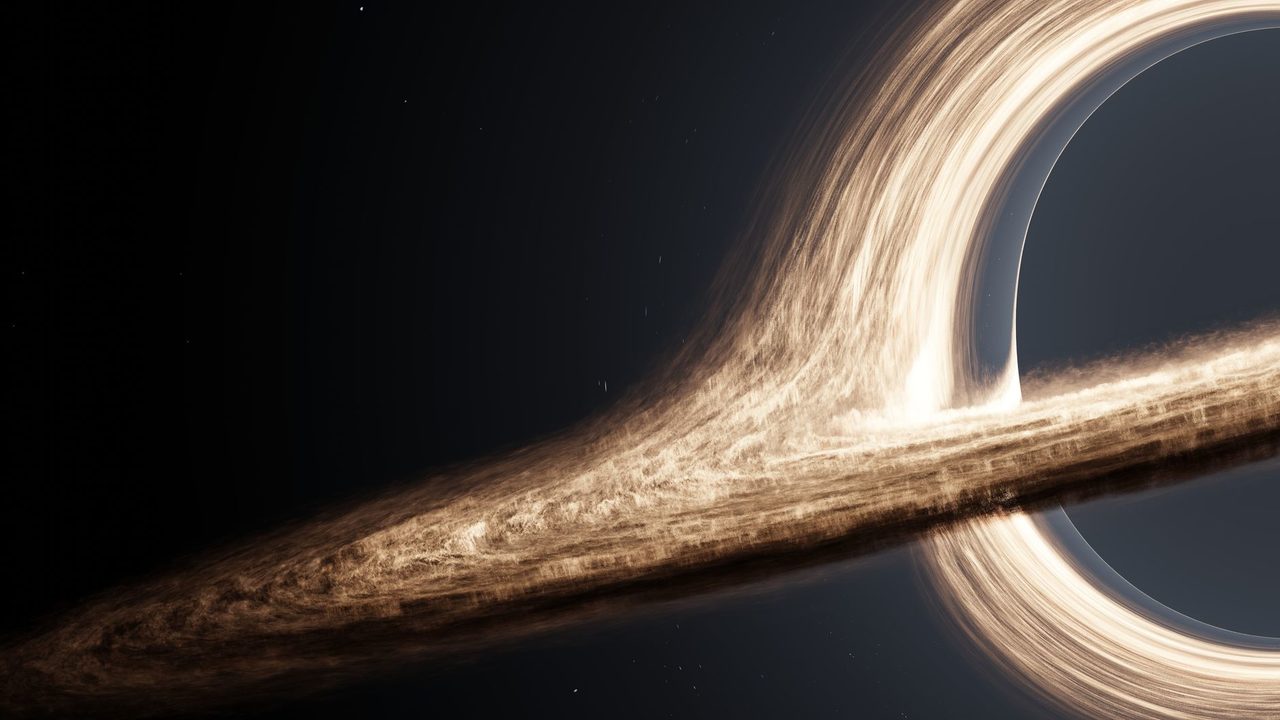
Black holes are known for merging, not breaking apart. But a team of physicists has calculated that, under the right conditions, a black hole could split into two, according to Universe Today. The idea is purely theoretical, and no one has observed such an event.

The researchers include Francesco Sannino of the University of Naples Federico II in Italy and the Quantum Field Theory Center at the University of Southern Denmark, along with Giacomo Cacciapaglia, Manuel Del Piano and Vania Vellucci. They studied possible mechanisms for black hole fragmentation and worked out what would have to happen for a split to occur.

Why a split is so hard

Black hole collisions are common in cosmic history and produce gravitational waves. Gravity near a black hole is so strong that it is hard to imagine any force tearing one apart, which is what made the question an unusual one for the team to take on.

The main obstacle is entropy, a measure of how many different microscopic arrangements a physical system can have while looking the same from the outside. For an ordinary black hole that is not rotating, splitting it into two pieces would lower its entropy. That makes the process thermodynamically unlikely, Universe Today explained.

What changes if the black hole spins

Rotation changes the picture. According to the team, spin alters the relationship between a black hole’s mass, its angular momentum and its entropy, and that shift could make fragmentation possible. A very rapidly spinning black hole could, in principle, break into two pieces.

There is a second hurdle. The two new black holes must be able to move apart rather than fall straight back together. Sannino said that once this requirement is included, the window for splitting largely closes again, except possibly for black holes rotating close to their maximum possible rate. Universe Today reports that both of the resulting black holes would also need to keep spinning at or near that maximum.

If a split did happen, the black hole’s event horizon would take on a trouser-like shape as it divided, with two legs joining a single body. The researchers call this a “pair-of-pants topology.” The two resulting black holes would then drift apart, keeping the momentum and speed of the original.

Which black holes might be candidates

Sannino said the team cannot yet give a single probability that a black hole will split. He said it depends on how gravity behaves beyond Einstein’s theory, and the researchers are working to quantify that. He added that small primordial black holes should be more prone to splitting than much larger astrophysical black holes.

Universe Today noted that the black hole at the center of the galaxy M87 has a measured spin, so in theory it could break apart if conditions were right. The outlet also said such events seem unlikely to have happened, though the researchers do not rule out that they have occurred in specific cases.

Why it matters

This research does not change anything in daily life, and it does not suggest that any black hole near us is about to divide. Its value is in testing the limits of what physics allows. The result also ties the question to an open one: how gravity works beyond Einstein’s theory. The calculation shows that the answer would affect whether black holes can split at all.

The work is theoretical, and the authors say a single probability cannot yet be given. It remains a set of calculations rather than an observed phenomenon.

How a split could be detected

Sannino said a split might be detected indirectly. Gamma-ray telescopes such as Fermi-LAT can search for signals from tiny black-hole fragments that might form during mergers. If such signals turned up, they could point to fragmentation, though no such detection has been reported.

Around Prague, based on reporting by Universe Today

Share: Telegram WhatsApp

More science news

Kids Who Logged More Screen Time Scored Better on Brain Tests as Teens
Children who spent more time on screens between about age 8 and age 16 tended to do better on thinking tests as teenagers, according to a Finnish study reported by ScienceAlert. The finding runs again
The Pleiades: A Misty Dipper of Sibling Stars Visible From Almost Anywhere on Earth
The Pleiades star cluster, also called the Seven Sisters or Messier 45, can be seen from almost every part of the globe, according to EarthSky. It appears as a tiny, misty dipper of stars, and Novembe
Can One Clock Tick at Two Speeds at Once? Physicists Propose a Test
A team of physicists says today’s best atomic clocks could be used to look for a strange quantum effect: a single clock experiencing more than one rate of time at the same moment. ScienceDaily,
Fanged ‘Vampire Camel’ With a Giraffe-Like Neck Found in Old Museum Fossils
A previously unknown camel with long, curved fangs once roamed the Great Plains of North America, and its bones have been sitting in museum collections for about a century. ScienceAlert reported that
Astronomers Watch Two Stars Merge in Andromeda, Start to Finish, for the First Time
For the first time, astronomers have watched two stars merge as it happened, according to Live Science. The pair, a supergiant and a star slightly smaller than the sun, orbited each other for thousand
Ancient Storm Deposits Rise and Fall on a 405,000-Year Beat, Study Finds
Layers of rock left behind by powerful ancient storms appear to grow thicker and more common on a cycle of roughly 405,000 years, according to a new paper reported by ScienceAlert. The authors suggest

Related news

Children who spent more time on screens between about age 8 and age 16 tended to do better on thinking tests as teenagers, according to a Finnish study reported by ScienceAlert. The finding runs against a common assumption that screens simp
The Pleiades star cluster, also called the Seven Sisters or Messier 45, can be seen from almost every part of the globe, according to EarthSky. It appears as a tiny, misty dipper of stars, and November is the month when it shines from dusk
A team of physicists says today’s best atomic clocks could be used to look for a strange quantum effect: a single clock experiencing more than one rate of time at the same moment. ScienceDaily, citing materials from Kyushu University,
A previously unknown camel with long, curved fangs once roamed the Great Plains of North America, and its bones have been sitting in museum collections for about a century. ScienceAlert reported that paleontologists have now named it Vampyr
For the first time, astronomers have watched two stars merge as it happened, according to Live Science. The pair, a supergiant and a star slightly smaller than the sun, orbited each other for thousands of years and then came together in jus
Layers of rock left behind by powerful ancient storms appear to grow thicker and more common on a cycle of roughly 405,000 years, according to a new paper reported by ScienceAlert. The authors suggest the rhythm may be tied to slow, periodi
A European-Japanese spacecraft is due to enter orbit around Mercury on Nov. 21, more than eight years after it left Earth, Space.com reported. The BepiColombo mission, run jointly by the European Space Agency (ESA) and the Japanese Aerospac
Wolves howl mainly to stay connected with one another, not because they see the moon, according to researchers who spoke to Live Science. The sound helps scattered pack members find each other, warns rival packs and builds a sense of group
A rival to the standard picture of the universe has passed a series of tests, according to Universe Today. Researchers at the University of Ottawa say their model reproduces key observations without dark matter or dark energy, and it implie
Two of NASA's Mars explorers have paused their science work because of technical problems, the agency announced Thursday, Nov. 19, according to Space.com. The Perseverance rover is dealing with a radio fault, and the Mars Odyssey orbiter ha
Negotiations at the COP31 UN climate summit in Turkey are deadlocked after running through the night, the BBC reported. Countries have not been able to agree on a new global climate deal, and two fights are holding things up: whether the te
SpaceX launched a classified mission for the U.S. Space Force on Nov. 20, sending an undisclosed payload to orbit from California's central coast, Space.com reported. The rocket's first stage returned safely, but the public did not see the