Star That Faked 27 Supernovas Is Being Fed On by a Hidden Black Hole or Neutron Star
USD 22,01
Popular
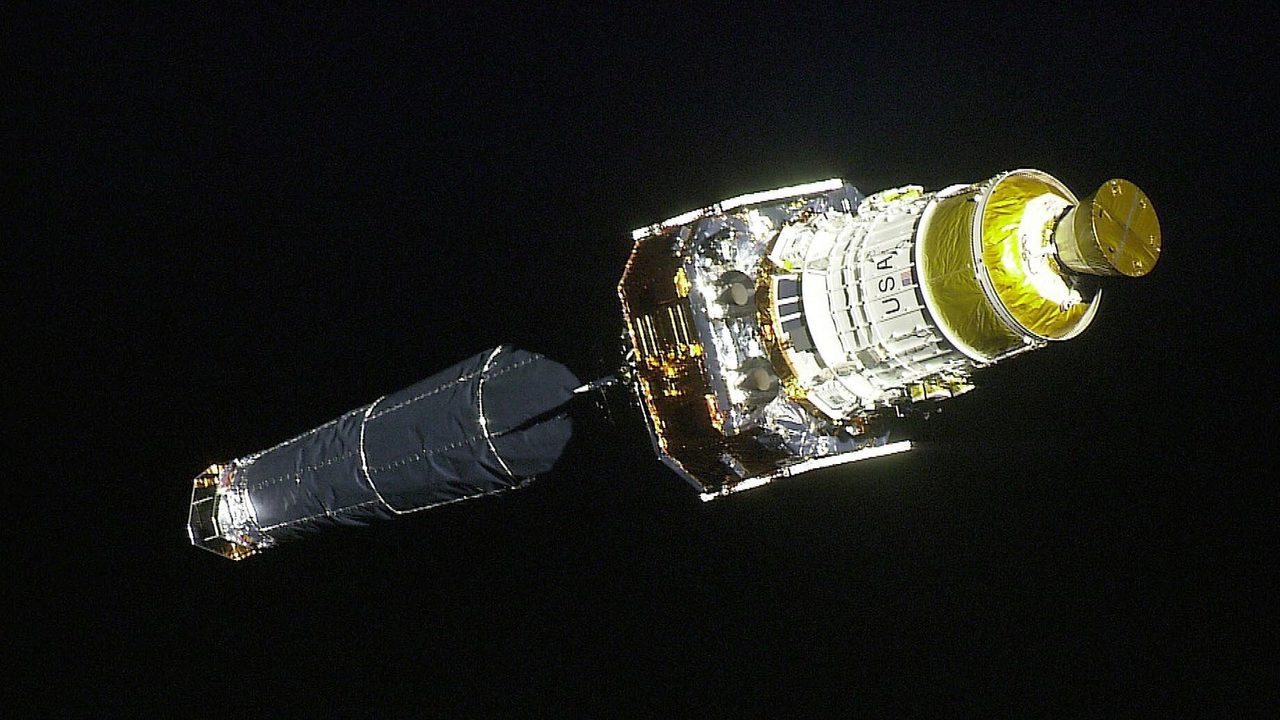
A star that has imitated a supernova 27 times and counting is being drained by an unseen companion, either a black hole or a neutron star, according to Space.com. NASA's Chandra X-ray Observatory caught the telltale X-rays that point to the hidden object, solving a puzzle that has lasted 15 years.
The star, called AT 2016blu, sits in the spiral galaxy NGC 4559, about 25 million light-years away in the constellation Coma Berenices. The finding is described in a paper published Nov. 9 in The Astrophysical Journal.
A supernova that never ended
Astronomers thought they had spotted an exploding star on Jan. 11, 2012, when a bright flash appeared on the outskirts of NGC 4559. A real supernova destroys a massive star that has run out of nuclear fuel. This time, though, the light faded and the star was still there. It then flared again, and it has kept doing so every 113 days.
Several other stars have been seen behaving this way over the past decade or two, and until now nobody knew what made them repeat the false alarm. Mojgan Aghakhanloo of the University of Virginia said astronomers had been watching this star brighten and dim on a regular schedule for 15 years.
How Chandra found the hidden companion
AT 2016blu is a luminous blue variable, one of the most massive and luminous kinds of star. Such stars are unstable and periodically shed material from their outer layers into space. Faking a supernova is not part of their normal behavior, so the team needed a different approach.
Núria Torres-Albà, also of the University of Virginia, said the researchers realized they needed X-ray data timed to catch the star during an outburst. Aghakhanloo's team won observing time on Chandra, and the chance came in March 2026. Chandra had looked toward NGC 4559 by coincidence in 2001 and 2002 and noticed nothing unusual. This time it recorded a powerful burst of X-rays that coincided with another false supernova.
Those observations indicate that the star has a compact companion, either a neutron star or a stellar-mass black hole, on an elliptical 113-day orbit. Both kinds of object are left behind when a massive star really does explode, so the system was once a pair of massive stars.
How a feeding companion fakes an explosion
Each time the compact object swings closest to the luminous blue variable, its gravity pulls gas off the unstable star. The stolen gas forms a swirling accretion disk around the companion that grows hot enough to emit X-rays.
Those X-rays heat a cloud of dense gas that the star ejected years earlier, and the cloud glows brightly in visible light, which looks like a supernova. Nathan Smith of the University of Arizona said the team had suspected that the repeating optical flashes were powered by periodic blasts of high-energy X-rays.
The calculations suggest the compact object takes at least 440 billion trillion pounds of material each year, and possibly about two orders of magnitude more. That is only 800 millionths of the mass of the sun, while the blue variable is at least 33 times the sun's mass. Even so, the rate is far above the maximum a neutron star can safely take in, known as the Eddington limit, which helps explain the extreme energy released.
Why it matters
For astronomers, the result offers a physical explanation for supernova impostors, a class of objects whose repeated outbursts had no clear cause. It also ties them to a second mystery. AT 2016blu is bright enough in X-rays to count as an ultra-luminous X-ray source, a type of source whose power supply is still unclear, although black holes and neutron stars are leading candidates.
That raises the question of whether such impostors could help explain those sources. Space.com cautioned that it is too early to say. Only one other impostor, SN 2010da, has shown X-ray emission typical of material accreting onto a companion, and in that case the companion is known to be a massive red supergiant rather than a compact object.
The result also shows how much timing matters in astronomy. Chandra saw nothing odd in 2001 and 2002, and the answer came only when it was pointed at the star during an outburst.
Read next
Hidden Black Hole or Neutron Star Blamed for Star's Eruptions Every 113 Days
Black Hole Jets Light Up Gas Far Beyond a Galaxy’s Stars, Study Finds
Hunting Lone Black Holes Within 50 Light-Years of Earth, Hidden in Gas Clouds
Around Prague, based on reporting by Space.com
Cover photo: NASA/STS-93/Cady Coleman / Wikimedia Commons (public domain)