Trump Press Conference After Asia Trip: What He Said on AI, Chips and Putin
USD 22,26
Popular
President Donald Trump held a long White House press conference Friday after returning from a three-day trip to Asia, where he met jointly with Chinese President Xi Jinping and Russian President Vladimir Putin. According to NPR, the trip produced little in the way of agreements on major global issues, and the one new item from the session was a plan with Xi for joint limits on artificial intelligence.
NPR's White House correspondent said the event was largely a meandering talk that included about 30 minutes on the trip and Trump's relationships with the two leaders. The Guardian reported that the event also worked as an early showcase for the 2028 Republican field, with Vice President JD Vance and Secretary of State Marco Rubio standing behind the president.
What Trump said about AI and chips
Trump said he and Xi agreed to put in place guardrails on artificial intelligence, which he calls super intelligence, and said the two of them would set joint limits because no third country is comparable. NPR reported that details were scarce. It also noted that the idea is a shift, since Trump has previously resisted restrictions on AI development and has repeatedly said he wants the U.S. to keep its lead over China.
Trump also said he would not allow U.S. companies to build AI data centers outside the country, according to NPR. The network pointed out that his administration has allowed Nvidia to sell advanced chips to China after the company's chief executive, Jensen Huang, lobbied him last year. A House Foreign Affairs Committee list released Thursday detailed requests by Nvidia and AMD to sell chips to Chinese firms, NPR said. As of May, the administration had approved the sale of nearly 900,000 advanced chips, with buyers including Alibaba and Tencent, both of which appear on a Pentagon list of Chinese companies linked to the military. NPR said it remains unclear whether Trump wants those sales to continue or stop.
Cybersecurity shake-up and the CISA vacancy
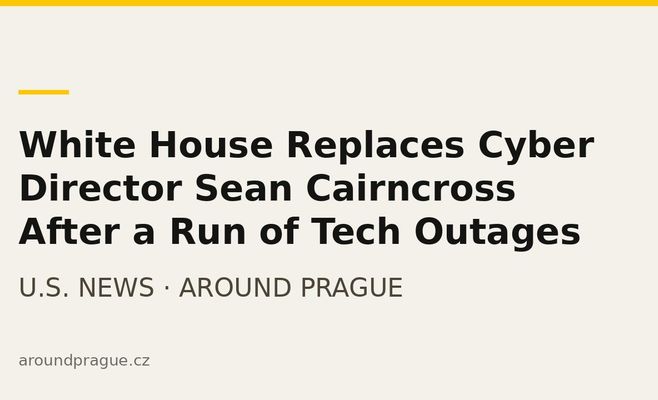
Trump confirmed that he fired the White House cybersecurity director, Sean Carncross, saying he did not think the official was good enough, NPR reported. The job goes to Kirsten Davies, the Defense Department's chief information officer. NPR noted that the post is a policy role rather than an operational one.
The agency that handles election security and protection of government networks, the Cybersecurity and Infrastructure Security Agency, has had no director since Trump took office almost two years ago, NPR said. His nominee, Michael LoSapio, had a Senate confirmation hearing Thursday. According to NPR, Democratic senators pressed him, and he declined to say who won the 2020 presidential election and said he did not consider the Jan. 6, 2021, events at the Capitol an attack. NPR said his confirmation is not assured.
Putin, Iran and the 2028 question
Asked whether Putin, whom he has called his friend, is also a friend of America, Trump replied, “I can’t speak to America.” NPR's correspondent said Trump kept arguing that the relationship would benefit the country, though that has not yet been visible, and the war in Ukraine continues.
On Iran, NPR said there was no sign the war, now nearly nine months old, was discussed in detail on the trip. Trump repeated that Iran cannot have a nuclear weapon and that Tehran wants a deal. NPR said the main recent development has been increased Iranian attacks on oil tankers.
The Guardian reported that a reporter asked Trump which of Vance and Rubio would make a better president, and he did not answer. Asked whether the Iran war was worth losing the Senate, Vance said he shares the goal of keeping Iran from getting a nuclear weapon, but that the president makes the decision and his own job is to support him, according to the Guardian.
What this means for readers
For readers, the main practical points are still open questions. No details have been given on how joint AI guardrails with China would work or who they would cover. The chip sales Trump has allowed remain an open policy question. The vacant CISA director post matters because that agency handles election security. Whoever fills it will be responsible for the 2028 election, NPR said. The Guardian said that the first signs of the 2028 contest are already visible among the president's own team.
Around Prague, based on reporting by NPR, The Guardian