Oleshky residents describe hunger, mines and electric-shock torture
USD 21,76
Popular
Residents evacuated from Oleshky, a city in the Kherson region occupied by Russian forces, call life there hell: hunger, cold, mined streets, disappearances and torture. According to the German outlet Bild, this is what Ukrainians brought out of the city have said. Before the war, about 24,000 people lived in Oleshky; one evacuee says that only around 1,700 are left.
Hunger and mines in the occupied city
Olya, a teacher of Ukrainian language and literature, stayed in the city with her husband Andriy and their children until the evacuation was agreed. At first the family believed the occupation would not last long, but the situation only got worse. “From March it became unbearable,” Olya says. “The roads were mined, and we had no water and no gas.”
A small market operated near the hospital, where people from nearby villages sold food. According to Olya, Russian troops banned it, and when asked why, they answered: “You must starve.” The shops had been looted and the food was gone. “In April and May, people, especially the elderly, looked like ghosts,” she recalls.
When Olya’s daughter broke her leg, the family could not get to the hospital because Russian soldiers were stationed there. A doctor examined the girl at home and advised taking her to Kherson, but driving along the mined streets was terrifying. “Children no longer behave like children. They have lost their childhood,” Olya says. She also tells of an elderly man who could not endure the hunger, the cold and the conditions, and broke down. “When I remember all this now, I want to cry. But I have no tears left.”
Electric-shock torture and bodies in basements
Even harsher testimony comes from Volodymyr Kostyan. He says he was detained on 15 November 2022 while delivering food to other people. The Russian side accused him of passing the coordinates of Russian military equipment to the Ukrainian army and of helping people fleeing the occupied territories. He says there was no evidence, yet he spent about a year in captivity.
He was tortured with electric shocks using a Soviet TA-57 field telephone. “They attached wires to my genitals and mocked me: ‘The connection is so good now that you can call Putin,’” Kostyan says. He knows of about nine torture sites around Oleshky and Hola Prystan.
Kostyan also speaks of pro-Ukrainian residents who have gone missing: according to him, people were killed and their bodies thrown into basements.
The evacuation and those who stayed
Roman, an architect who does not want to give his surname, describes bodies lying in the streets. When he learned about the evacuation, he went to fetch his parents, but at first they were afraid and did not want to leave. “The streets are full of corpses. As long as they’re not shooting, I’ll bury at least some of them,” his father told him. Roman himself narrowly avoided Russian troops several times: “I knew they could grab me at any moment.”
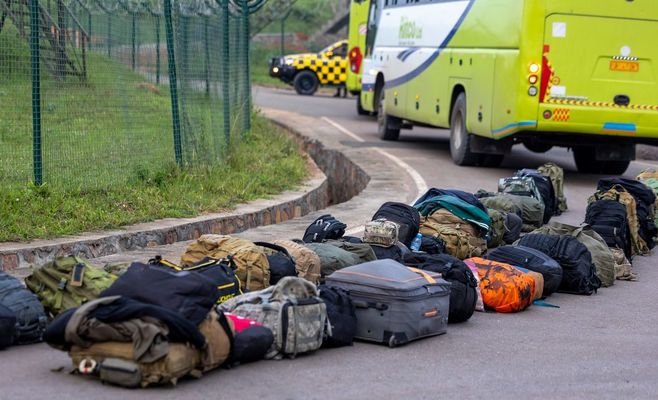
The evacuation became a new ordeal: Roman recalls 16 hours on a bus with no chance to use a toilet. The evacuees were then flown to Rostov on a Russian military transport plane, an Il-76. From there they made their way to Gomel in Belarus and finally crossed the border back into Ukrainian-controlled territory.
Not everyone managed to get out. According to Roman, about 1,700 people are still in Oleshky, mostly elderly, sick or with limited mobility. Because of the mined roads, some of them would not even be able to reach the evacuation buses. For those who were brought out, the hell is over; for those who remain, it goes on.
Around Prague, based on reporting by novinky.cz