Prague Street Art: 10 Spots Where the City Speaks in Color — From the Lennon Wall to a Giant 2026 Mural
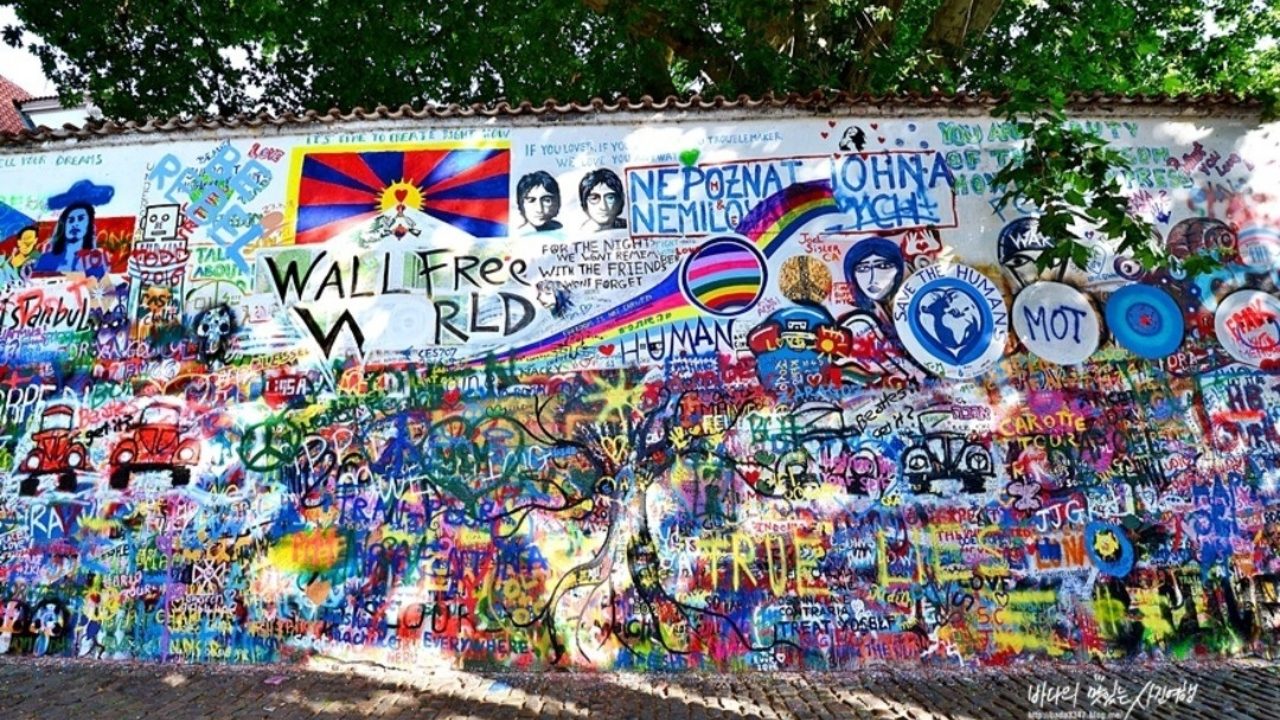
Prague is famous for its Gothic spires and Baroque façades, but the city has another side — one that's alive, bold and constantly changing. This guide is for anyone tired of postcard views who wants to see contemporary Prague through the eyes of street artists: from the legendary wall in Malá Strana to the industrial quarters of Holešovice and Žižkov, where murals share space with bars and techno clubs. Grab a bike or comfortable shoes — most of these spots are scattered across different districts, and the route will easily fill a whole day.
John Lennon Wall, Malá Strana
Prague's most famous wall stands on Velkopřevorské náměstí, beside the garden wall of the Grand Priory of the Knights of Malta, just a couple of minutes from Charles Bridge. It's Prague's historic, legal graffiti wall, where an unknown artist painted a portrait of John Lennon after his assassination in 1980; over time the wall became a space of free expression in what was then communist Czechoslovakia. The artwork here gets repainted dozens of times, yet it's never empty — a living monument to freedom of speech that's free to visit at any hour.
Husitská a Prokopova, Žižkov
At the corner of Husitská and Prokopova streets in Žižkov stands one of the city's most talked-about murals — a portrait of writer Franz Kafka by Spanish artist Escif, showing him half-buried, with the word "Pomoc" ("Help") written above his head. The mural is deliberately left to "age" — cracks and layers of graffiti only heighten its dramatic effect. It's worth strolling the whole length of Husitská street, one of the district's main hubs of alternative art.
Argo, Milíčova 14, Žižkov
On the façade of the Argo publishing house in Žižkov is a work by the Israeli duo Dede and Nitzan Mintz, created during a three-week residency. The mural, titled "Ambitions," nods to Dede's ambition to grow as an artist and Nitzan's dream of being published by Argo. It's one of two collaborative works by the pair in the neighborhood — the second is just a couple of blocks away.
Ponec, Husitská 24a, Žižkov
The Ponec Theatre on the same street features the duo's second collaborative piece. Titled "Objects," this mural on the theatre's façade explores attachment and longing. Dede's signature giant wooden animals weave through the composition alongside the city's architectural details, while Nitzan's texts add a poetic layer to the work.
Žižkovská televizní věž, Žižkov
The TV Tower at Mahler Park is itself a controversial piece of Brutalist architecture, but it owes its fame to David Černý's sculptural mural. The base of the tower is decorated with the colorful "Tower Babies" mural, in which giant crawling infants climb up the tower's surface, adding a playful touch to this otherwise imposing structure. It's a great excuse to head up to the observation deck and take a closer look at the art along the way.
MeetFactory, Ke Sklárně 15, Prague 5 – Smíchov
This industrial contemporary art center, founded by artist David Černý, is tucked between a highway and an active railway line in Smíchov. MeetFactory is a non-profit international center for contemporary art established in 2001 by Černý; after the 2002 floods, the project relocated from Holešovice to an industrial building in Smíchov. The building is easily recognized by the two red cars suspended from its façade, and its Wall Gallery program focuses on large-scale works that push beyond classic street art. Admission to the galleries costs around 100 CZK, and it's open daily from 1 pm.
DOX, Holešovice
The DOX Centre for Contemporary Art in Holešovice is not just an exhibition space — it's an art object in its own right. Located in Holešovice, DOX is a dynamic space dedicated to contemporary art, design and architecture, whose façade is often decorated with vivid murals and street art, making it a favorite among street-art enthusiasts. Works by Pasta Oner — the most recognizable Czech street artist, known for his pop-art style — regularly appear here.
Vnitroblock, Holešovice
A former industrial zone between Tusarova and Dělnická streets has transformed into a trendy creative hub. Vnitroblock is a multifunctional, inspiring space between these two streets in Holešovice, featuring an industrial café, a restaurant, and event venues, including the unconventional D&B gallery and the Sector dance studio. On the way in from the Dělnická entrance, it's worth peeking into the neighboring workshops and shops — small art objects are scattered there too.
Trafo Gallery, Holešovická tržnice, Bubenské nábřeží 306/13, Prague 7
The legendary "Trafačka" gallery has moved into Hall 14 of the former Holešovice slaughterhouse. Trafo Gallery is a private exhibition space in the former abattoir that has, since 2006, showcased leading artists working across painting, sculpture, media installations, graffiti and photography. Nearby you'll find Jatka78 and a cluster of Vietnamese shops — the vibe here is anything but touristy. The gallery is open during exhibitions: Tue–Sun 3–7 pm, Saturdays from 10 am.
Mural Ruzyně, Vlastina, Prague-Ruzyně
The most ambitious project of recent years is a giant wall on Vlastina street in the Ruzyně district. The newest addition to the 2026 mural map is Mural Ruzyně on Vlastina street in Prague's Ruzyně: a concrete wall over 700 meters long that's gradually becoming a monumental open-air gallery, with thirty Czech and international street artists working on it as part of the Urban Pictus international festival, dedicated to the theme of a city's beauty in motion. It's worth visiting right now, while the wall is still being painted — in a year or two it will look completely different.
Prague's street art isn't packaged into a single tourist route — and that's exactly its charm: murals hide in Žižkov courtyards, on Holešovice's concrete overpasses, and in Smíchov's industrial back alleys, coexisting with bars, galleries and 19th-century slaughterhouses. Plan your own route of 3–4 spots at a time, and don't forget to step inside galleries like MeetFactory or Trafo — that's where the street art continues indoors.
See also:
Comments (0)
Please be polite. Spam and insults will be removed.