Josefov: 8 Synagogues and Prague's Old Jewish Cemetery — A Guide to Europe's Foremost Jewish Quarter
Josefov — Prague's former Jewish ghetto between the Old Town and the Vltava — is today regarded as one of the most complete and best-preserved Jewish quarters in Europe. Packed into an area of just a few hundred metres are six historic synagogues, a centuries-old town hall with an unusual clock, and one of the oldest functioning Jewish cemeteries in the world. This guide is for anyone who wants to grasp, in a single leisurely walk, the history of Prague's Jewish community — from the Middle Ages to the Holocaust — and see genuine 13th–19th-century interiors rather than reconstructions.
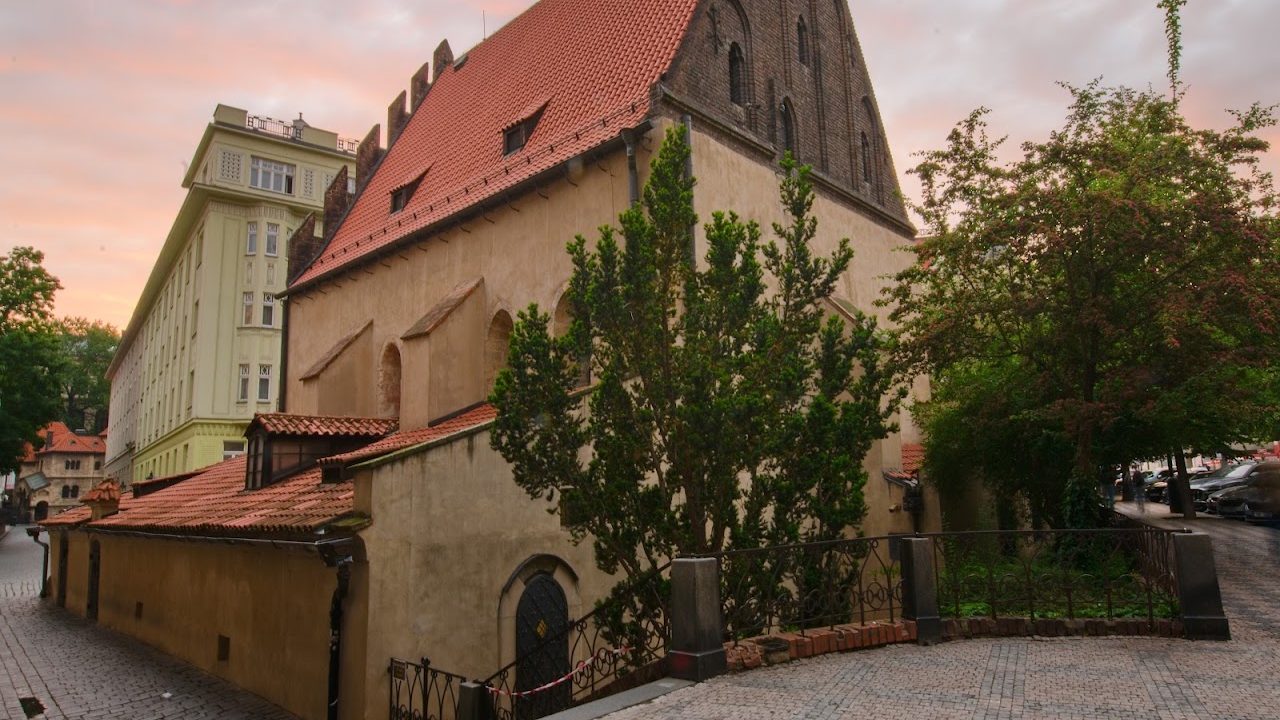
Staronová synagoga, Josefov
The synagogue stands on Červená ulice, opposite the Židovská radnice, and it is the true star of the quarter. The oldest landmark of Prague's Jewish Town and the oldest surviving synagogue in Europe, the Old-New Synagogue dates back to the late 13th century and has served as the main synagogue and house of prayer of Prague's Jewish community for more than 700 years. Inside is a two-nave hall divided by two pillars beneath a five-part vault. The site is also tied to the legend of the Golem: according to tradition, Rabbi Loew created the Golem — a living being made of clay — to protect the Jewish community from threats and persecution, and legend holds that it still rests in the attic beneath the roof. Note: the Old-New Synagogue can only be visited as part of the general tour of Prague's Jewish Town, including the Jewish Museum sites, and entry to it requires a separate ticket in addition to the general museum pass.
Pinkasova synagoga, Široká 3, Josefov
Located on Široká street, right by the entrance to the Old Jewish Cemetery. The Pinkas Synagogue was built in the early 16th century and is one of the two oldest synagogues in Prague. After the war it was turned into a memorial: thanks to the efforts of Hana Volavková, the museum's first post-war director, the Pinkas Synagogue was transformed between 1955 and 1960 into a monument to the nearly 80,000 Bohemian and Moravian Jews who fell victim to the Shoah. The names of all the victims are hand-inscribed on the walls — a sight that is hard to forget. On the upper floor is a permanent exhibition of children's drawings from the Terezín ghetto. As part of the Jewish Museum, the synagogue is open daily except Saturdays and Jewish holidays, usually from 9:00 to 18:00 in summer and until 16:30 in winter.
Starý židovský hřbitov, Josefov
The cemetery adjoins the Pinkas and Klausen Synagogues and is considered one of the quarter's chief attractions. It is one of the oldest Jewish cemeteries in the world, founded in the early 15th century; the last burial here took place at the end of the 17th century. It holds graves dating from 1439 to 1789 — around 12,000 tombstones in total, beneath which roughly 100,000 people are believed to be buried. Because of the ghetto's cramped space, burials were made in several layers: since Jews were forbidden to bury their dead outside the ghetto, graves were dug one on top of another, and some old burial sites have as many as 12 "layers". Among those buried here is the legendary Rabbi Loew, whose grave is still covered with small stones left by visitors as a token of remembrance.
Klausová synagoga, U Starého hřbitova 3a, Josefov
The synagogue stands right at the cemetery entrance, at U Starého hřbitova 3a, 110 00, Prague 1. It is the quarter's only example of early Baroque architecture: the Klausen Synagogue remains the largest synagogue on the site of the former Prague ghetto and is also the only surviving example of early Baroque style here. It takes its name from small prayer houses known as "klausen": after these burned down in the great ghetto fire of 1689, a new synagogue in the early Baroque style was built on the site between 1689 and 1694. Today it houses an exhibition on Jewish traditions and customs — from the Sabbath to wedding and funeral rites.
Obřadní síň, Josefov
The Ceremonial Hall stands next to the Klausen Synagogue, by the cemetery entrance, and is built in a Neo-Romanesque style dating from the early 20th century. The Jewish Ceremonial Hall holds special cultural and spiritual significance — it houses the second part of the exhibition "Jewish Customs and Traditions", which begins in the Klausen Synagogue. The ground floor once hosted the ritual washing of the dead before burial, while the upper floor was used for gatherings of the Prague Burial Society. The building is included in the single Jewish Museum ticket along with the six synagogues and the cemetery.
Maiselova synagoga, Maiselova 10, Josefov
The synagogue stands on the street of the same name, Maiselova, just steps from Staroměstská metro station. It was once the largest synagogue in Prague, though it was rebuilt and reduced in size several times; the building's current appearance dates from the turn of the 19th and 20th centuries. It is named after Mordecai Maisel, the wealthiest man of his time and a patron of the Jewish community: under his patronage the Jewish Town experienced an unprecedented golden age, and today's Maiselova street in central Prague still bears his name. Today the synagogue houses an exhibition on the history of Jewish settlement from its origins to the Age of Enlightenment, as well as the museum's cultural events.
Španělská synagoga, Vězeňská 1, Josefov
The youngest, and arguably the most striking, synagogue in the quarter stands on Dušní street. The Spanish Synagogue is the youngest — and for many the most beautiful — synagogue of the former Prague Jewish Town; it stands on Dušní street, next to the Church of the Holy Spirit and a small park with Jaroslav Rona's statue of Franz Kafka. Inside is a lavish Moorish decor with floral ornamentation reminiscent of Spain's Alhambra, which is where the name comes from. It also houses an exhibition on the history of the Jews in the Czech lands during the 19th and 20th centuries.
Židovská radnice, roh Maiselova a Červená, Josefov
The town hall stands on the corner of Maiselova and Červená streets, opposite the Old-New Synagogue. The Jewish Town Hall stands at the corner of Maiselova and Červená in the northern part of the former ghetto, right across the street from its neighbour, the Old-New Synagogue. Its main attraction is the clock: above the building's main façade is a clock with a Hebrew dial whose hands run backwards, while another clock, set in the dome above the gallery, has Roman numerals and runs in the usual direction. You can't go inside — the building today houses the administrative offices of Prague's Jewish community — but it's well worth admiring the unique clocks from the outside.
All six synagogues, the cemetery and the Ceremonial Hall are covered by the single Jewish Museum in Prague ticket (valid daily except Saturdays and Jewish holidays); the Old-New Synagogue requires a separate admission ticket. When visiting the cemetery and the active synagogues, men are required to cover their heads — kippahs are provided at the entrance. Plan on two to four hours to explore the quarter: that should be enough to take your time visiting all eight stops on the route and truly absorb the centuries-long history of Prague's Jewish community.
See also:
Comments (0)
Please be polite. Spam and insults will be removed.