Clock Change in Czechia 2027: Dates to 2031, Time and Direction
Popular
The next clock change in Czechia is on the night before Sunday 28 March 2027: at 2:00 the clocks jump forward to 3:00, so the night is one hour shorter. If you go to bed at 23:00 and get up at 7:00 on the new clock, you sleep 7 hours instead of 8. The clocks go back on Sunday 31 October 2027, from 3:00 to 2:00. The dates for 2027–2031 are already fixed by a government regulation, and the EU has not abolished the change. Around Prague checked the regulation and documents of the European Commission, České dráhy and others on official websites on 3 November 2026.
Clock change dates in Czechia, 2027–2031
The dates come from government regulation (nařízení vlády) No. 181/2026 Sb. on summer time in 2027–2031. The government approved it on 7 September 2026, it was published on 7 October, and it takes effect on 1 January 2027. It rests on Act No. 54/1946 Sb. and EU Directive 2000/84/EC. All ten dates are written into it; none is calculated.
| Year | Summer time starts: at 2:00 clocks go to 3:00 | Summer time ends: at 3:00 clocks go back to 2:00 |
|---|---|---|
| 2027 | Sunday 28 March | Sunday 31 October |
| 2028 | Sunday 26 March | Sunday 29 October |
| 2029 | Sunday 25 March | Sunday 28 October |
| 2030 | Sunday 31 March | Sunday 27 October |
| 2031 | Sunday 30 March | Sunday 26 October |
They match the EU rule "last Sunday of March and of October"; the European Commission published the same days on 18 March 2026. This year's autumn change was on 25 October 2026.
What happens overnight and how much you sleep
- In spring (28 March 2027) the clock goes from 2:00 straight to 3:00. The hour from 2:00 to 3:00 does not exist that day, so the day has 23 hours. Czechia moves to summer time (středoevropský letní čas, SELČ).
- In autumn (31 October 2027) the clock goes back from 3:00 to 2:00. The hour from 2:00 to 3:00 happens twice, so the day has 25 hours. Czechia returns to Central European Time (středoevropský čas, SEČ).
Our calculation for a night from 23:00 to 7:00 by the wall clock: 7 hours of sleep in spring, 9 in autumn.
For shift workers the regulation is explicit (§ 4): if a shift falls on the change and becomes shorter, the set weekly working time is 1 hour shorter that week; if it becomes longer, 1 hour longer.
Time difference with Moscow, Kyiv, London and New York
Prague is on UTC+1 in winter and UTC+2 in summer. The differences are our calculation from UTC offsets and each country's own rules.
| City | Offset winter / summer | Difference from Prague in winter | Difference from Prague in summer |
|---|---|---|---|
| Moscow | UTC+3 all year | 2 hours ahead | 1 hour ahead |
| Kyiv | UTC+2 / UTC+3 | 1 hour ahead | 1 hour ahead |
| London | UTC+0 / UTC+1 | 1 hour behind | 1 hour behind |
| New York | UTC−5 / UTC−4 | 6 hours behind, except two short periods (5 hours) | 6 hours behind |
Example: at noon in Prague it is 14:00 in Moscow in winter and 13:00 in summer; 13:00 in Kyiv; 11:00 in London; 6:00 in New York.
- Russia does not change its clocks. Federal Law No. 107-FZ (Article 4, part 5, added by Law No. 248-FZ of 21 July 2014) rules out seasonal changes; Moscow time is UTC+3.
- Ukraine still changes its clocks under Cabinet resolution No. 509 of 13 May 1996, most recently on 25 October 2026. The Rada passed bill No. 4201 on 16 July 2024; its website has listed it since 21 August 2024 as sent to the President for signature, with no record of signing. The 2021 second-reading text abolishes seasonal changes and sets Kyiv time at UTC+2. If it takes effect like that, the summer difference with Prague would disappear (our calculation).
- The United Kingdom changes on the same days as Czechia: 28 March and 31 October 2027 (1:00 to 2:00, and 2:00 back to 1:00). The moment is the same, 1:00 UTC, so the gap with Prague is always one hour.
- The United States starts summer time on the second Sunday of March and ends it on the first Sunday of November, at 2:00 local time. In 2027 that is 14 March and 7 November (our calculation). So from 14 to 28 March and from 31 October to 7 November the gap with Prague is only 5 hours.
Will the EU abolish clock changes?
Not yet. As of 3 November 2026 there is no decision.
- Directive 2000/84/EC requires all EU countries to start summer time on the last Sunday of March and end it on the last Sunday of October.
- On 12 September 2018 the Commission proposed ending seasonal changes and letting each country choose its permanent time. The European Parliament backed it on 26 March 2019 (410 for, 192 against, 51 abstentions). The Council has not adopted a position. The Parliament's tracker (updated 20 September 2026) marks the file "Blocked" by the Council.
- In 2025 the Polish presidency proposed a two-year trial of permanent summer time. Member states wanted more analysis, and the Commission began an impact study in February 2026, due by the end of 2026.
An abolition needs a text agreed by the Council and Parliament, and there is none. Each country would pick its permanent time, summer or winter; which one is unknown. In spring 2027 Czechia changes its clocks under the regulation.
In practice: trains, night transport, flights, phones
- Long-distance night trains. On 20 October 2026 České dráhy announced that ten night trains with sleeping and couchette cars would wait at chosen stations and leave on winter time, otherwise they would run an hour early. EN 407 Chopin waited in Břeclav until 4:20; nightjet 456 Graz–Praha–Berlin in Pardubice until 2:07. The midnight IC 579 Brněnský drak ran on summer time all the way.
- In spring it is reversed. Before the 2026 change ČD warned that 13 night trains would be "late" by about an hour: passengers spend the usual time on board but arrive later by the clock. Morning connections mostly do not wait, but at Břeclav and Bohumín trains with sleeping cars are held so direct cars still connect. Regional trains are not affected: none run in that hour.
- The 2027 list is not published yet. ČD publishes it a few days ahead (in 2026: 25 March and 20 October). Track a train in the Můj vlak app or at cd.cz/vlak.
- Prague night trams and buses are hardly affected. PID's autumn 2026 notice: a trip leaving its first stop before 1:59 ran fully on summer time; from 2:00 on, trips followed the winter timetable.
- Flights. Prague Airport's winter schedule runs from 25 October 2026 to 27 March 2027. If you fly on the night of the change, check the time with your airline.
- Phones and computers switch by themselves if automatic date, time and time zone are on (iPhone: Settings, General, Date & Time, Set Time Automatically and Set Time Zone Automatically; Android: Automatic date and time and Automatic time zone). Wall clocks, ovens and car clocks usually need changing by hand.
Clock change in Czechia (FAQ)
When do the clocks change in Czechia in 2027?
Forward on Sunday 28 March, back on Sunday 31 October 2027.
What time do the clocks change in Czechia, and which way?
In spring at 2:00 forward to 3:00; in autumn at 3:00 back to 2:00.
Will Czechia stop changing the clocks?
Not yet. The regulation sets the changes up to 2031, and the EU has no decision.
What is the time difference between Prague and Moscow or Kyiv?
Kyiv is 1 hour ahead all year; Moscow 2 hours ahead in winter and 1 hour in summer.
How does the clock change affect trains?
Regional trains are not affected. Night trains wait in autumn and run about an hour "late" in spring.
Sources: e-Sbírka 181/2026 Sb., MPSV, EUR-Lex C/2026/1660, Commission, Council 10045/26, Parliament tracker, Kremlin.ru 107-FZ, Ukraine Ministry of Economy, Bolhrad RDA, Rada bill 4201, GOV.UK, NIST, ČD, 20 Oct 2026, ČD, 25 Mar 2026, PID, Prague Airport. Checked on 3 November 2026.
See also: Czech Holiday Calendar 2027, Best Time to Visit Prague.
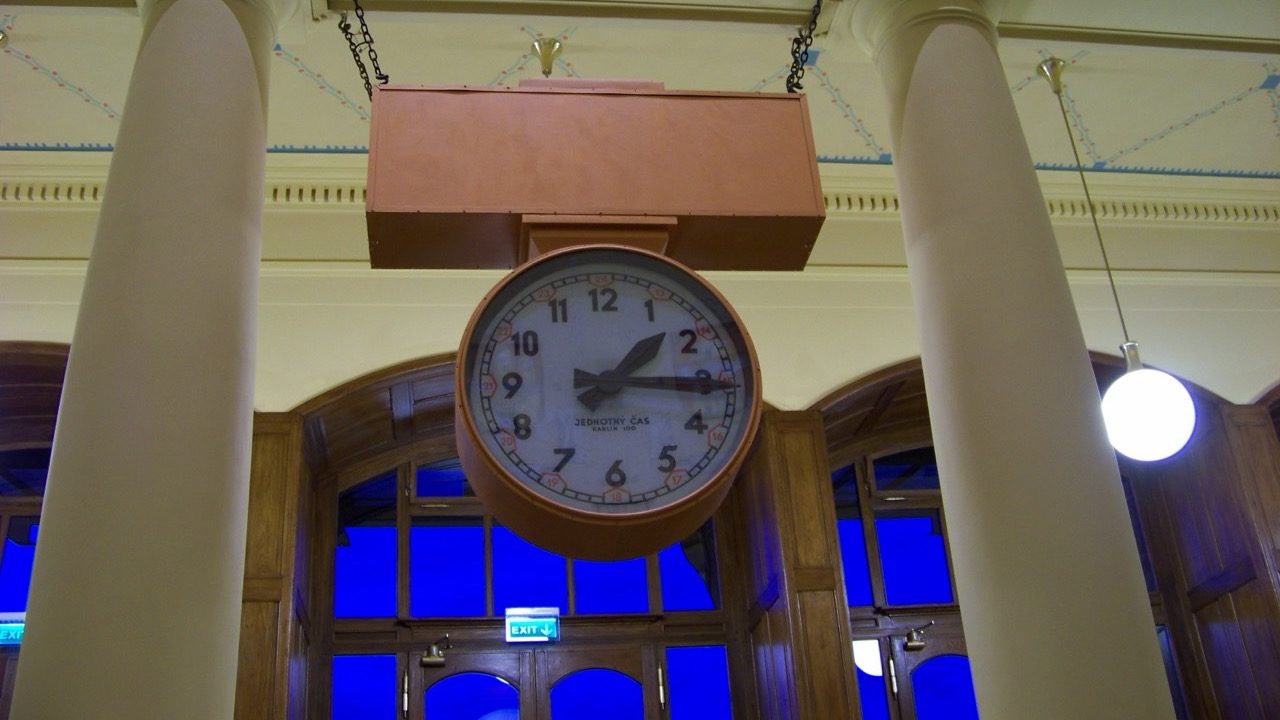
Photo: a clock in the old hall of Praha hlavní nádraží. ŠJů, Wikimedia Commons, CC BY-SA 3.0.
Comments (0)
Please be polite. Spam and insults will be removed.