Czech Citizenship by Descent for Americans: Rules and Steps
Popular
Americans can claim Czech citizenship by descent in two main ways. If a parent or grandparent lost Czech or Czechoslovak citizenship before January 1, 2014, you make a declaration under Section 31(3) of the Czech Citizenship Act ($46 at the Embassy in Washington in November 2026). If the citizenship was never lost and passed to you at birth, you ask for a citizenship certificate ($28). A great-grandparent is not enough for the declaration. Around Prague checked the Act and the Czech Interior Ministry, embassy and consulate pages on official websites on November 10, 2026.
Who qualifies
The rules are in Act No. 186/2013 Coll., on Citizenship of the Czech Republic, in force since January 1, 2014. Two routes matter most; a rare third, Section 32, is in the table below.
- Route 1: citizen by birth. A child is a Czech citizen by birth if at least one parent was a citizen on that day (Section 4), wherever the child was born. Older births are judged by the law of their time (Section 64). If the family's citizenship was never lost, the Embassy says, it passes on to the next generations. You then ask only for a certificate of citizenship (osvědčení o státním občanství, Sections 42 to 47).
- Route 2: declaration. A person who lost Czech or Czechoslovak citizenship before January 1, 2014 can regain it by declaration (Section 31(1)). Since September 6, 2019, so can that person's child or grandchild (Section 31(3), Act No. 207/2019 Coll.), even if the ancestor has died, the Los Angeles consulate notes.
Which route is yours? The Embassy's rule of thumb: Czechoslovak and Czech citizens who naturalized in the US between November 14, 1929 and December 31, 2013 as a rule lost their original citizenship automatically. They, and their children and grandchildren born after that loss, use the declaration. People who naturalized in other years, or never took another citizenship, and their descendants ask for the certificate.
Who does not qualify
Section 31 and the consulates list cases in which a declaration cannot be accepted.
- Great-grandchildren. Section 31(3) names only parents and grandparents.
- The Slovak line. The ancestor became, or would have become, a citizen of the Slovak Socialist Republic on January 1, 1969, or took Slovak citizenship later and still holds it. In very general terms, the Embassy says, a person born in Slovakia before 1953 and direct descendants may be, or should be, regarded as Slovak citizens.
- Decree No. 33/1945 and Transcarpathian Ukraine. The ancestor lost citizenship under the presidential decree on persons of German and Hungarian ethnicity, or under the treaty with the Soviet Union on Transcarpathian Ukraine (No. 186/1946 Coll.). As a rule, the Embassy says, only people from Carpathian Ruthenia who lived on Czech territory after 1945 might be eligible.
- Ancestors who left before 1918. Section 31 covers only people who lost Czech or Czechoslovak citizenship, and Czechoslovakia was created in 1918. The Embassy says earlier emigrants' citizenship may be affected by the 1870 Naturalization Convention between the United States and Austria-Hungary; it gives no simple yes or no.
This is not legal advice, and nobody can promise a result. The Embassy says it cannot draw final conclusions or reliably predict the outcome, especially for families that left before 1953. The decision is made by the authorities in Czechia.
The routes at a glance
| Route | Who it fits | Section of the Act | What you file |
|---|---|---|---|
| Citizen by birth | A parent was a citizen on the day you were born and the chain was never broken | § 4, § 64; §§ 42–47 | Application for a citizenship certificate |
| Former citizen | You lost Czech or Czechoslovak citizenship before January 1, 2014 | § 31(1) | Declaration |
| Child or grandchild | A parent or grandparent is or was such a former citizen; you are not a Slovak citizen | § 31(3); minors § 31(5) | Declaration |
| Federal citizen of 1992 (rare) | Held federal Czechoslovak citizenship on December 31, 1992 but neither Czech nor Slovak citizenship; direct descendants | § 32 | Declaration; proof of not being a Slovak citizen |
| Born abroad 1949–1969 | Born outside Czechoslovakia between October 1, 1949 and May 7, 1969 | § 33 | Closed since January 1, 2015 (Interior Ministry) |
Documents the consulates ask for
For a declaration under Section 31(3), the Embassy and the consulates general list:
- the declaration, a statement on Slovak citizenship and a personal data form, all in Czech;
- your birth certificate and, if you married, your marriage certificate;
- birth and marriage certificates of the Czech parent and grandparent, as needed to prove the line;
- proof of when and how the ancestor lost citizenship, usually the US Certificate of Naturalization;
- copies of old Czechoslovak papers, such as passports or domicile certificates;
- a valid ID, such as a US passport.
US documents need an apostille first and a certified Czech translation second. Birth and marriage certificates get the apostille from the Secretary of State of the issuing state; federal documents from the US Department of State. The consulates ask for translators appointed by the Czech courts and for originals or certified copies. For the Certificate of Naturalization the offices differ: the Embassy's declaration page asks for an apostille and a translation, while Los Angeles says the original needs neither. Ask your office first.
Missing Czech certificates of an ancestor can be requested as duplicates through a consular office ($28 each at the Embassy). The consulates do not search archives for you. Route 1 needs the application with a questionnaire, your and your parents' certificates and any earlier citizenship papers (Section 45).
Where to apply in the United States
You deal with the one office of four that covers your home state.
| Office | States covered | How a declaration is filed |
|---|---|---|
| Embassy, Washington, DC | Alabama, Arkansas, District of Columbia, Florida, Georgia, Kentucky, Louisiana, Maryland, Mississippi, North Carolina, Ohio, Oklahoma, South Carolina, Tennessee, Texas, Virginia, West Virginia, Puerto Rico | In person only; appointment: [email protected] |
| Consulate General, New York | Connecticut, Delaware, Maine, Massachusetts, New Hampshire, New Jersey, New York, Pennsylvania, Rhode Island, Vermont | In person only, not by mail; appointment: [email protected]; offers a preliminary assessment form |
| Consulate General, Chicago | Illinois, Indiana, Iowa, Kansas, Michigan, Minnesota, Missouri, Nebraska, North Dakota, South Dakota, Wisconsin | In person by appointment ([email protected]); complete files also by mail with notarized signatures |
| Consulate General, Los Angeles | Alaska, Arizona, California, Colorado, Hawaii, Idaho, Montana, Nevada, New Mexico, Oregon, Utah, Washington, Wyoming | In person; appointment: [email protected] |
The certificate application (route 1) can be mailed to the Embassy or to New York with notarized signatures. Honorary consulates only help in emergencies and verify signatures and copies, the Embassy's list shows. The decision itself is made in Czechia: by the regional authority for your last permanent residence there or, if you never had one, by the Prague 1 Municipal District Office (Sections 37 and 44).
How long it takes and what it costs
- The law. A consulate forwards a declaration within 30 days (Section 37). A certificate is issued without delay, or within 180 days in complex cases that need archive research (Section 46). The Interior Ministry's page adds that a declaration is decided within 60 days.
- The US offices. New York quotes about 3 to 6 months for a declaration and 2 to 3 months for a certificate once the complete file is sent to Czechia, and at least 6 to 9 months overall before you can apply for a passport. The Embassy says archive research for families that left before 1953 takes at least six months.
Embassy fees for November 2026 (recalculated monthly; other offices post their own lists): declaration $46, certificate of citizenship $28, entry of a birth in the Special Registry in Brno $9, passport $110. Filed in Czechia, a Section 31 declaration costs 500 CZK, about $23 at the Czech National Bank rate of 21.702 CZK per US dollar on November 10, 2026. Apostilles, translations and USCIS copies come on top.
After approval: birth certificate, passport, dual citizenship
- The paper. A successful declaration ends with a certificate of acquisition (listina o nabytí státního občanství). You become a citizen on the day you receive it (Section 37); in the US you must also sign a confirmation of receipt.
- One year. That paper, like a route 1 certificate, proves citizenship for one year only (Section 41). Use the year to apply through your consulate for a Czech birth certificate from the Special Registry (zvláštní matrika) in Brno; the Embassy warns that this can take several months.
- Passport. Apply in person; it is valid for 10 years and issued within 120 days when requested at an embassy.
- Dual citizenship. Czech law has allowed it since January 1, 2014. USA.gov adds that dual citizens must use a US passport to enter and leave the United States.
- EU rights. A Czech citizen is an EU citizen and may live and work in any EU country without a work permit.
If you do not qualify
The other way is naturalization after years of legal residence in Czechia, with language and civics exams; the Act gives no legal entitlement to it (Section 12). See our guide to Czech citizenship by naturalization.
Czech citizenship by descent: FAQ
Can I get Czech citizenship through my great-grandparents?
Through a grandparent, yes, by declaration under Section 31(3). Through a great-grandparent, only if the citizenship was never lost and passed down by birth through every generation; then you ask for a certificate.
Do I need to speak Czech?
No exam is required: the language and civics exam belongs to naturalization (Section 19). But forms and written submissions must be in Czech, and the consulates say they cannot translate for you.
How long does it take?
At least 6 to 9 months before you can apply for a passport in simple cases and more than a year in complicated ones, the New York consulate says.
Does the US allow dual citizenship with the Czech Republic?
Yes. Czech law has allowed dual citizenship since January 1, 2014, and USA.gov says US citizens do not have to choose one nationality over the other.
My ancestor came from Slovakia, or left Bohemia before 1918. Do I qualify?
Section 31 may not cover you: it excludes those who became or would have become Slovak citizens on January 1, 1969, and requires that the ancestor once held Czech or Czechoslovak citizenship. Ask your consular office before you collect documents.
Sources: Act No. 186/2013 Coll. (in Czech); Czech Interior Ministry: Section 31 declaration, Section 33, citizenship certificate; Embassy in Washington: citizenship by declaration, citizenship overview, consular fees, consular districts; consulates general in New York (declaration page), Chicago and Los Angeles; USA.gov: dual citizenship; European Union: living in the EU and working abroad. Checked on November 10, 2026; fees change every month, so confirm them with your consular office before you file.
See also: US citizens traveling to Prague: entry rules, EES and ETIAS, Prague, Vienna and Budapest: a first-trip itinerary, Prague before or after a Viking river cruise, From Prague to your river cruise ship in Passau, Nuremberg or Regensburg, Permanent residency in Czechia, Czech digital nomad visa, How to learn Czech, Sudetenland explained, Prague itinerary for 1 to 3 days.
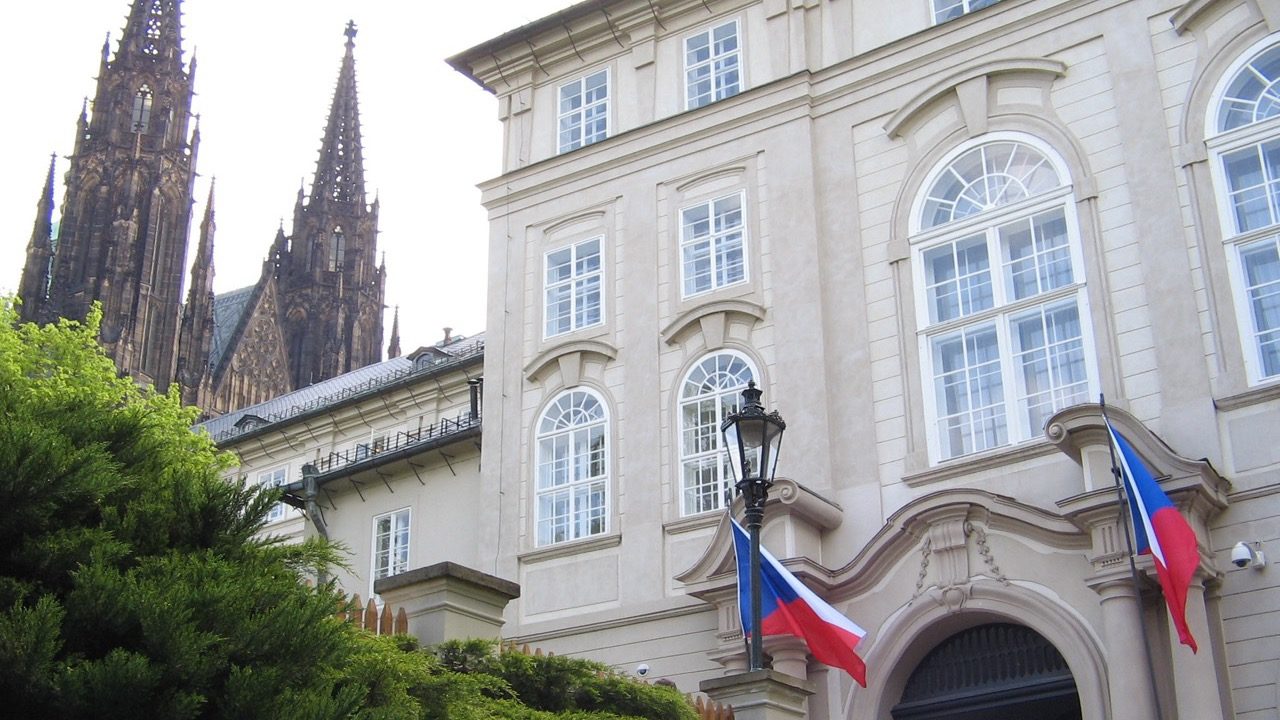
Photo: Czech flags at Prague Castle, with St. Vitus Cathedral behind. spaceman117, Wikimedia Commons, CC BY 3.0.
Comments (0)
Please be polite. Spam and insults will be removed.