Prague Entry Requirements for US Citizens: Visa, EES, ETIAS
Popular
US citizens do not need a visa to visit Prague. You may stay in Czechia and the rest of the Schengen area for up to 90 days in any 180-day period. Your passport must be valid for at least three months after the day you leave Schengen and must have been issued within the last 10 years. Since April 10, 2026, your photo and four fingerprints are recorded in the EU's Entry/Exit System (EES) at the first Schengen airport you land in. ETIAS, the future online travel authorization (EUR 20, about $22), is not in operation and has no start date. Around Prague checked the rules on official EU, Czech and U.S. government websites on November 10, 2026.
What a US citizen needs: 2026 and 2027 at a glance
| Item | Now (rules on November 10, 2026) | Later in 2027 |
|---|---|---|
| Visa | Not needed for up to 90 days in any 180 days | Same rule |
| Passport | Valid at least 3 months after you leave Schengen; issued within the last 10 years | Same rule |
| EES (photo, fingerprints) | At the external Schengen border since April 10, 2026. Nothing to apply for in advance | Same; on a repeat trip your data is only verified |
| ETIAS | Not required: the system is not in operation | Not known: no start date announced. Once it starts: EUR 20 (about $22), valid 3 years |
| Travel medical insurance | Carry proof: Czech police may ask for it. Standard: at least EUR 30,000 (about $33,600) | Same rule |
Dollar amounts are our calculation. At the Czech National Bank rates of November 10, 2026 (1 USD = 21.702 CZK, 1 EUR = 24.335 CZK), one euro is about $1.12.
Visa: 90 days in any 180
The United States is on the EU list of visa-exempt countries (Regulation (EU) 2018/1806, Annex II). The Czech foreign ministry adds that the exemption covers short, non-profit stays only: sightseeing, a river cruise, visiting family.
The border officer may still ask about the purpose of your trip and whether you can pay for it and for the journey home (Article 6 of the Schengen Borders Code). Keep your hotel or cruise confirmation and return ticket handy.
Passport: three months, not six
The Schengen Borders Code (Regulation (EU) 2016/399, Article 6) sets two tests:
- the passport is valid for at least three months after the day you plan to leave Schengen;
- it was issued within the previous 10 years.
Example: you fly home from Budapest on May 20, 2027. Your passport must be valid until at least August 20, 2027.
Where does "six months" come from? The Czech Embassy in Washington explains it: to use all 90 days you need 90 days plus three months, about six months of validity on arrival. For a two-week trip that is a comfortable margin, not the legal minimum.
The 90/180 rule on a multi-country trip
The 90 days are counted for the whole Schengen area, not per country. From each day of your stay, look back 180 days: at most 90 of them may be in Schengen. The days you enter and leave both count.
- Central Europe. Czechia, Germany, Austria, Slovakia and Hungary are all in Schengen. Prague, a week on the Danube and Budapest are one continuous stay.
- Lower Danube. Croatia, Romania and Bulgaria are in Schengen too (Romania and Bulgaria since January 1, 2025). Serbia is not, so a ship calling there leaves Schengen and re-enters.
- Britain and Ireland. Neither is in Schengen, so days in London or Dublin do not count.
Two official tools count for you: the European Commission's short-stay calculator and the EES tool Check how long you can stay, which asks for your passport number and does not reflect stays that began before April 10, 2026.
EES: where you give your fingerprints
EES has been fully operational at every external border crossing of the 29 countries that use it since April 10, 2026, the official EU website says. On your first entry an officer takes a photo of your face and scans four fingerprints; your passport is not stamped. The EU pages name no fee and no application before travel. If you refuse, you are denied entry. For what is stored and who is exempt, see our EES and ETIAS guide.
Registration happens at your first Schengen airport:
- You connect in Frankfurt, Munich, Amsterdam or Paris. You pass border control and EES there, so allow time for it. The onward flight stays inside Schengen and uses Prague's Terminal 2, with no passport control.
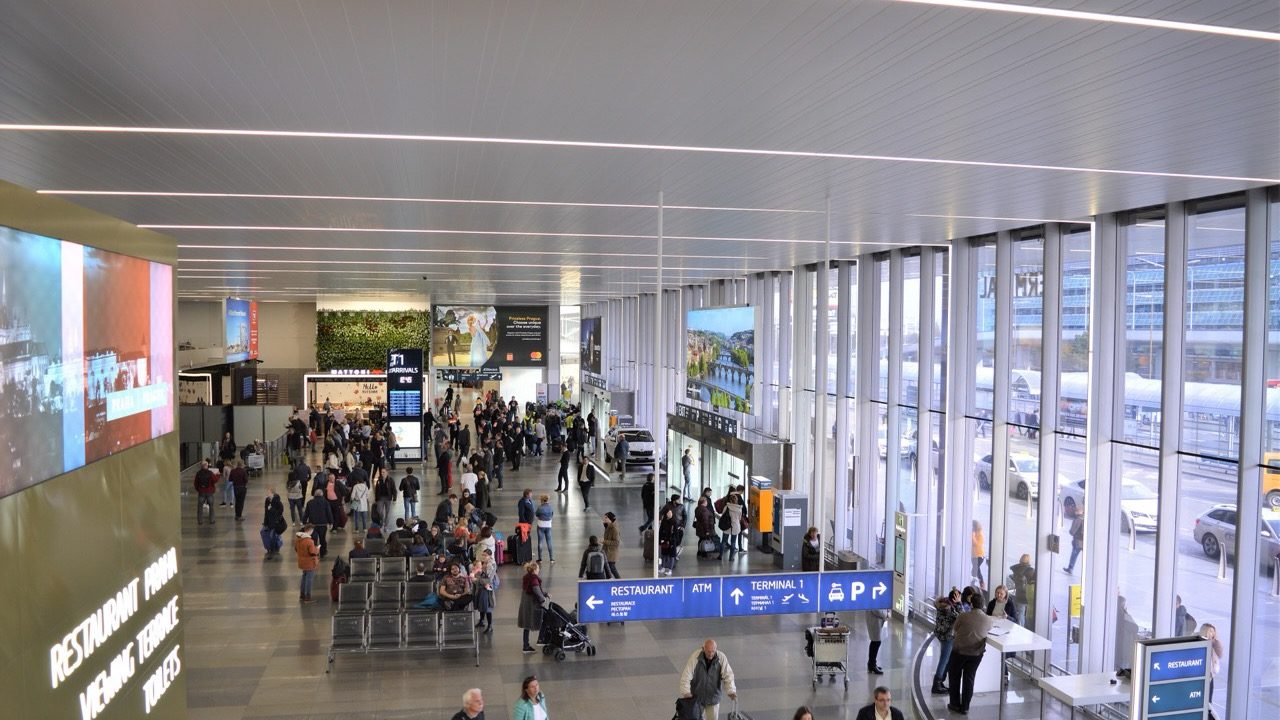
- You arrive from outside Schengen (a nonstop flight from the US, or a connection in London or Dublin). You are checked in Prague, at Terminal 1. The airport asks non-EU passengers to register at a self-service EES kiosk in the arrivals area first and then go to passport control.
Terminal 1 arrivals is being expanded (five more passport desks, four self-service gates; completion planned for the end of April 2027), and the airport warns that lines may form. Your exit is recorded at the last Schengen airport on your way home.
ETIAS: not yet, and no date
ETIAS is a planned online travel authorization for visa-exempt visitors, Americans included. On November 10, 2026, the official EU website said ETIAS is "currently not in operation" and that the start date will be announced several months before launch. It gives no date, quarter or year. You cannot apply and do not need ETIAS today.
The EU site on the future system:
- the fee is EUR 20 (about $22); applicants under 18 or over 70 do not pay;
- the authorization is valid for three years or until the passport expires, whichever comes first;
- the only official place to apply will be the EU website travel-europe.europa.eu and its app; other websites are intermediaries that add their own charges.
In Czechia: passport, hotel registration, insurance, cash, medicines
- Passport on you. Under the Czech Aliens Act (No. 326/1999, Section 103), a foreigner must prove identity with a travel document when the police ask. The U.S. Embassy, thinking of pickpockets, suggests carrying a copy and leaving the original in the hotel safe; the law does not mention copies. Take the original whenever you cross a border.
- Registration. Foreigners must report their address to the Foreign Police within three working days of arrival (Section 93). A hotel does this for you, which is why the front desk asks for your passport. In a private home, the duty is yours.
- Travel medical insurance. The Schengen Borders Code does not list it as an entry condition, but Czech law obliges a foreigner to show proof of it during a residence check (Section 103). The Czech Embassy in Washington gives the standard for visa-free stays: at least EUR 30,000 (about $33,600) for emergency and hospital care and medical repatriation, for the whole stay and the whole Schengen area. Medicare usually does not cover care outside the US, says medicare.gov, so check your plan and carry the policy.
- Cash. Anyone entering or leaving the EU with EUR 10,000 (about $11,200) or more in cash must file a customs declaration. The limit applies per person.
- Medicines. Czech customs allows medicines bought outside the EU only in the amount you normally need for the trip. The Czech Embassy recommends bringing the original box or leaflet and a prescription or doctor's letter. Controlled ("addictive") substances fall under stricter rules: ask the Czech Embassy before you fly. In Prague, see our guides to English-speaking doctors and 24-hour pharmacies.
Germany and Austria are running temporary checks at their land borders with Czechia until March 15, 2027, so keep your passport within reach on the train or bus; see our Germany–Czechia border controls guide.
Lost passport: the U.S. Embassy in Prague
The embassy is at Tržiště 15, 118 01 Praha 1 – Malá Strana. The phone number, also for emergencies after hours, is +420 257 022 000 (from the US: 011 420 257 022 000).
- Report a theft to the Czech police; the emergency number is 112.
- For urgent travel the embassy issues emergency passports without an appointment, 8:30–11:00 a.m. and 1:00–3:00 p.m., except weekends and US and Czech public holidays.
- Bring forms DS-11 and DS-64, one 2×2 inch photo and the police report if you have one. In most cases the passport is ready the same day.
- Before the trip, enroll in STEP (Smart Traveler Enrollment Program) for security alerts; the link is on the embassy's U.S. Citizen Services page.
Staying longer than 90 days or working
Work, or a stay of more than 90 days, is outside the visa exemption: ask the Czech Embassy in Washington which visa or permit applies. See our guides to the Czech digital nomad visa and to Czech citizenship.
This guide is not legal advice. The border officer decides on entry, and the Czech authorities decide on visas and residence.
US citizens entering Czechia: questions and answers (FAQ)
Do US citizens need a visa for Prague?
No. A US passport allows up to 90 days in any 180-day period in the whole Schengen area. Work and longer stays are not covered.
Does my passport need three or six months of validity for the Czech Republic?
Three months beyond the day you leave Schengen, and the passport must be less than 10 years old. Six months is the figure the Czech Embassy gives for a full 90-day stay.
When does ETIAS start for Americans?
No date has been set. On November 10, 2026, the official EU site said ETIAS is not in operation and the start will be announced several months ahead.
Will I be fingerprinted at Prague Airport?
Only if Prague is your first Schengen airport. If you connect in Frankfurt, Amsterdam or Paris, EES registration happens there.
Do I need travel insurance to enter Czechia?
It is not an entry condition in the Schengen Borders Code, but Czech police may ask for proof during your stay. The standard is at least EUR 30,000.
Sources: ETIAS, official EU website, EES, official EU website, European Commission on ETIAS, Schengen Borders Code, Regulation (EU) 2018/1806, ETIAS Regulation (EU) 2018/1240, European Commission: Schengen area, temporary internal border controls, Czech Embassy in Washington: travel document, health insurance without a visa and medication, Czech Interior Ministry: arrival and obligations of foreigners, Act No. 326/1999 (in Czech), EU cash controls, Czech Customs on medicines, Prague Airport: travel documents and EES, U.S. Embassy in Prague: contact, emergency passports and travelers and residents, Medicare: travel outside the U.S. Checked on November 10, 2026; rules can change, so confirm them before you travel.
See also: EES and ETIAS: entering Czechia and the EU, From Prague Airport to the city center, Is Prague safe? Scams, pickpockets and tipping, Prague before or after a river cruise: extension guide, From Prague to your cruise ship in Passau, Nuremberg or Regensburg, Prague, Vienna and Budapest: a first-trip itinerary, Czech citizenship by descent for Americans, Tax-free shopping and VAT refunds.
Photo: Arrival hall of Terminal 1, Václav Havel Airport Prague. Felix Riehle, Wikimedia Commons, CC BY-SA 4.0.
Comments (0)
Please be polite. Spam and insults will be removed.