Politics By

Poll: Only SPD voters aren't afraid of war escalation in Ukraine
Poll: Only SPD voters aren

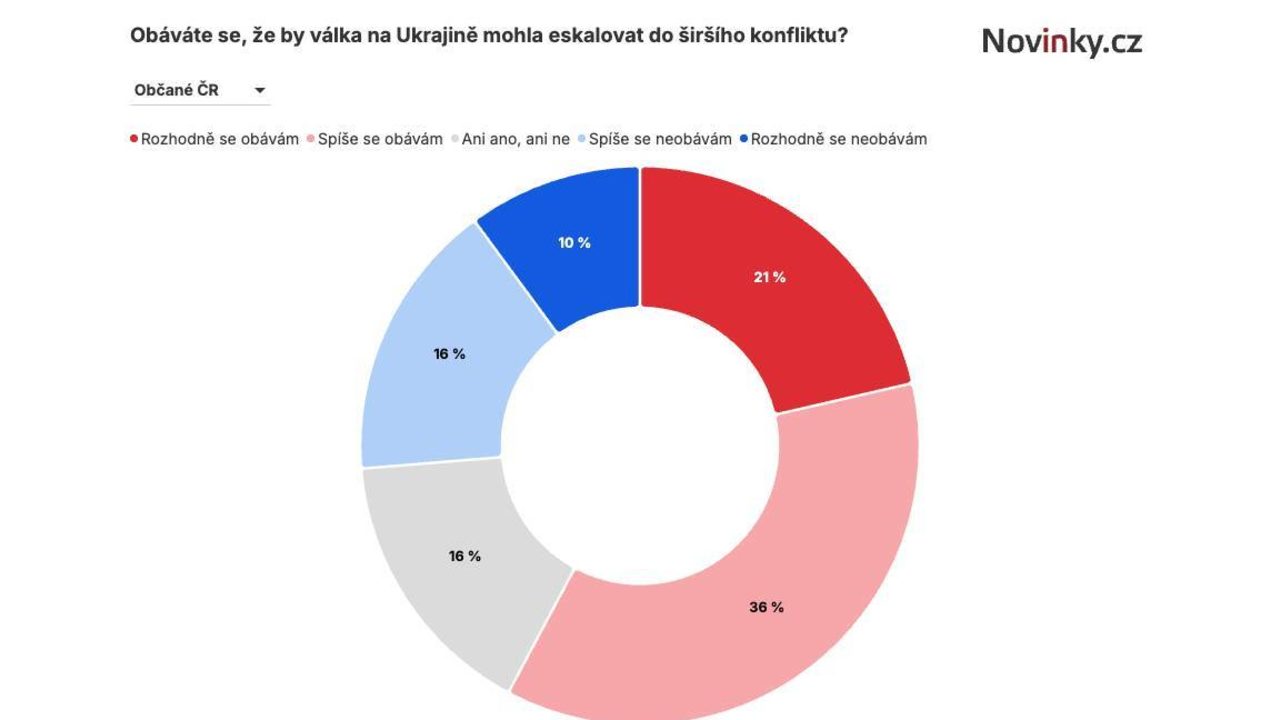
Most Czechs fear an escalation of the war in Ukraine, but among SPD voters, those who see no such threat are in the majority. This is according to an exclusive poll cited by the news outlet Novinky.

Fear of escalation runs highest among supporters of the opposition parties — the Pirates, the Spolu coalition and the STAN movement — with nearly seven in ten voters from each of these parties expressing such concerns. Among Motorists and ANO supporters, the figure is roughly half. SPD voters, however, turned out to be the only group where those who are not worried about escalation form the majority — 49%, compared with just 35% who say they feel anxious.

Different perceptions of the threat

According to political scientist Otto Eibl of Masaryk University, different voter groups have built up their own notions of where the danger comes from. "For a long time, SPD has portrayed Russia as a less immediate threat. Instead, the party emphasizes the risk that helping Ukraine could drag the Czech Republic into the war. That's why its voters may see rising defense spending, new arms deliveries, or greater NATO involvement not as steps that strengthen security, but as things that bring conflict closer," the expert explained.

He noted that SPD has long used narratives compatible with Russian propaganda, and the party's current stance toward Ukraine is significantly more restrained than that of the previous government. "It's no surprise that its voters perceive the Russian threat itself differently," Eibl added.

Among supporters of Spolu, STAN and the Pirates, the picture is almost a mirror image: they link Czech security to EU and NATO membership, cooperation with Western allies, and support for Ukraine. "The Babiš government has shaken this course by cutting planned defense spending, limiting part of the aid to Ukraine, and engaging in a sharp dispute with the president over the country's representation at the NATO summit," the political scientist noted. In his view, for voters who see the Czech Republic's firm ties to the West as one of the main guarantees of security, this in itself becomes a source of anxiety.

ANO voters: the threat is real, but the money is enough

Differing perceptions of the threat are accompanied by differing assessments of whether defense spending is adequate. Three-quarters of SPD voters — among whom only about a third fear escalation — consider current defense spending sufficient. Among Spolu supporters, seven in ten of whom feel anxious, only 10% share that view.

"It's interesting that even groups who consider the state's defense spending adequate, such as ANO voters, are still worried about the conflict spreading beyond Ukraine," Tereza Fridrichová, a political analyst at NMS, told Novinky. She suggested these voters likely hope that if escalation does occur, both the Czech Republic and its NATO allies will be spared.

Eibl considers the position of ANO voters to be distinct: the movement traditionally prioritizes domestic needs — healthcare, pensions, public services — over international commitments to allies. "Their stance doesn't necessarily mean they don't see Russia as a threat — rather, they believe the Czech Republic is already spending enough on defense, and that extra money is needed at home. So they can simultaneously fear an escalation of the war and oppose further increases in defense spending," the expert concluded.

For comparison, according to an NMS poll conducted for the organization Paměť národa, two-thirds of Czechs feared escalation back in 2024. Meanwhile, the share of people who categorically feel no fear has, according to the same research, doubled since then — from 5% to 10%.

Around Prague, based on reporting by novinky.cz
Share: Telegram WhatsApp

More U.S. news

US Strikes Iran's Qeshm Island as War Costs Top $47.1 Billion
The U.S. military carried out limited strikes on Iran's Qeshm Island on Nov. 2, hours before the midterm elections, according to U.S. officials who spoke to CBS News and Radio Free Europe/Radio Libert
What to Watch as Midterm Polls Close and Why Control of Congress May Take Days
Millions of Americans are voting in midterm elections that will decide whether President Donald Trump's Republicans or the opposition Democrats control Congress. The BBC reported that once polls close
How Michigan and Alaska Surprises Could Decide Which Party Controls the Senate
Two late controversies, one in Michigan and one in Alaska, have shaken up the fight for the Senate and could help decide which party holds the majority, according to an NBC News analysis. If the Alask
Why a Judge Threw Out the Case Against Two Former FBI Officials
A federal magistrate judge on Monday dismissed a criminal complaint accusing two former FBI officials of lying to Congress about their roles in the Hunter Biden investigation, delivering a sharp rebuk
U.S. Strikes Iranian Island on Eve of Midterms, Calling It Self-Defense
The U.S. military carried out limited strikes on Iran's Qeshm Island on Monday, the day before the midterm elections, according to NBC News, which cited two U.S. officials. The officials said the acti
Supreme Court Turns Down DOJ Bid to Set Aside California Mail Ballots
The U.S. Supreme Court on Monday refused a Trump administration request to intervene in a fight over California mail ballots, one day before Election Day. The Justice Department had asked the court to

Related news

The European Commission is closely monitoring the bill to abolish fees for Czech Television (ČT) and Czech Radio (ČRo) and is in contact with the Czech authorities. Commission spokesman Lammert said the Czech side has already replied to a l
Politician Turek posted two photos of his master’s diploma on social media and soon deleted both: people had found typos on them and differences between the two images. The trigger was criticism of his claim to be a “diplomat by training.”T
Staff at Czech Television and Czech Radio have been on strike since midnight to protest the government's plan to move the funding of public media under the state budget. Both outlets are operating in a limited mode, and the strike will last
The uncle of Prime Minister Andrej Babiš, tied to the family story of “emigration” to Canada, turned out to be a former Gestapo officer and SS member. This is according to a new study by the Institute for the Study of Totalitarian Regimes,
Prime Minister Andrej Babiš has said Czechia does not support the return of Russian hockey players to international tournaments. He criticised the ruling of the Court of Arbitration for Sport (CAS) in Lausanne, which last week lifted, with
Czech President Petr Pavel attended Monday’s cabinet meeting, where the concept for developing the army through 2040 was discussed. He reproached the cabinet for not making defence spending a priority and also spoke about Russian athletes a
The reform of public media in Czechia has turned into a symbol of the confrontation between the government and the opposition. That is the finding of a poll by the NMS agency: three quarters of voters of the governing parties support cuttin
Prime Minister Andrej Babiš has admitted that the first reading of the bill abolishing licence fees for public media did not go well. Deputies voted after half past four in the morning, but according to Babiš, it was a necessary step, and d
Czech Prime Minister Andrej Babiš has said the government is preparing an alternative way of funding public media, without direct payments from the state budget. He suggested that citizens could pay voluntarily, and the coalition will discu
Students at Czech universities will be able to miss classes on Tuesday without penalty in order to join protests backing Czech Television and Czech Radio. Meanwhile, Prague's DAMU faculty has banned Culture Minister Oto Klempíř and the head
A federal court in California has barred the US Justice Department from threatening criminal prosecution against state and county authorities that refuse to comply with the Trump administration’s demands to check the votes of alleged non-ci
Russian President Vladimir Putin said that Russia is ready for war with Europe but does not want one. He was responding to talk that Europe intends to prepare for a conflict with Russia by 2030, Russian media report.“Many in Europe talk onl