US Strike on Iran's Qeshm Island Sparks New Attacks on Bahrain and Kuwait
USD 22,26
Popular
Iran said it struck American drone and missile sites in Kuwait after the United States hit a missile launch site on Qeshm Island in the Strait of Hormuz, according to Reuters and AFP. Bahrain also reported intercepting Iranian aerial attacks, the third time in a week, deepening doubts about diplomacy meant to end a war that has pushed up global energy prices.
Outright fighting has largely subsided since the war began in late February, AFP reported, but there is no peace deal and the United States continues to blockade Iranian ports.
What happened in the Gulf
An American official told AFP that U.S. fighter jets used precision munitions against a Revolutionary Guards missile launch site on Qeshm. The official said the strike answered Iranian aggression targeting U.S. personnel and assets. Iran's IRNA news agency, citing a regional official, said the strike caused no serious damage. Iranian media separately said no infrastructure was damaged.
The strike followed an Iranian drone attack in Bahrain. The Revolutionary Guards said their drones hit a radar system operated by U.S. forces at Sheikh Isa Air Base, and described it as a reply to repeated U.S. drone incursions into Iranian airspace. They also said they captured a U.S. drone south of Qeshm. Bahrain's armed forces said they destroyed a number of Iranian aerial attacks before they reached their targets. Explosions were heard in the capital as a phone alert told residents to seek safety.
Bahrain, home to the U.S. Navy's Fifth Fleet, had not been hit for weeks until Iranian drone attacks on Friday and Sunday, AFP reported.
On Wednesday, Iran's army said it targeted U.S. drone and missile installations at Kuwait's Ali Al Salem base. According to The Business Standard, which cited Reuters reporting, it was Tehran's first attack on Kuwait since September. Kuwait said its air defenses were countering hostile drones and that it reserved the right to take all necessary measures to protect its territory. Bahrain accused Iran of a systematic hostile approach toward it.
Warnings and a dirty bomb report
Iran's army chief, Amir Hatami, warned that if the United States repeats what he called its mistake, Iran has plans to respond more forcefully and without geographic limits.
Separately, CNN cited seven anonymous U.S. officials as saying Iran was working out how to target senior administration figures with a bomb laced with chemical or radioactive material. The report stopped short of saying Iran planned to carry it out. President Donald Trump said he was taking the reports very seriously. Iran's foreign minister, Abbas Araghchi, dismissed them as propaganda, and the Foreign Ministry called the allegations baseless. Secretary of State Marco Rubio said in Manila he did not see any imminent threat to Washington.
Why it matters for energy prices and shipping
The Strait of Hormuz is a key route for oil and gas shipments. Global oil and gas prices have shot up since Tehran declared the strait closed and shipping was severely disrupted, The Business Standard reported. The U.S. military is working to protect ships passing through the waterway despite Iran's attempts to close it, according to AFP.
The risk to shipping is not abstract. The Business Standard reported that a surge in attacks on vessels since October threatens to strain global oil supplies further. A crew abandoned a liquefied petroleum gas tanker off Oman's Khasab on Tuesday. ADNOC L&S of the United Arab Emirates said one crew member was missing and 11 were injured after one of its vessels was attacked in the strait.
The U.S. blockade is also cutting off Iran's oil exports and hammering its economy, AFP reported.
A wider war and the diplomatic track
The United States and Israel attacked Iran on Feb. 28, and Tehran responded with strikes on Israel and Gulf states hosting U.S. bases, according to The Business Standard. The conflict spread to Lebanon, where Israel and Hezbollah fought, and to Yemen, where the Iran-aligned Houthis have attacked Saudi energy facilities and airports. On Wednesday a Saudi-led coalition said it intercepted a Houthi cruise missile aimed at Riyadh. The Houthis did not immediately confirm that. Saudi Arabia condemned Iran's latest attacks and called for an end to aggression and a return to negotiations.
Qatari and Iranian officials met on Tuesday. Qatari spokesperson Majed Al Ansari said the talks aimed at narrowing the gap between proposals.
What happens next
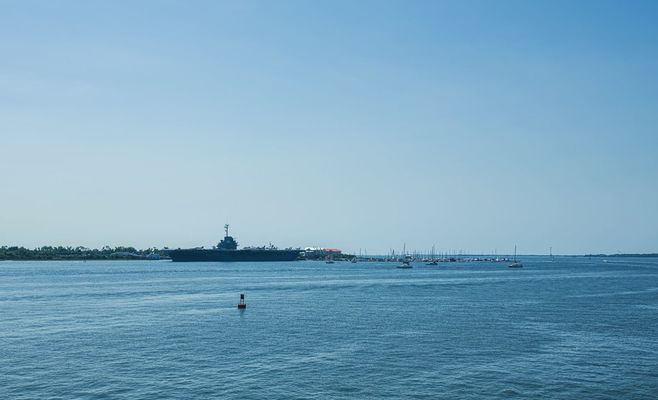
The United States moved the USS Theodore Roosevelt into the region, bringing the number of American carrier strike groups there to three, AFP reported. Two other supercarriers, the George H W Bush and the George Washington, are already deployed, along with more than a dozen destroyers.
The flare-up comes ahead of a trilateral summit in Shenzhen between Trump, Xi Jinping and Vladimir Putin. China says they will discuss world peace, and Trump has said he plans to raise the Iran war.
Analysts see calculated escalation rather than a return to full war. Andreas Krieg of MENA analytica said both sides are probing each other's red lines. Hasan Al Hasan of the International Institute for Strategic Studies called Iran's approach cautious, but said further escalation cannot be ruled out if the United States widens its targets deeper inside Iran.
Around Prague, based on reporting by The Daily Star, https://globalpost.com/, The Business Standard